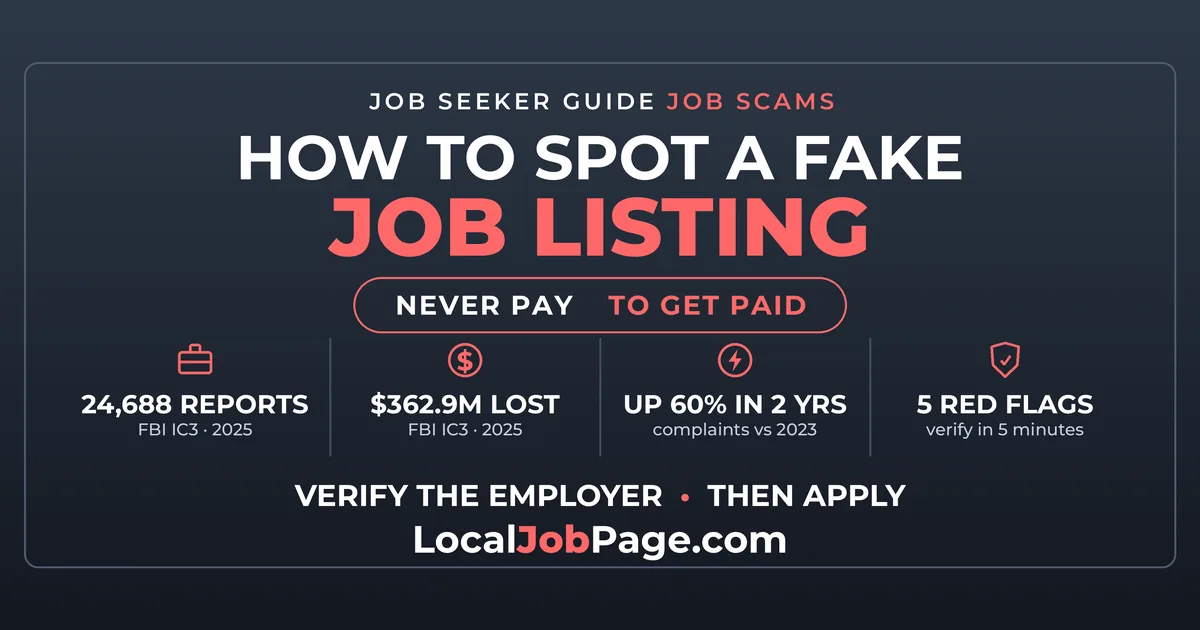
How to Spot a Job Scam Before You Apply
Published: September 12, 2026 | By LocalJobPage Team
A text offers $28 an hour to work from home as an "online assessor" and asks you to reply YES. Nobody at that company posted the job. The reply is step one of a script that ends with you sending money.
Employment fraud cost Americans $362.9 million in 2025, per complaints filed with the FBI's Internet Crime Complaint Center. Five red flags catch nearly all of it.
Need work now? Skip straight to the job links and begin searching now →
📊 What the Numbers Say
The FBI's 2025 Internet Crime Report counted 24,688 complaints under its employment crime type, with reported losses of $362,934,762 for calendar year 2025. The two prior years in the same table: 20,044 complaints and $264,223,271 in 2024, and 15,443 complaints and $70,234,079 in 2023. Across those three years, complaints rose about 60 percent and losses ran roughly five times higher. That arithmetic is ours, from the figures as the FBI printed them.
The FBI defines the category narrowly: someone believes they are legitimately employed and loses money, or launders money or items during that employment. These are complaints people chose to file, so the count is a floor, not a census. A second federal series agrees. In its December 2024 Data Spotlight, the FTC put losses to job scams at $90 million in 2020, $286 million in 2023, and over $220 million in the first half of 2024 alone.
🚩 Five Red Flags That Settle It
Any one is enough to walk away. You do not have to prove it is a scam.
- The first contact was a text, WhatsApp, or Telegram message you did not invite. In an alert published April 30, 2026, the FTC said legitimate employers do not recruit that way. The current version asks you to reply "YES" rather than click a link, because a reply feels harmless.
- You are asked to pay for anything. Training, equipment, a starter kit, a background check, crypto to unlock more work. The FTC's phrasing: paying to get paid is a sure sign of a scam.
- A check arrives before you have worked a shift. Deposit it, keep a cut, send the rest on. It bounces weeks later and the bank takes the money back from you. An honest employer never asks for part of a check back.
- You are offered money to rate, like, or boost things online. The FTC states that paying people to rate or like things is illegal. The offer itself is the tell.
- Bank details or a Social Security number are wanted before there is a written offer. Real onboarding collects both after you are hired, inside the employer's payroll system. Not in a chat thread.
⚠️ The Three That Take the Most Money
Task scams. You do repetitive work in an app, watch a balance climb, then get asked to deposit your own money, usually in crypto, to withdraw it. Balance and deposit both vanish. The FTC counted roughly 50 such reports in 2021, about 0.6 percent of the job scam reports it received, and roughly 20,000 in the first half of 2024, about 38.8 percent.
Fake checks. Still working, because money showing in your account is not the same as a check having cleared.
Reshipping and money handling. Advertised as delivery operations specialist or quality control manager. You forward packages bought with stolen cards, or move funds between accounts. The FBI's definition covers laundering money or items during employment, which is what matters here: this one can end with you as a defendant.
✅ The Five Minute Check
Run all five before you apply. The FTC recommends the first two directly.
- Open the employer's own website and find its careers section. If the role is not listed there, treat the posting as unverified.
- Search the company name alongside the words scam, review, and complaint.
- Check the recruiter's email domain against the company's real domain, character for character. Free webmail for a national employer is a tell.
- Ask for the work address and the hiring manager's name, then confirm both.
- Never deposit an unexpected check, and never move money for an employer you have not met.
One caution on step one: the FTC has warned that scammers lift expired postings from real employers, edit them, and repost them. A real company name proves nothing. The role on the company's site does.
🔎 Where to Search Instead
Remote work, data entry, and customer service are the categories scammers imitate hardest, because all three have real openings behind them.
Start here:
- Remote jobs
- Customer service jobs
- Data entry jobs
- Administrative assistant jobs
- Warehouse associate jobs
- Medical assistant jobs
- Part time jobs
- Amazon jobs
- UPS jobs
🗺️ Where to Look in Your City
The ten largest markets on the network. A city site also shows where the employer actually is.
- Remote jobs in New York
- Remote jobs in Los Angeles
- Remote jobs in Chicago
- Remote jobs in Houston
- Remote jobs in Phoenix
- Remote jobs in Philadelphia
- Remote jobs in Dallas
- Remote jobs in Atlanta
- Remote jobs in Seattle
- Remote jobs in Miami
Not on the list? Find your city.
Questions Job Seekers Ask
The company is real. Doesn't that mean the job is?
No. Impersonating a real employer is the standard playbook. Verify the role on the careers page, not the company.
Can I actually get in trouble for a reshipping job?
Yes. Forwarding goods bought with stolen cards, or moving money for an employer, is how money mule cases start. Not knowing is a defense you then have to make.
I already sent money. What now?
Ask your bank or the payment service about a reversal right away; the window is short and shorter with crypto. Then file at reportfraud.ftc.gov and with the FBI at ic3.gov.
Is it ever normal to pay before a job?
Paying a school for a credential you keep is normal. Paying an employer for the privilege of working there is not. If the money goes to the company hiring you, walk.
What about recruiters who message me on social media?
Some are real. Treat the message as a lead, not an offer: find the role on the employer's own site and reply there. The FTC has also warned that scammers watch public "I got the job" posts to impersonate your new employer.
🧭 What to Do Next
The defense against a fake job is a real pipeline. Several applications a week to verified employers makes an unsolicited text easy to ignore. Create a free job seeker account, or browse every open job.
Employers: impersonation costs you candidates and your brand. Posting where applicants can check the role against your careers page is part of the fix. Post a job or review pricing.
Related Reading
- Holiday Seasonal Jobs 2026: When to Apply and Where to Look
- Warehouse and Logistics Jobs: What They Pay and How to Get Hired
- Healthcare Jobs Without a Bachelor's Degree
- Skilled Trades Jobs: What They Pay and How to Get In
Scammers are patient. They count on you being tired of applying. The five minute check is the cheapest thing in a job search.