Healthcare Jobs Without a Bachelor's Degree: What They Pay and How Long Training Takes
HEALTHCARE HIRING — The shortest path into a healthcare paycheck does not run through a four-year degree. It runs through a certificate you can finish in under a year, a state exam, and a clinic that needs the shift covered. The federal government tracks these roles one by one, and the numbers are specific enough to plan around.
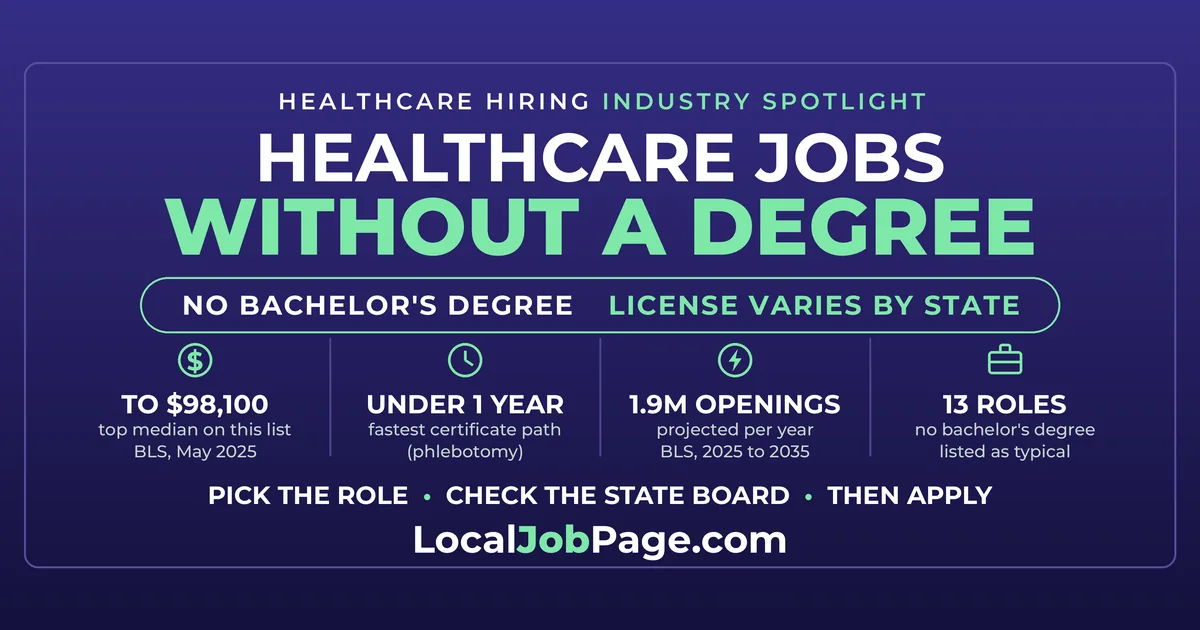
Eleven of the healthcare roles in this guide carry a national median wage above $45,000 a year, and the Bureau of Labor Statistics lists a bachelor's degree as the typical entry-level education for none of them.
Just want the openings? Skip straight to the job links and begin searching now →
Every wage below is a national median annual wage for May 2025, the most recent Occupational Employment and Wage Statistics data from the U.S. Bureau of Labor Statistics. Growth rates are BLS Employment Projections for 2025 to 2035, from the Occupational Outlook Handbook updated August 27, 2026. A median means half the people in that job earned less, and a projection is a ten-year model, not a promise about next year. Local pay and local licensing rules can both differ from the national picture.
💼 The Jobs
Healthcare hiring is not one job market. It is three, separated by how long the credential takes.
The front door: a high school diploma and employer training. Home health aides and nursing assistants are the two largest entry points; BLS counted 1,558,700 nursing assistant and orderly jobs in 2025. Neither pays well by the standards of this list, but both put you inside a facility, on a payroll, with a resume line. That is the point of starting there.
Under a year: the certificate roles. BLS says most phlebotomists complete a certificate program at a community college or vocational school lasting less than one year, and expects roughly 18,000 phlebotomy openings a year through 2035. Medical assistants are the volume play: 833,900 jobs in 2025, and a projected 13 percent growth adding 107,600 positions, which BLS classes as much faster than average. Pharmacy technicians held 471,200 jobs with 6 percent projected growth. Dental assistants and medical records specialists round out this tier.
A year or two: the licensed and technical roles. This is where the money is. Licensed practical and vocational nurses clear $64,000 at a median, and BLS still lists a postsecondary nondegree award as the typical way in. Surgical technologists, radiologic and MRI technologists, respiratory therapists, sonographers and dental hygienists all sit above that, and all are associate-degree or certificate roles. MRI technologists specifically drew a $95,480 median. BLS projects respiratory therapy to grow 9 percent and dental hygiene 8 percent through 2035, both much faster than average.
For contrast: registered nurses, where BLS lists a bachelor's degree as the typical entry-level education, had a May 2025 median of $97,550. Two roles below pay within a few hundred dollars of that without one.
💵 What It Pays
National median annual wages, May 2025, Bureau of Labor Statistics, with the typical entry-level education BLS assigns each occupation.
| Occupation | Median (May 2025) | Typical entry-level education |
| Dental hygienists | $98,100 | Associate's degree |
| Diagnostic medical sonographers | $96,590 | Associate's degree |
| Respiratory therapists | $82,280 | Associate's degree |
| Radiologic and MRI technologists | $81,390 | Associate's degree |
| Surgical assistants and technologists | $64,700 | Postsecondary nondegree award |
| Licensed practical and vocational nurses | $64,400 | Postsecondary nondegree award |
| Medical records specialists | $51,140 | Postsecondary nondegree award |
| Dental assistants | $48,070 | Postsecondary nondegree award |
| Pharmacy technicians | $45,750 | High school diploma or equivalent |
| Medical assistants | $45,690 | Postsecondary nondegree award |
| Phlebotomists | $45,230 | Postsecondary nondegree award |
| Nursing assistants and orderlies | $41,870 | Varies |
| Home health and personal care aides | $35,800 | High school diploma or equivalent |
🎓 Training and Credentials
The state you work in matters more here than anything else on this page.
Nursing assistants complete a state-approved program combining nursing instruction with supervised clinical work, then typically pass a competency exam for state certification; many nursing home jobs also require placement on a state registry. Phlebotomy certificates run under a year, and while some employers hire on a high school diploma plus on-the-job training, BLS says many prefer professional certification. Medical assistants are unusual: BLS lists no prior work experience and no on-the-job training as typical requirements, so the credential itself is the entry bar.
Licensing tightens as pay rises. Respiratory therapists must be licensed in every state except Alaska, where national certification is recommended instead. Every state licenses dental hygienists, generally requiring a degree from an accredited program plus written and clinical exams; your state Board of Dental Examiners is the authority, not a school's admissions page. Most states require radiologic technologists to be licensed or certified, and BLS notes employers typically require or prefer certification either way.
On cost: BLS observes that many employers pay the certification exam fee for pharmacy technicians even where states do not require it. Ask about tuition assistance and exam reimbursement in the interview. Hospital systems and large pharmacy chains are the most likely to have a program.
🔥 Who's Hiring
The employer mix shapes your schedule. Among medical assistants in 2025, BLS reports 56 percent worked in offices of physicians, 17 percent in hospitals, 10 percent in outpatient care centers and 8 percent in offices of other health practitioners. That is roughly the shape of the entry-level clinical market: doctors' offices and clinics hire the most people, hospitals pay more and run around the clock, and long-term care carries the heaviest turnover.
Across all healthcare occupations, BLS projects employment to grow much faster than average from 2025 to 2035, with about 1.9 million openings a year from growth plus workers leaving these occupations permanently. Most are replacements rather than new positions. A replacement opening is still an opening.
⚠️ Who This Field Is Not For
Four things wash people out, and they are cheaper to learn now than after tuition.
Licensure does not travel automatically. A credential earned in one state may not transfer to another without extra steps. Check the board in the state where the work is performed before you enroll.
Background checks are structural. BLS lists a criminal background check among the requirements states commonly impose on pharmacy technicians, and screening is standard across patient-facing roles. Ask the state board what it actually disqualifies before you spend money on a program.
The hours are the job. Medical assistants mostly work full time, and BLS notes some work evening, weekend or holiday shifts in facilities open around the clock. Hospitals and long-term care do not close.
Growth is uneven. Nursing assistants are projected to grow 3 percent through 2035; medical assistants, 13 percent. Both are hiring. Not the same bet.
🔎 Where to Aim Right Now
Search the occupation title, not "healthcare." Postings are written in credential language, and the title is what the tracking system matches on. With no credential yet, start with the aide and technician searches and read what employers say they will train.
Start here:
- Medical assistant jobs
- Certified nursing assistant jobs
- Phlebotomist jobs
- Pharmacy technician jobs
- Licensed practical nurse jobs
- Surgical technologist jobs
- Radiologic technologist jobs
- Respiratory therapist jobs
- Patient care technician jobs
- CVS Health jobs
🗺️ Where to Look in Your City
Healthcare hires everywhere, but these are large metros where hospital systems, outpatient networks and long-term care operators cluster, and each has its own LocalJobPage site.
- Healthcare jobs in Houston
- Healthcare jobs in Boston
- Healthcare jobs in Philadelphia
- Healthcare jobs in Baltimore
- Healthcare jobs in Nashville
- Healthcare jobs in Minneapolis
- Healthcare jobs in Atlanta
- Healthcare jobs in Phoenix
- Healthcare jobs in Chicago
- Healthcare jobs in Tampa
Not on the list? Find your city.
Frequently Asked Questions
Which healthcare job pays the most without a bachelor's degree?
Dental hygienists, at a $98,100 national median in May 2025, then diagnostic medical sonographers at $96,590. BLS lists an associate's degree as the typical entry-level education for both, and both require licensure that takes real time to earn.
What is the fastest healthcare credential to earn?
Phlebotomy. BLS says most phlebotomists complete a certificate program lasting less than one year, and the occupation carried a $45,230 national median in May 2025. Nursing assistant programs are also short, though the competency exam and registry step add time.
Do I need a license, or is certification enough?
It depends on the role and the state. Respiratory therapists need a license in every state except Alaska, and every state licenses dental hygienists. Most states license or certify radiologic technologists and regulate pharmacy technicians in some form. For medical assistants and phlebotomists, certification is usually an employer preference, not a state requirement.
Can I get hired with no healthcare experience at all?
Yes, in the entry tier. BLS lists no prior work experience and no on-the-job training as typical requirements for medical assistants, and a high school diploma or equivalent for pharmacy technicians and home health aides.
Will an employer pay for my training?
Sometimes, and it is worth asking directly. BLS notes many employers cover the certification exam cost for pharmacy technicians. Large hospital systems and national pharmacy chains are the most likely to run tuition assistance.
Is healthcare actually still hiring?
BLS projects healthcare occupations overall to grow much faster than average from 2025 to 2035, with about 1.9 million openings a year across the decade. Growth varies sharply by occupation, so pick the role before you pick the school.
🧭 Your Next Step This Week
Pick one occupation from the table, look up your state's licensing board, and search that exact job title. Ten real postings tell you more than any program brochure will.
Create a free LocalJobPage account to save searches and catch new healthcare postings, or browse every open job on the board.
Employers: clinics, dental practices and home care agencies can post openings as an employer. See pricing.
Related Reading
- August 2026 Jobs Report: Where the 162,000 New Jobs Actually Are
- Holiday Seasonal Jobs 2026: When to Apply and Where to Look
The credential is the gate, and most of these open in under two years. Decide which door you are walking through, then let the job title do the searching.