Auto Mechanic Jobs: What They Pay and How to Get Hired
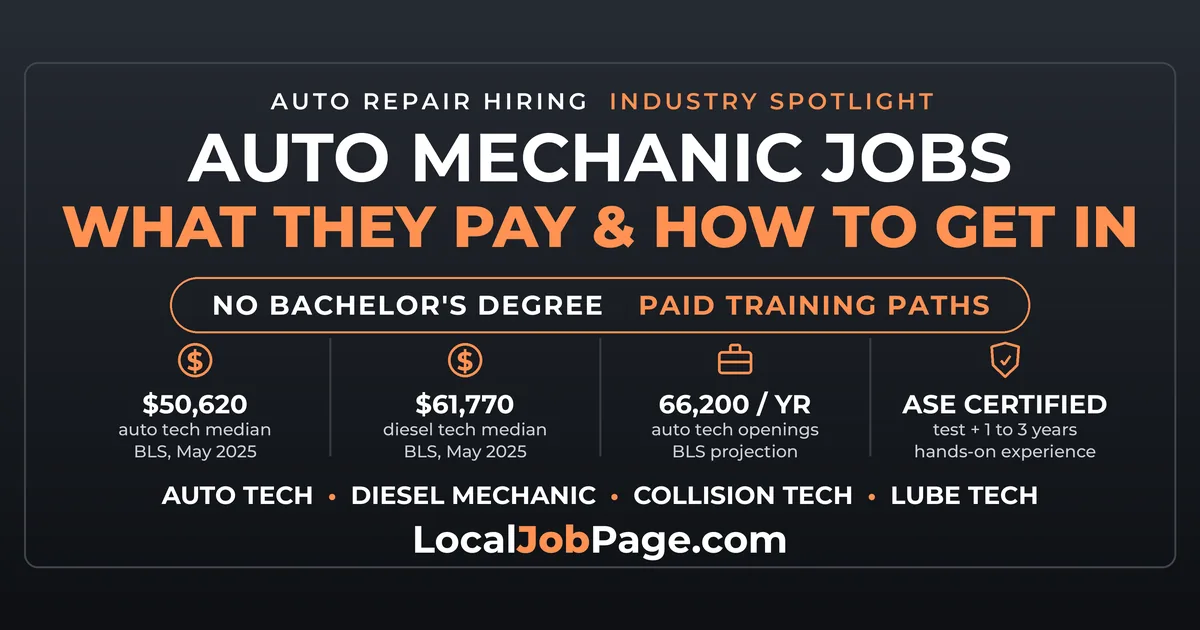
AUTO REPAIR HIRING — The United States had 825,800 automotive service technician and mechanic jobs in 2025, and the Bureau of Labor Statistics expects about 66,200 openings in the field every year through 2035. Most of those openings come from people retiring or changing careers, which means shops are hiring at the bottom of the ladder whether the economy is hot or not.
Three auto mechanic jobs you can enter without a bachelor's degree, what each paid in 2025, how long the training takes, and why the first year of tools matters as much as the first paycheck.
Ready to go? Skip straight to the job links and begin searching now →
💼 The Jobs Behind "Mechanic"
"Mechanic" covers three different trades with different tools, customers and pay. Every figure below comes from the Bureau of Labor Statistics Occupational Outlook Handbook, using May 2025 wages and the 2025 to 2035 projection decade.
Automotive service technicians and mechanics. The largest group by far. They diagnose and repair cars and light trucks: brakes, steering, engines and electrical and electronic systems. BLS projects 5 percent growth through 2035, faster than the average occupation, and lists a postsecondary certificate as the typical way in, though plenty of shops still train from scratch.
Diesel service technicians and mechanics. 316,000 jobs in 2025, working on semis, buses, delivery fleets and heavy equipment. About 24,400 openings a year. BLS lists a high school diploma as the typical entry education, with long-term on-the-job training after that.
Automotive body and glass repairers. 185,800 jobs in 2025 and about 13,900 openings a year. Body repairers straighten frames, replace panels and refinish paint after a collision. Glass installers replace windshields and side glass.
💵 What Auto Mechanics Make
BLS reported a median annual wage of $50,980 across all U.S. occupations in May 2025. Here is how the three trades compare.
| Occupation | May 2025 median pay | Projected change, 2025–35 |
| Diesel service technicians and mechanics | $61,770 ($29.70/hr) | +4% |
| Automotive body and related repairers | $54,890 | +4% (body and glass combined) |
| Automotive service technicians and mechanics | $50,620 ($24.34/hr) | +5% |
| Automotive glass installers and repairers | $47,630 | +4% (body and glass combined) |
| All U.S. occupations | $50,980 | – |
A median is a median: half the people in that occupation earned less. The honest read is that the typical car technician earns about the national median, not well above it. The spread is where the opportunity sits. BLS put the lowest-paid 10 percent of automotive technicians under $34,660 in May 2025 and the highest-paid 10 percent above $81,790. For diesel technicians the range ran from $44,530 to $88,740.
Where you work moves the number too. Automotive technicians at car dealers had a May 2025 median of $59,920, against $49,630 at independent repair shops and $45,700 at parts and tire retailers. Diesel technicians employed by local governments had a median of $71,460, the highest of any industry BLS lists for that trade.
🎓 Training and Credentials
School is common but not required. BLS says most car technicians complete a program in automotive service technology at a high school, community college or technical institute, ending in a certificate or an associate degree. Program graduates need a shorter stretch of on-the-job training. People who skip school usually start as trainees, helpers or lube technicians and learn on the shop floor for longer.
Diesel is learned mostly on the job. Trainees start by cleaning parts, checking fluids and moving vehicles, then work up to diagnostics. Some employers prefer a diesel program from a community college, and some send experienced techs to manufacturer classes. BLS notes diesel technicians might need a commercial driver's license to test-drive buses and large trucks.
Body work takes years to master. BLS says body repairers typically need two or three years of hands-on training to work fully on their own, though some get there in one. Basic glass work can be learned in about six months. A few states license auto glass installers, so check yours.
Apprenticeships exist, and some are free. Caliber Collision, for one, describes on its own careers site a no-cost technician apprentice program of 12 to 18 months, paid, pairing each apprentice with an experienced technician at one of more than 1,800 locations.
Certifications. The federal Environmental Protection Agency requires every technician who buys or works with refrigerants, which includes car air conditioning, to be certified in handling them. Beyond that, the industry standard is ASE certification. ASE requires passing a test plus one, two or three years of hands-on experience depending on the certification, lets formal training substitute for part of that experience, and makes certificates good for five years. You can sit the tests before you have the experience, but the certificate is not issued until you do.
🔥 Who's Hiring
Car dealers are the biggest single employer of automotive technicians, at 32 percent of the field in BLS figures, followed by independent repair and maintenance shops at 25 percent. Another 15 percent are self-employed, and parts and tire retailers employ 6 percent. Diesel is spread wider: trucking companies employ 18 percent of diesel technicians, wholesalers 13 percent, and local governments and repair shops 9 percent each.
Search by employer type as well as job title. Dealership service departments, quick-lube and tire chains, collision repair chains, fleet operators, transit agencies and equipment rental companies all hire technicians, and many list entry roles under titles like lube tech, tire tech or shop helper.
⚠️ Who This Field Is Not For
The work is physical. BLS describes greasy parts, awkward positions, lifting tires and heavy components, standing most of the day, and exposure to fumes, chemicals and noise. Most technicians work full time, and that can include evenings and weekends.
Then there are the tools. BLS notes that employers usually supply the lifts, power tools and diagnostic computers, but technicians typically buy their own hand tools: wrenches, sockets, pliers and the boxes to keep them in. Ask any shop what its tool policy is before you accept an offer, and be wary of buying an expensive set on credit before you know which work you will be doing. Ask how pay is calculated, not just the rate.
🔎 Where to Aim Right Now
Search the trade, then the entry title, then the employer. "Lube technician" and "tire technician" are the classic first jobs, and both put you inside a shop where the next opening is a technician's bay.
Start here:
- Automotive technician jobs
- Mechanic jobs
- Lube technician jobs
- Tire technician jobs
- Diesel mechanic jobs
- Collision technician jobs
- Auto glass technician jobs
- Service advisor jobs
- Caliber Collision jobs
🗺️ Where to Look in Your City
Every metro needs mechanics, so these markets are a mix: large car-dependent metros, plus freight and fleet hubs for diesel work. Each has its own LocalJobPage site.
- Automotive technician jobs in Detroit
- Diesel mechanic jobs in Houston
- Automotive technician jobs in Phoenix
- Mechanic jobs in Atlanta
- Diesel mechanic jobs in Indianapolis
- Mechanic jobs in San Antonio
- Diesel mechanic jobs in Kansas City
- Collision technician jobs in Tampa
- Automotive technician jobs in Sacramento
- Mechanic jobs in Oklahoma City
Not on the list? Find your city.
Frequently Asked Questions
Do I need to go to school to become a mechanic?
Not always. BLS lists a postsecondary certificate as the typical entry for car technicians, but some start with a high school diploma as a trainee or lube tech. Diesel technicians typically start with a high school diploma and long-term on-the-job training.
How much do auto mechanics make?
BLS put the May 2025 median at $50,620 a year, or $24.34 an hour, for automotive service technicians and mechanics. Diesel technicians had a median of $61,770 and auto body repairers $54,890. Dealership technicians earned more than those at independent shops.
Do I have to buy my own tools?
Usually you supply hand tools and the employer supplies lifts, power tools and diagnostic equipment, according to BLS. Policies vary, so ask before you accept an offer.
What is ASE certification and do I need it?
It is the industry's standard technician credential. ASE requires a passed test plus one to three years of hands-on experience depending on the certification, and certificates last five years. It is not a legal requirement, but BLS notes many employers require or prefer certification.
Is being a mechanic a stable job?
BLS projects 5 percent growth for car technicians from 2025 to 2035, faster than average, and about 66,200 openings a year. Projections are a ten-year model, not a forecast of next year, but most of those openings come from replacing workers who leave the field.
🧭 Get Into the Bay
Pick the trade that fits you, find the nearest certificate program or paid apprenticeship, and apply to two or three entry-level shop jobs this week while you decide. Create a free LocalJobPage account to save searches and catch new technician postings, or browse everything currently open.
Employers: if you are short on technicians, lube techs or body repairers, candidates are searching by trade and by city right now. Post your openings or see pricing.
Related Reading
- Skilled Trades Jobs: What They Pay and How to Get In Without a Degree
- Truck Driving and Delivery Jobs: What They Pay and How to Get a CDL
- Manufacturing Jobs: What They Pay and How to Get In
The first year in a shop is oil changes, tire rotations and a tool bill. The payoff comes when you can diagnose what the car's computer can't, and that skill is needed in every town with a road.