Truck Driving and Delivery Jobs: What They Pay and How to Get a CDL
TRANSPORTATION HIRING — Truck driving is one of the few jobs where a few months of training, not a degree, can lead to pay near $60,000 a year. The catch is the license. A commercial driver's license, or CDL, takes a learner's permit, federally required training and a skills test, and the rules on who can drive where are set by federal regulation. Most delivery and shuttle driving needs only a regular license and a clean record.
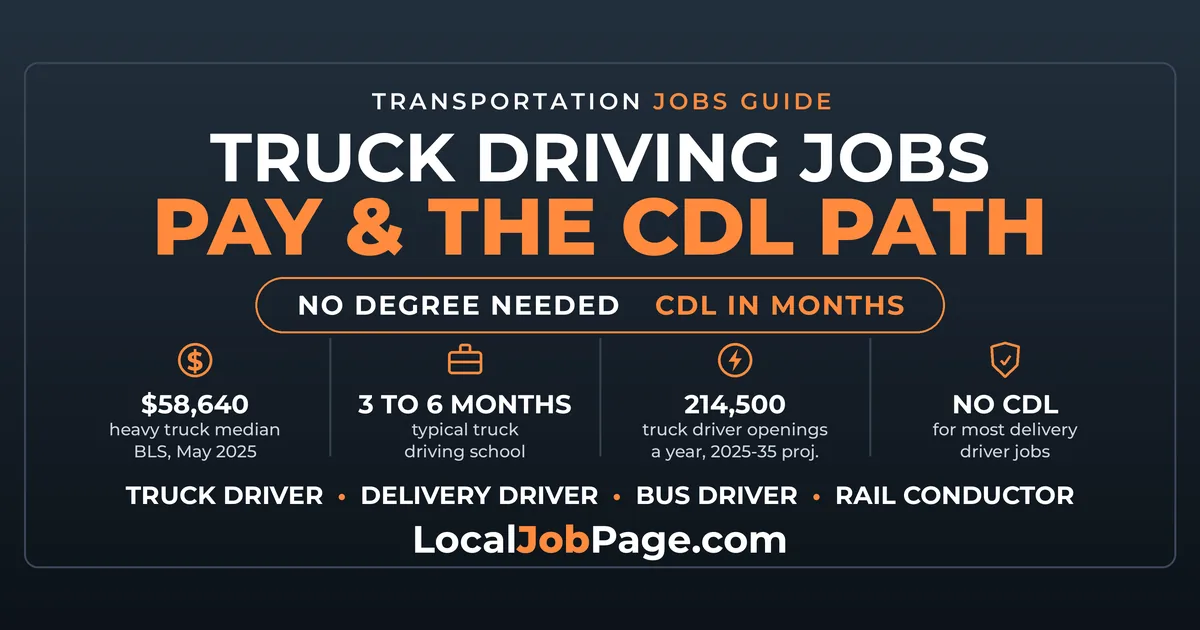
Heavy and tractor-trailer truck drivers earned a median of $58,640 in May 2025, and the Bureau of Labor Statistics expects about 214,500 openings a year in that job alone through 2035.
Need work now? Skip straight to the job links and begin searching now →
💼 The Driving Jobs, From No License Needed to CDL
Heavy and tractor-trailer truck drivers haul freight in big rigs, on long-haul runs that keep them away for days or on regional and local routes. They need a CDL. BLS counted 2,221,200 of these jobs in 2025, the largest group in this guide.
Delivery truck drivers and driver/sales workers run local routes in trucks under 26,001 pounds: parcels, groceries, supplies. Driver/sales workers also take orders and sell to the customers on their route. BLS says these jobs need a regular driver's license, and employers train new hires on the job, often with a mentor riding along. There were 1,511,400 of them in 2025.
Bus drivers work for transit agencies, intercity lines, charter companies and school districts. Every bus driver needs a CDL with a passenger endorsement, and school bus drivers add a school bus endorsement.
Taxi drivers, shuttle drivers and chauffeurs move people rather than freight. BLS lists no formal education requirement and says company training runs from one day to two weeks. A CDL is required only for vehicles built to carry 16 or more passengers. Ride-hailing rules vary by state and city.
Railroad workers, including conductors and locomotive engineers, are a smaller field with the highest pay here. Railroads train their own hires, and BLS says workers must be at least 21.
💵 What Truck Driving and Delivery Jobs Pay
These are national medians from the Bureau of Labor Statistics for May 2025, the most recent wage data. A median is the midpoint: half the people in the job earned less.
| Job | Median annual pay (May 2025) |
| Railroad workers | $78,820 |
| Heavy and tractor-trailer truck drivers | $58,640 |
| Bus drivers | $49,390 |
| Delivery truck drivers and driver/sales workers | $43,950 |
| Taxi drivers, shuttle drivers and chauffeurs | $37,960 |
The spread inside each job matters as much as the midpoint. For heavy truck drivers, the lowest-paid 10 percent earned less than $40,140 and the top 10 percent more than $79,380. BLS says long-haul pay is usually a per-mile rate plus bonuses, so miles driven, cargo and experience move the paycheck. Drivers employed by trucking companies had a median of $60,320, a little above those driving for wholesalers, manufacturers or construction firms.
On the delivery side, light truck drivers had a median of $44,860, and those working for couriers and messengers did better, at $47,700. Driver/sales workers came in at $38,770, though tips and commissions can add to that. Among bus drivers, transit and intercity drivers earned a median of $59,050 against $47,920 for school bus drivers, who usually work only when school is in session.
One limit on the taxi figure: BLS wage data comes from employers, so it does not capture app-based drivers working for themselves.
🎓 How to Get a CDL
The CDL is the gate to the best-paid road jobs, and the steps are set by federal rules that every state applies.
- Pick the class. A Class A CDL covers tractor-trailers and other combinations of 26,001 pounds or more. Class B covers single heavy vehicles such as straight trucks and large buses. Most long-haul jobs ask for Class A.
- Get a commercial learner's permit. You pass a knowledge test first. Under federal rules you must hold the permit at least 14 days before you can take the skills test, and it is good for up to a year.
- Finish entry-level driver training. Since February 7, 2022, the Federal Motor Carrier Safety Administration has required anyone getting a first Class A or B CDL, upgrading from B to A, or adding a passenger, school bus or hazardous materials endorsement for the first time to complete training with a provider on its Training Provider Registry. Check that a school is listed before you pay it.
- Pass the medical exam. BLS notes drivers need a physical every two years, with vision and hearing standards, and are subject to random drug and alcohol testing.
- Pass the skills test in the class of vehicle you plan to drive.
BLS says truck driving school programs typically take three to six months. Some carriers run their own training or cover tuition for new drivers who agree to stay for a set period. Read that agreement closely: leaving early can mean paying the training back. After hiring, new drivers usually spend several weeks riding with an experienced mentor.
Age matters too. Federal rules require drivers to be at least 21 to drive a commercial vehicle across state lines. Most states let 18-year-olds drive within the state, which is why many younger drivers start on local and regional routes.
📊 Where the Openings Are
Most openings come from replacing drivers who retire or leave, not just new jobs. BLS projections for 2025 to 2035 are a model, not a promise:
- Heavy and tractor-trailer truck drivers: employment up 4 percent, about as fast as average, with roughly 214,500 openings a year.
- Delivery truck drivers and driver/sales workers: up 7 percent, much faster than average, about 152,700 openings a year.
- Taxi drivers, shuttle drivers and chauffeurs: up 9 percent, about 55,900 openings a year.
- Bus drivers: up 2 percent, about 77,600 openings a year.
- Railroad workers: up 1 percent, about 6,100 openings a year, so competition is stiffer.
🔥 Who Hires Drivers
Freight carriers hire the most CDL drivers, from national truckload companies to small regional fleets. Private fleets run by grocery chains, retailers, beverage distributors and manufacturers hire drivers to move their own goods. Parcel carriers such as UPS and FedEx, and the delivery contractors that move Amazon packages, hire delivery drivers, and parcel carriers have historically added seasonal help ahead of the holidays. Transit agencies, charter lines and school districts hire bus drivers, and new hires train beside experienced drivers before taking a route alone. Freight railroads train their own conductors, which BLS says can take up to 12 months.
⚠️ Who These Jobs Are Not For
Driving jobs screen hard. Expect a motor vehicle record check, and for CDL work, pre-employment drug testing and a medical exam. Certain medical conditions can disqualify a driver under federal rules. Long-haul trucking means nights, weekends and holidays away from home, and federal hours-of-service limits shape your whole week: up to 11 hours driving in a 14-hour window, then 10 hours off. Delivery routes are physical work, with a lot of lifting and many stops a day.
🔎 Where to Aim Right Now
If you have no CDL yet, start with delivery and shuttle driving and the trainee CDL programs. If you already have one, search by class and route type.
Start here:
- CDL driver jobs
- Class A CDL jobs
- Truck driver jobs
- CDL trainee jobs
- Delivery driver jobs
- Local driver jobs
- School bus driver jobs
- Shuttle driver jobs
- UPS jobs
- FedEx jobs
🗺️ Where to Look in Your City
These network metros sit on major interstate freight corridors and distribution clusters, including the big parcel air hubs in Memphis and Louisville.
- Truck driver jobs in Memphis
- Truck driver jobs in Louisville
- Truck driver jobs in Indianapolis
- Truck driver jobs in Columbus
- Truck driver jobs in Dallas
- Truck driver jobs in Fort Worth
- Truck driver jobs in Kansas City
- Truck driver jobs in Chicago
- Truck driver jobs in Atlanta
- Truck driver jobs in Jacksonville
- Truck driver jobs in Phoenix
- Truck driver jobs in Long Beach
Not on the list? Find your city.
Frequently Asked Questions
How much do truck drivers make?
Heavy and tractor-trailer truck drivers earned a median of $58,640 a year, or $28.19 an hour, in May 2025, according to the Bureau of Labor Statistics. The top 10 percent earned more than $79,380.
How long does it take to get a CDL?
BLS says truck driving school programs typically last three to six months. Federal rules also require you to hold a learner's permit for at least 14 days before the skills test and to finish entry-level training with a registered provider.
Do I need a CDL to be a delivery driver?
Usually not. BLS says delivery truck drivers drive trucks under 26,001 pounds and need a regular driver's license. Employers train new drivers on the job.
How old do you have to be to drive a truck?
You must be at least 21 to drive a commercial vehicle across state lines under federal rules. Most states allow drivers 18 and older to drive within the state.
Will a company pay for my CDL training?
Some carriers do, usually in exchange for a work commitment. Read the contract before you sign, since leaving early can mean repaying the cost.
Start Driving for a Living
Create a free LocalJobPage account to save driver searches and get new postings as they go up, or browse all jobs near you.
Employers: need drivers? Post your driving jobs on LocalJobPage and reach job seekers in 50 cities.
Related Reading
- Warehouse and Logistics Jobs: What They Pay and How to Get Hired
- Amazon Raises Starting Pay to $20 an Hour: What Warehouse Job Seekers Should Know
- Skilled Trades Jobs: What They Pay and How to Get In Without a Degree
- Indianapolis Transportation Hiring Event Oct. 23: CDL and Delivery Driver Jobs at WorkOne Indy
- The Port of Long Beach: Trade, Trucking, and Logistics Jobs
If you have a clean driving record, a delivery job may need nothing more than an application, and a CDL can be a few months away. Pick the license that matches the life you want on the road, then start applying.