Physical and Occupational Therapy Jobs: What They Pay and How to Get In
HEALTHCARE HIRING — Rehab therapy is one of the few corners of healthcare where a two-year degree can pay close to $70,000 and the job is still projected to grow several times faster than the average for all jobs. Physical and occupational therapy clinics, hospitals, nursing facilities and home health agencies all run on the same small set of job titles.
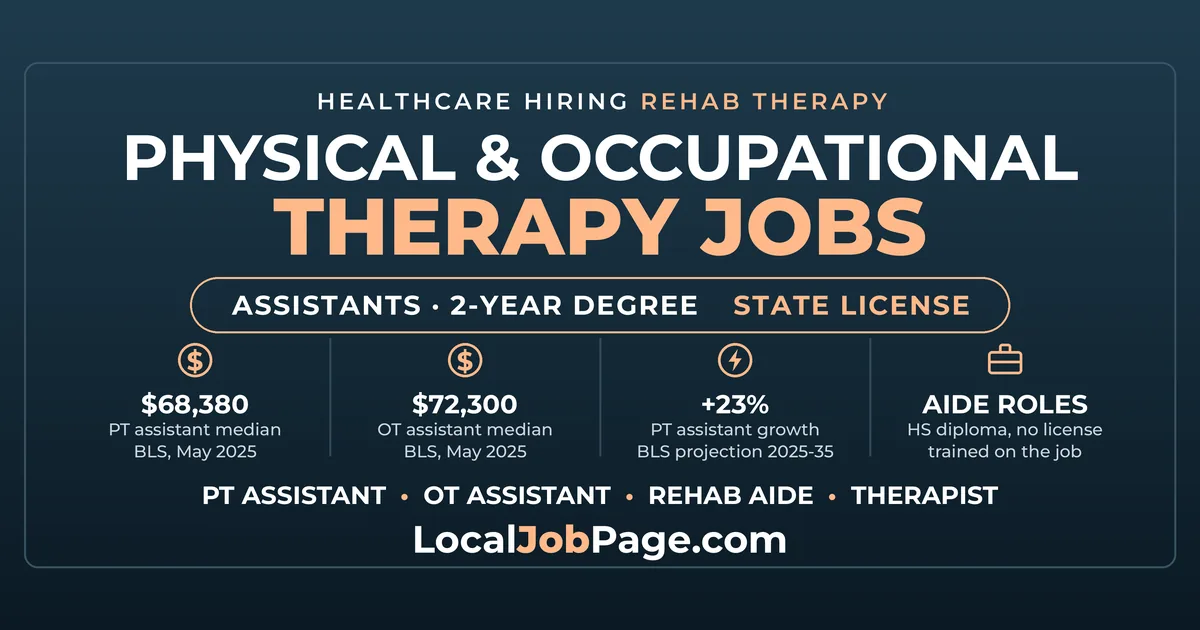
Physical therapist assistants and occupational therapy assistants are the two fastest-growing jobs in this guide, both need an associate's degree, and both carried a national median above $68,000 in May 2025.
Ready to go? Skip straight to the job links and begin searching now →
Every wage below is a national median annual wage for May 2025 from the U.S. Bureau of Labor Statistics' Occupational Employment and Wage Statistics program, as published in the Occupational Outlook Handbook. Growth figures are BLS Employment Projections for 2025 to 2035. A median means half the people in that job earned less, and a projection is a ten-year model, not a promise about next year. For comparison, BLS puts the median for all occupations at $50,980 and average projected growth at 3 percent.
💼 The Jobs in Physical and Occupational Therapy
Aides: the front door. Physical therapist aides and occupational therapy aides clean and set up treatment areas, move patients, and handle scheduling and insurance paperwork. BLS says aides typically need a high school diploma plus on-the-job training; for physical therapy aides that training runs about one week to one month. No state requires physical therapist aides to be licensed, and BLS says occupational therapy aides typically are not regulated by state law. Physical therapy is the bigger employer here, with about 49,000 aide jobs in 2025 against 4,400 in occupational therapy.
Assistants: the sweet spot. Assistants deliver hands-on treatment under a licensed therapist's direction. A physical therapist assistant runs exercises, applies techniques like stretching and massage, records progress and coaches patients and families. Occupational therapy assistants help patients build or recover the skills they need for daily living and working. BLS counted 114,100 physical therapist assistant jobs and 52,200 occupational therapy assistant jobs in 2025, and projects growth of 23 percent and 21 percent respectively through 2035.
Therapists: the licensed lead. Physical therapists, occupational therapists and speech-language pathologists evaluate patients, write the treatment plan and supervise the people carrying it out. All three are graduate-degree professions: a doctoral degree for physical therapy, typically a master's for occupational therapy and speech-language pathology.
💵 What Therapy Jobs Pay
National median annual wages, May 2025, Bureau of Labor Statistics, with the typical entry-level education and projected growth BLS assigns each occupation.
| Occupation | Median (May 2025) | Typical entry-level education | Projected growth, 2025–35 |
| Physical therapists | $102,760 | Doctoral or professional degree | 12% |
| Occupational therapists | $100,330 | Master's degree | 15% |
| Speech-language pathologists | $97,870 | Master's degree | 17% |
| Occupational therapy assistants | $72,300 | Associate's degree | 21% |
| Physical therapist assistants | $68,380 | Associate's degree | 23% |
| Occupational therapy aides | $39,160 | High school diploma or equivalent | 4% |
| Physical therapist aides | $35,240 | High school diploma or equivalent | 4% |
The spread inside each job is wide. For physical therapist assistants, the lowest-paid 10 percent earned less than $47,750 and the highest-paid 10 percent more than $89,510. For occupational therapy assistants, the range ran from under $51,490 to over $89,780. Physical therapists ranged from under $77,140 to more than $135,140.
Where you work moves the number too. BLS reports physical therapist assistants in home healthcare earned a median of $80,050, and those in nursing care facilities $77,440, compared with $63,080 in therapy offices. Occupational therapy assistants show the same pattern: $77,310 in home healthcare and $76,780 in nursing care facilities.
🎓 Training and Credentials
The license is the job here, and licensing is set state by state.
For physical therapist assistants, BLS says all states require an associate's degree from an accredited program, usually about two years, covering anatomy, physiology and kinesiology plus supervised clinical work. All states also require licensure or certification, which typically means graduating from an accredited program and passing a qualifying exam. Some states add a state-law exam, a criminal background check or a minimum age of 18, and continuing education may be required to keep the credential.
Occupational therapy assistants follow a similar track: an associate's degree from an accredited program, typically about two years full time including several months of fieldwork. Most states require a license, which takes the accredited program, the fieldwork and an exam. Passing the certification exam also earns the COTA title, which requires continuing education to keep.
Therapist roles are a longer commitment. BLS says doctor of physical therapy programs typically last three years, and every state licenses physical therapists, occupational therapists and speech-language pathologists after a qualifying exam.
Before you enroll anywhere, confirm two things: that the program is accredited, and what your state's licensing board requires in the state where you plan to work.
🔥 Who's Hiring
The employer mix decides your day. Among physical therapist assistants, BLS reports 44 percent work in offices of physical, occupational and speech therapists, 20 percent in hospitals, 12 percent in home healthcare and 10 percent in nursing care facilities. Occupational therapy assistants lean harder toward long-term care: 39 percent in therapy offices, 19 percent in nursing care facilities and 17 percent in hospitals.
Speech-language pathology looks different. BLS says 39 percent of speech-language pathologists work in educational services, which means school districts are a major employer, alongside therapy practices and hospitals.
BLS ties the growth to an aging population and chronic conditions such as diabetes and obesity, and expects providers, especially in outpatient and long-term care, to rely more on assistants to keep costs down. It projects about 24,900 openings a year for physical therapist assistants and aides combined and about 8,600 for occupational therapy assistants and aides, mostly from replacing people who retire or change fields.
⚠️ Who This Field Is Not For
It is physical work. BLS notes physical therapist assistants and aides are often on their feet, lifting and moving patients, which carries a real risk of back injury.
Aide pay is not assistant pay. Aide roles are a fine way to see the field from inside, but the median sits near $35,000 to $39,000 and growth is projected at 4 percent. The money and the growth are in the assistant credential.
Hours stretch. Most people in these jobs work full time, but part-time work is common and clinics often run extended hours, so evenings and weekends come with the territory.
The license does not travel by itself. A credential earned in one state may need extra steps to use in another. Check the board in the state where the work is performed.
🔎 Search Therapy Jobs Now
- Physical therapist assistant jobs
- Occupational therapy assistant jobs
- Physical therapy aide jobs
- Rehab aide jobs
- Physical therapist jobs
- Occupational therapist jobs
- Speech-language pathologist jobs
- Home health therapy jobs
- Select Medical jobs
Search the exact title. Postings are written in credential language, and "PTA" or "COTA" in a listing tells you the license level the employer expects.
🗺️ Where to Look in Your City
Therapy jobs follow hospitals, outpatient clinics and long-term care, so these are large metros with deep healthcare networks, including Sun Belt markets with big retiree populations.
- Therapy jobs in Tampa
- Therapy jobs in Miami
- Therapy jobs in Phoenix
- Therapy jobs in Tucson
- Therapy jobs in Houston
- Therapy jobs in Dallas
- Therapy jobs in Philadelphia
- Therapy jobs in Boston
- Therapy jobs in Columbus
- Therapy jobs in Denver
Not on the list? Find your city.
Frequently Asked Questions
How much does a physical therapist assistant make?
The national median was $68,380 in May 2025, according to BLS. The lowest-paid 10 percent earned under $47,750 and the highest-paid 10 percent more than $89,510, with home healthcare paying the highest industry median at $80,050.
What is the difference between a PT aide and a PT assistant?
Assistants deliver treatment under a physical therapist's direction and must be licensed or certified in every state after an accredited associate's program. Aides handle setup, patient transport and paperwork, train on the job, and are not licensed by any state.
How long does it take to become an occupational therapy assistant?
BLS says accredited programs usually take about two years full time, including several months of fieldwork, followed by an exam. Most states then require a license.
Can I work in physical therapy without a degree?
Yes, as an aide. BLS lists a high school diploma or equivalent as typical, with on-the-job training of about one week to one month.
Which therapy job pays the most?
Physical therapists, at a $102,760 national median in May 2025, followed closely by occupational therapists at $100,330. Both require a graduate degree and a state license.
Are therapy jobs still growing?
BLS projects much faster than average growth from 2025 to 2035 for every licensed role in this guide, led by physical therapist assistants at 23 percent. Aide roles are projected to grow 4 percent.
🧭 Your Next Step This Week
Pick the layer you are aiming for, look up your state's licensing board, and search that exact title. If you are not ready for a program yet, an aide job will show you the work from inside a clinic.
Create a free LocalJobPage account to save searches and catch new therapy postings, or browse every open job on the board.
Employers: therapy practices, home health agencies and nursing facilities can post openings as an employer. See pricing.
Related Reading
- Healthcare Jobs Without a Bachelor's Degree: What They Pay and How Long Training Takes
- Nursing Jobs: What They Pay and How to Become a Registered Nurse
- School Jobs: What They Pay and How to Get Hired Without a Teaching License
- Social Services Jobs: What They Pay and How to Get In
Two years and a license separate a $35,000 aide job from a $68,000 assistant job in this field. Pick your layer, check your state board, and let the job title do the searching.