Social Services Jobs: What They Pay and How to Get In
SOCIAL SERVICES HIRING — Social services jobs are one of the few fields where a high school diploma can get you in the door and a degree can take you a long way up. Case aides, community health workers, social workers and counselors do the work behind food banks, county benefit offices, shelters, schools, hospitals and treatment centers, and the Bureau of Labor Statistics expects the field to keep growing faster than the job market as a whole.
The entry roles need a high school diploma and on-the-job training, the clinical roles need a master's degree and a state license, and the pay climbs with each step in between.
Need work now? Skip straight to the job links and begin searching now →
💼 The Jobs in Social Services
The field covers several distinct jobs, and the titles on job postings rarely match the government's names for them. Here is what each one actually involves.
Social and human service assistants are the front line. Postings call them case aides, case management assistants, family support workers, intake coordinators or program assistants. They help clients apply for benefits like food assistance or housing, check in on them, connect them with services and keep the case file current. BLS counted about 463,400 of these jobs in 2025.
Community health workers work in neighborhoods rather than offices. They help people get to appointments, find coverage and resources, and stick with healthier habits. BLS notes that speaking a second language helps in some communities.
Social workers manage cases and help people cope with problems in daily life. Child, family and school social workers are the largest group, about 405,100 of the 816,100 social work jobs in 2025, followed by healthcare social workers in hospitals and clinics and mental health and substance abuse social workers.
Substance abuse, behavioral disorder and mental health counselors work with people facing addiction, depression and other conditions, in outpatient centers, residential programs and private practices.
Probation officers and correctional treatment specialists work with people on probation or parole, or in custody, and help them stay on track.
💵 What Social Services Jobs Pay
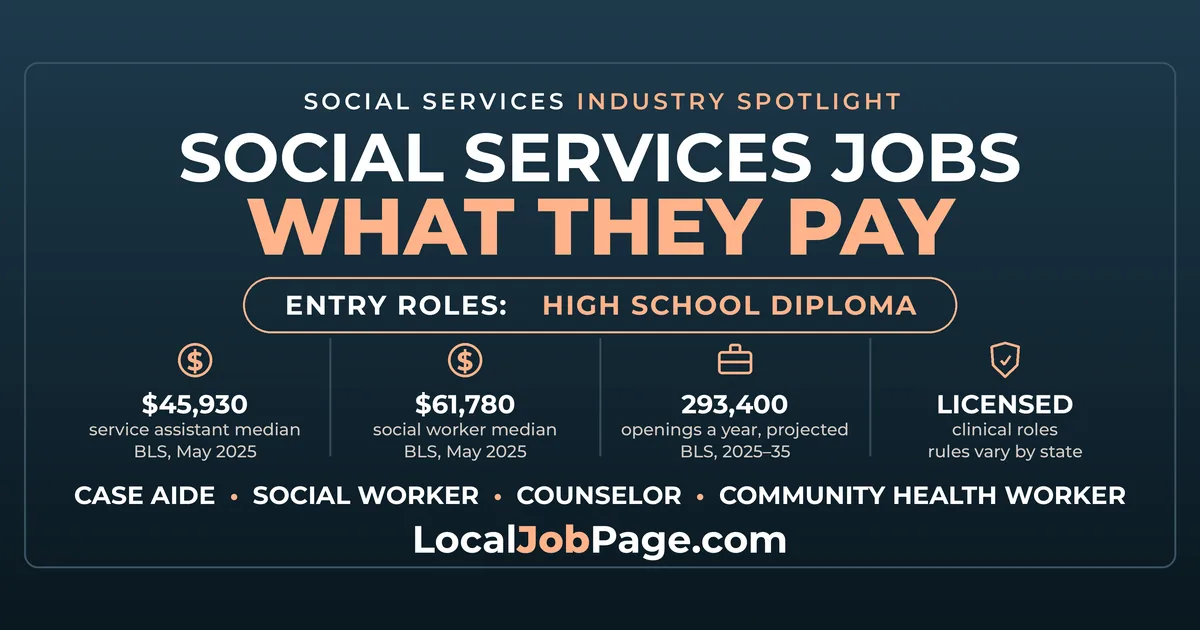
These are national medians from the Bureau of Labor Statistics Occupational Outlook Handbook for May 2025, the most recent available. A median is the midpoint: half the people in that job earned more and half earned less. Local pay can differ a lot from these figures.
| Job | Median pay, May 2025 | Typical entry education |
| Social and human service assistants | $45,930 a year ($22.08/hr) | High school diploma |
| Community health workers | $51,850 a year ($24.93/hr) | High school diploma |
| Substance abuse, behavioral disorder and mental health counselors | $59,350 a year ($28.53/hr) | Master's degree |
| Social workers | $61,780 a year ($29.70/hr) | Bachelor's degree |
| Probation officers and correctional treatment specialists | $66,270 a year | Bachelor's degree |
For comparison, BLS put the median for all occupations at $50,980 in May 2025, and the median for the community and social service group as a whole at $58,300.
The spread inside each job is wide. Among service assistants, the lowest-paid 10% earned less than $34,200 and the highest-paid 10% earned more than $63,290. For social workers, the range ran from under $42,790 to over $100,090. Where you work matters too: BLS reported a median of $49,990 for service assistants in local government, compared with $42,790 in nursing and residential care facilities.
🎓 Training and Credentials
This is where the field sorts itself, and it is worth knowing before you apply.
No degree needed to start. BLS lists a high school diploma as the typical entry point for service assistants and community health workers, with short-term training on the job, often in case management. Some employers prefer or require an associate's or bachelor's degree in human services, psychology or a related field, so read each posting. Some states require community health workers to be certified, which can mean finishing an approved training program; your state's board of health or human services department will say whether that applies to you.
A bachelor's degree opens social work. A bachelor's in social work is the most common requirement for entry-level, nonclinical social work jobs. Some states also license or credential nonclinical social workers, so check your state's licensing board.
Clinical work takes a master's and a license. Every state requires clinical social workers to be licensed, which means a master's in social work, supervised clinical experience after graduation that can take several years, and a clinical exam. Mental health counselors also need a state license in every state. Substance abuse counselor rules vary most of all: BLS reports requirements ranging from a high school diploma to a master's degree depending on the position, the state and the employer, though private practice always requires a master's and a license.
The practical path many people take: start as a service assistant or community health worker, learn the system, then go back to school for a degree while working. BLS notes that moving from assistant into case management or social work typically takes a bachelor's or master's degree.
📊 Where the Field Is Growing
BLS projects employment in community and social service jobs to grow much faster than average from 2025 to 2035, with about 293,400 openings a year across the group. Those openings include both new positions and the need to replace people who change careers or retire. These are ten-year projections from a model, not a forecast of next year's hiring.
Counselors lead the projected growth at 18% over the decade. BLS projects 13% for community health workers, 7% for service assistants and 6% for social workers. In raw openings, social work is the biggest door, at about 69,100 a year.
🔥 Who's Hiring
Government is a major employer. State and local government agencies, outside schools and hospitals, account for 27% of social worker jobs, and local government holds 11% of service assistant jobs. Think county human services departments, child protective services, public health departments and housing authorities.
Nonprofits are the other big employer: family service agencies, food banks, shelters, faith-based charities and community action agencies. Hospitals, outpatient clinics, behavioral health centers, residential treatment programs and school districts round it out.
⚠️ Who This Field Is Not For
Be honest with yourself before you apply. BLS notes that understaffing and large caseloads can make the work stressful, and some jobs include evenings, weekends, holidays or on-call shifts. Some employers require a criminal background check, and jobs that involve traveling to see clients may require a valid driver's license. If you want a clinical career, plan for years of school and supervised hours before you can practice on your own.
If the work fits you, it is steady, it is needed in every community, and the first step does not require a degree.
🔎 Search Social Services Jobs Now
- Case manager jobs
- Case aide jobs
- Social worker jobs
- Community health worker jobs
- Behavioral health technician jobs
- Substance abuse counselor jobs
- Family support specialist jobs
- Intake coordinator jobs
- Salvation Army jobs
Want to browse everything? See all open jobs.
🗺️ Where to Look in Your City
State capitals carry the state agencies that run human services programs, on top of their own county offices and nonprofits, so they are a good place to start.
- Case manager jobs in Sacramento
- Case manager jobs in Phoenix
- Case manager jobs in Denver
- Case manager jobs in Austin
- Case manager jobs in Oklahoma City
- Case manager jobs in Nashville
- Case manager jobs in Atlanta
- Case manager jobs in Indianapolis
- Case manager jobs in Columbus
- Case manager jobs in Boston
Not on the list? Find your city.
Frequently Asked Questions
Can I get a social services job without a degree?
Yes. BLS lists a high school diploma as the typical entry education for social and human service assistants and community health workers. Some employers prefer a degree, so check each posting.
How much do social workers make?
The national median for social workers was $61,780 a year in May 2025, according to BLS. Healthcare social workers had a median of $67,880, and child, family and school social workers $59,550.
Do I need a license to be a social worker?
Clinical social workers need a license in every state. Some states also license nonclinical social workers, so check with your state's social work licensing board.
What is the difference between a case aide and a case manager?
Titles vary by employer. In general, a case aide or assistant supports the caseload with paperwork, client contact and referrals, while a case manager carries the caseload and makes the plan. BLS notes that moving into case management typically takes a bachelor's or master's degree.
Which social services job is growing fastest?
Among the jobs in this guide, BLS projects the fastest growth from 2025 to 2035 for substance abuse, behavioral disorder and mental health counselors, at 18%.
Start Your Social Services Job Search
Set up a job seeker account and start applying. Register as a job seeker or browse all jobs.
Employers: hiring case aides, social workers or counselors? Post your openings on LocalJobPage.
Related Reading
- Healthcare Jobs Without a Bachelor's Degree: What They Pay and How Long Training Takes
- Childcare Jobs: What They Pay and How to Get Hired
- School Jobs: What They Pay and How to Get Hired Without a Teaching License
- Police, Firefighter and Corrections Jobs: What They Pay and How to Get Hired
Start where the door is open: a case aide or community health worker job gets you inside the field, and the degree can come later.