Police, Firefighter and Corrections Jobs: What They Pay and How to Get Hired
PUBLIC SAFETY HIRING — Police, firefighter, corrections and 911 dispatch jobs are some of the few steady, well-paid public jobs you can get into without a four-year degree. Most of them are government jobs with academy training, and all of them come with a long hiring process. Here is what each job pays, what it takes to get hired and where to search.
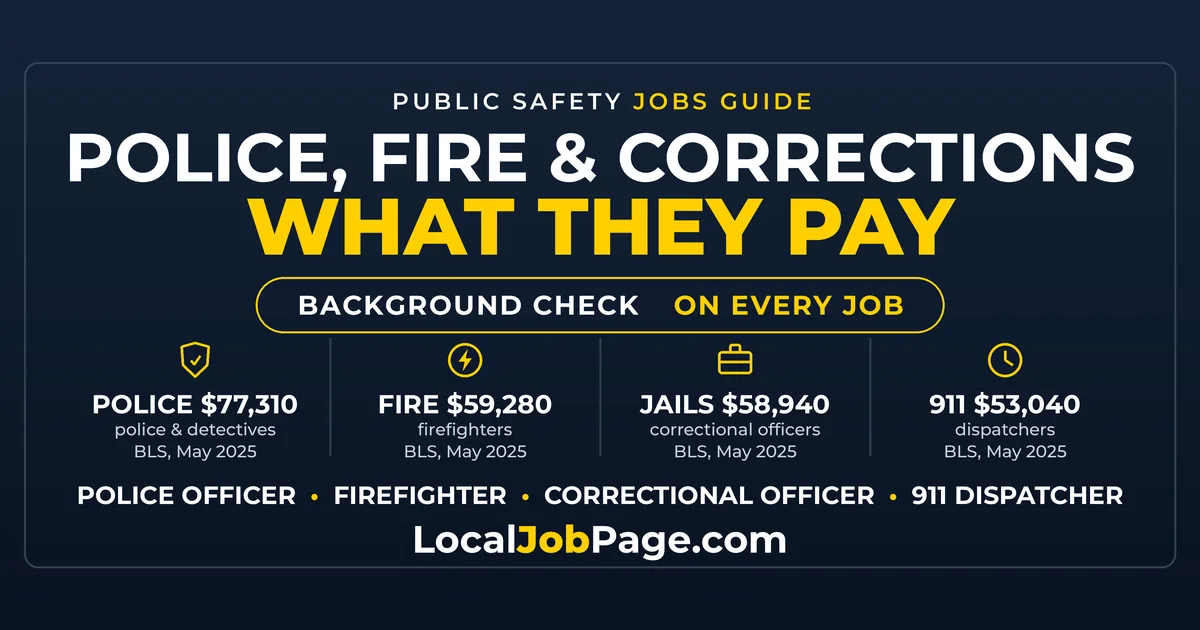
Police and detectives earned a national median of $77,310 in May 2025 and firefighters $59,280, according to the Bureau of Labor Statistics, and most of these jobs start with a high school diploma, an academy and a background check.
Ready to apply? Skip straight to the job links and begin searching now →
💼 The Public Safety Jobs, and What the Work Looks Like
Police officer and sheriff's deputy. You patrol an assigned area, answer calls, enforce laws, make arrests and write reports that may end up in court. City departments hire police officers, county sheriff's offices hire deputies and state agencies hire troopers. BLS counted 824,200 police and detective jobs in 2025. Detective work usually comes later, after time on patrol.
Firefighter. You respond to fires, and also to medical emergencies, car crashes and rescues. Between calls you train and maintain equipment. BLS counted 355,300 firefighter jobs in 2025, and notes that volunteers make up the largest share of firefighters nationwide, especially in communities under 25,000 people.
Correctional officer and bailiff. Correctional officers keep order in jails and prisons: supervising inmates, searching for contraband, escorting people and writing incident reports. Bailiffs keep order in courtrooms. BLS counted 397,800 correctional officer and jailer jobs and about 18,000 bailiff jobs in 2025.
911 dispatcher. You answer emergency calls, figure out what is happening and where, send police, fire or ambulance crews and stay on the line. BLS counted 105,600 police, fire and ambulance dispatcher jobs in 2025. It is the one public safety job done entirely from a desk.
💵 What Public Safety Jobs Pay
These are national medians from the BLS Occupational Outlook Handbook, for May 2025. A median is the midpoint: half the people in the job earned less. Overtime is common for police and firefighters, and how much a department offers varies, so ask about it when you apply.
| Job | National median pay, May 2025 |
| Police and detectives, all | $77,310 a year ($37.17 an hour) |
| Police and sheriff's patrol officers | $76,210 a year |
| Detectives and criminal investigators | $93,790 a year |
| Firefighters | $59,280 a year ($28.50 an hour) |
| Correctional officers and jailers | $58,940 a year |
| Bailiffs | $56,600 a year |
| Police, fire and ambulance dispatchers | $53,040 a year ($25.50 an hour) |
The spread inside each job is wide. For police and detectives, the lowest-paid 10 percent earned less than $48,160 and the top 10 percent more than $121,600. For firefighters, the range ran from under $34,910 to over $101,040. Where you work explains much of the gap.
Who signs the check matters too. Correctional officers and jailers at the federal level had a median of $74,630, against $59,990 in state government, $58,500 in local government and $46,910 in facilities support services, which is where private contractors sit. State government dispatchers had a median of $60,840, against $46,430 at ambulance companies.
🎓 Training and How the Hiring Process Works
Public safety hiring is slow on purpose. Depending on the job, expect a written exam, a physical test, interviews, a background check and a medical exam, and the steps can take months. Many agencies test in rounds, so watch for the next testing date.
Police. Education requirements range from a high school diploma to a college degree, depending on the agency. Candidates usually must be at least 21 and meet strict physical and personal standards. BLS notes that a felony conviction or drug use may disqualify an applicant, and that candidates may be asked to take polygraph and drug tests. Most state and local agencies require U.S. citizenship, and federal officers must be citizens. Recruits graduate from the agency's academy, which covers law, civil rights, patrol, firearms and self-defense, then train on the job.
Firefighters. Applicants are typically at least 18 with a valid driver's license and must pass written and physical tests, interviews, a medical exam and a drug screening. Some departments require EMT certification before you are hired, and requirements vary by city and state. New hires spend a few months at a fire academy, then serve a probationary period. Volunteer experience can help you land a career job, and wildland firefighters can enter apprenticeships of up to four years.
Correctional officers. A high school diploma is the usual bar for state and local jobs, followed by academy and on-the-job training. Minimum ages usually fall between 18 and 21, and some states require state certification. The Federal Bureau of Prisons asks more: a bachelor's degree or several years of experience in counseling, assistance or supervision.
Dispatchers. A high school diploma, an exam and a typing test are typical. Many states and localities require certification, some require 40 or more hours of training, and some set no requirement at all. Emergency Medical Dispatcher certification lets you give medical instructions over the phone. Probation usually lasts about a year.
🔥 Who's Hiring
Almost every employer here is a government: city police and fire departments, county sheriff's offices and jails, state police and highway patrols, state corrections departments, courts and the Federal Bureau of Prisons. Dispatch centers are run by cities, counties and states, and some hospitals and ambulance companies hire dispatchers too. Private companies that run detention facilities hire correctional officers as well, at lower median pay.
Turnover drives most of the openings. BLS projects about 60,100 openings a year for police and detectives, 26,800 for firefighters, 30,000 for correctional officers and bailiffs and 9,000 for dispatchers from 2025 to 2035, mostly to replace people who retire or move on. Corrections is the one shrinking field, with a projected 7 percent decline, yet it still opens tens of thousands of jobs a year. Projections are a model, not a promise, but the hiring does not stop.
⚠️ Who This Work Is Not For
- Your record. Every one of these jobs involves a background check. A felony or past drug use can end a police application, so read the agency's standards before you test.
- Your schedule. Police, corrections and dispatch run around the clock, and new hires usually get nights, weekends and holidays. Firefighters often work 24 hours on, then 48 or 72 off, sleeping at the station.
- Your body. BLS lists patrol officers and correctional officers among the occupations with the highest injury and illness rates. Physical tests are pass or fail.
- Your patience. Months can pass between the application and the academy. If you need a paycheck next week, line up other work while you wait.
🔎 Where to Aim Right Now
Search more than one title, because agencies post the same job under different names: deputy, detention officer, jailer, public safety telecommunicator. Then check your city and county government job pages for the next testing date.
Start here:
- Police officer jobs
- Sheriff's deputy jobs
- Firefighter jobs
- Correctional officer jobs
- Detention officer jobs
- 911 dispatcher jobs
- Emergency dispatcher jobs
- Bailiff jobs
- Federal Bureau of Prisons jobs
🗺️ Where to Look in Your City
These metros are home to some of the largest city police, fire and county jail systems in the country, which means the most openings and the most frequent testing dates.
- Police officer jobs in New York
- Police officer jobs in Chicago
- Police officer jobs in Los Angeles
- Detention officer jobs in Houston
- Correctional officer jobs in Philadelphia
- Firefighter jobs in Phoenix
- Firefighter jobs in Dallas
- Police officer jobs in Washington
- 911 dispatcher jobs in San Antonio
- Sheriff's office jobs in Jacksonville
Not on the list? Find your city.
Frequently Asked Questions
Do you need a college degree to be a police officer?
Not usually. BLS says requirements range from a high school diploma to a college degree depending on the agency, and some federal agencies require a bachelor's degree. Check each department's posting.
How much do firefighters make?
The national median was $59,280 a year, or $28.50 an hour, in May 2025, according to BLS. State government firefighters had a higher median, $64,980.
Is correctional officer a good job without a degree?
For many people, yes. State and local jobs usually start with a high school diploma and academy training, and the national median was $58,940 for correctional officers and jailers in May 2025. The tradeoffs are shift work and one of the highest injury rates of any occupation.
Can a criminal record keep you out?
It can. BLS notes that a felony conviction or drug use may disqualify a police applicant, and every job here involves a background check. Each agency sets its own standards, so read them before you apply.
How long does it take to get hired?
It can take months from application to academy, because of the exams, physical test and background check. Apply to more than one agency at a time if you can.
🧭 Start Your Public Safety Career
Set up job alerts so you see the next hiring window when it opens. Create a free LocalJobPage account, or browse all jobs near you.
Employers: Recruiting officers, deputies or dispatchers? Post your openings on LocalJobPage.
Related Reading
- Security Guard Jobs: What They Pay and How to Get Licensed
- Healthcare Jobs Without a Bachelor's Degree: What They Pay and How Long Training Takes
- Common Job Interview Questions and How to Answer Them
- How to Spot a Job Scam Before You Apply
Read an agency's background and fitness standards before you apply. If you clear them, start training for the physical test now, because the next testing date will not wait for you.