Security Guard Jobs: What They Pay and How to Get Licensed
SECURITY HIRING — Security guard jobs are one of the most common ways into steady work that start with a high school diploma, a background check and a short training course. There are close to 1.3 million of them, and they turn over constantly, which is why the postings never seem to stop.
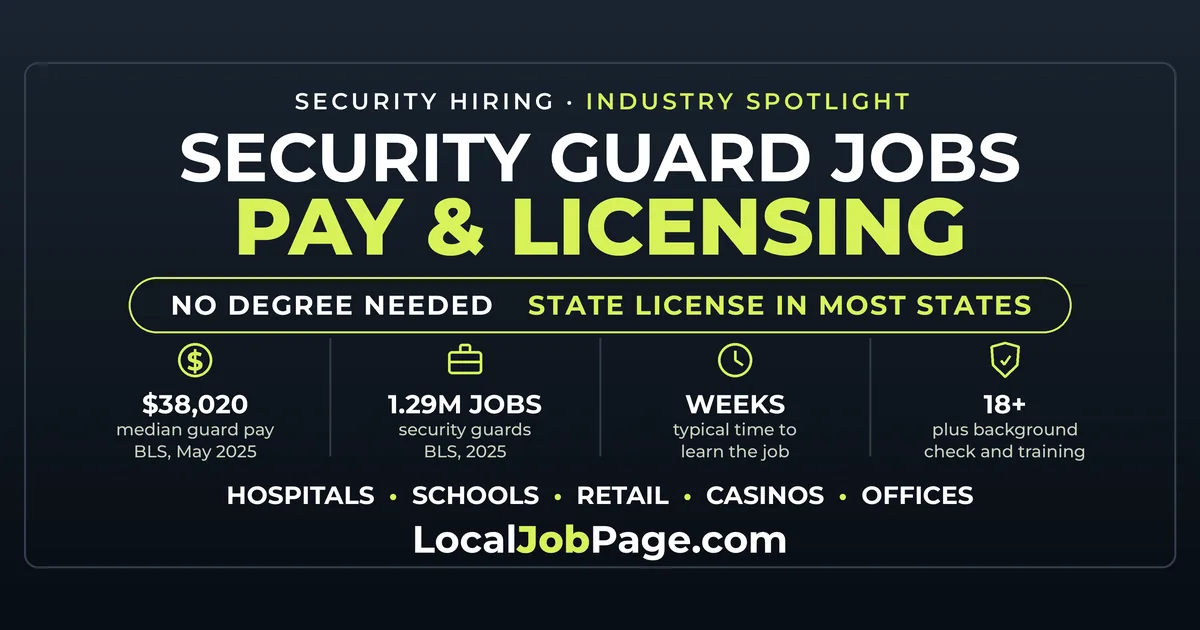
Security guards earned a national median of $38,020 in May 2025, most states require a license, and the fastest raises come from picking the right employer and the right post.
Need work now? Skip straight to the job links and begin searching now →
💼 The Jobs: What Security Work Actually Looks Like
The Bureau of Labor Statistics counted 1,294,300 security guard jobs in 2025. Most of the work is the same at its core: watch a property, control who comes in, patrol on a schedule, write down what happened and call for help when something goes wrong. Where you do it changes the job a lot.
- Contract security officer. You work for a guard company and get posted at a client's site: an office tower, a warehouse, a construction yard, a gated community. BLS puts 58 percent of guards in investigation, guard and armored car services, so this is where most first jobs are.
- In-house guard. A hospital, school district, college or store hires you directly. These posts tend to pay better, as the numbers below show.
- Armed guard. Banks, armored transport and some high-value sites. More screening, firearms training and a separate permit.
- Gambling surveillance officer. You watch the casino floor through cameras and look for cheating and theft. A small field, about 9,800 jobs, but it pays above the guard median.
Expect shifts. BLS says guards usually work about eight hours at a time on rotating schedules, and night shifts are common. That is a drawback for some people and the whole appeal for others: overnight posts are often quiet, and they leave daytime free for school or a second job.
💵 What Security Guard Jobs Pay
These are national medians from BLS for May 2025. A median is the middle: half the people in the job earned less, half earned more.
| Security guards | $38,020 a year |
| Gambling surveillance officers | $43,370 a year |
| Private detectives and investigators | $51,220 a year ($24.62 an hour) |
| Correctional officers and bailiffs | $58,850 a year |
The spread for guards is wide. The lowest-paid 10 percent earned less than $30,210, and the top 10 percent earned more than $58,840. Your state and city minimum wage set the floor, so entry pay in a high-wage state can sit well above the national median.
The bigger lever is who signs the check. BLS reports these May 2025 medians for guards by industry:
| Healthcare and social assistance | $44,920 |
| Educational services | $44,250 |
| Accommodation and food services | $37,640 |
| Investigation, guard and armored car services | $37,350 |
| Retail trade | $35,640 |
That is a gap of more than $7,000 a year between a hospital post and a typical contract post, for work that looks similar on paper. A common route is to start with a contract firm, get licensed and build a clean record, then apply for in-house jobs at hospitals and campuses.
🎓 Training and Licensing: How to Get Into Security Work
Most states require security guards to be licensed by the state where they work, according to BLS. The usual bar is three things: be at least 18, pass a background check, and finish the required training. Some states and casinos set the minimum age at 21 for casino work.
Training is short. BLS says many states recommend about 8 hours of training before your first assignment, 8 to 16 hours on the job, and 8 hours every year after that. Most guards learn the job in a few weeks. Gambling surveillance takes longer, often several months.
The details are set state by state, and they differ. California is a good example of how specific they get. Its Bureau of Security and Investigative Services requires a state and FBI background check and a power-to-arrest course before it issues a guard registration. New guards then owe 16 hours of skills training within 30 days of starting work, 16 more within six months, and 8 hours a year after that. Your state's rules may be lighter or heavier, so look up your own state's licensing agency before you pay for any course.
Armed work is a separate step. BLS notes that armed guards usually need their own license from the right government authority and face tougher background, criminal record and fingerprint checks. California, for one, issues a separate firearms permit.
Two money tips. Ask a guard company whether it pays for licensing or training before you pay for it yourself. And be wary of any "school" that guarantees a job: the license comes from the state, not the course.
🔥 Who's Hiring Security Guards
Contract security firms are the biggest employers by far. The large national companies, such as Allied Universal, Securitas and GardaWorld, hire guards in most big metros, along with many regional and local firms. Hospitals, school districts, universities, retailers, hotels, casinos, stadiums and property managers also hire their own guards.
Turnover keeps openings high even though the field is barely growing. BLS projects guard and gambling surveillance jobs to grow just 1 percent from 2025 to 2035, because cameras and remote monitoring are taking over some of the watching. But it still expects about 157,200 openings a year, mostly to replace people who move on. For a job seeker, that means steady postings and room to be picky about the post.
⚠️ Who Security Work Is Not For
Be honest with yourself on four points before you apply.
- Your record. Every state license involves a background check. What disqualifies you depends on the state, so read its rules before you pay any fees.
- Your schedule. Nights, weekends and holidays are normal, especially early on.
- Your feet. Many posts mean long hours standing or walking a patrol route, in any weather.
- Your temper. The job is mostly calm, but the bad moments involve angry or impaired people. Good guards de-escalate and report. They don't chase.
🔎 Where to Aim Right Now
Start with the unarmed officer roles that hire the most people, then look at the higher-paying in-house posts.
Start here:
- Security guard jobs
- Security officer jobs
- Unarmed security jobs
- Armed security jobs
- Hospital security jobs
- Campus security jobs
- Loss prevention jobs
- Security supervisor jobs
- Allied Universal jobs
- Securitas jobs
🗺️ Where to Look in Your City
These are the biggest job markets on our network, plus Las Vegas, where casino security and surveillance work is a field of its own.
- Security guard jobs in New York
- Security guard jobs in Los Angeles
- Security guard jobs in Chicago
- Security guard jobs in Houston
- Security guard jobs in Dallas
- Security guard jobs in Washington
- Security guard jobs in Atlanta
- Security guard jobs in Philadelphia
- Security guard jobs in Miami
- Security jobs in Las Vegas
Not on the list? Find your city.
Frequently Asked Questions
How much do security guards make?
The national median for security guards was $38,020 a year in May 2025, according to BLS. Guards at hospitals and schools had higher medians, about $44,000 to $45,000, while retail posts were lower.
Do I need a license to be a security guard?
In most states, yes. BLS says most states require guards to be licensed by the state where they work. Requirements usually include being 18 or older, a background check and training. Check your own state's licensing agency for the exact rules.
How long does security guard training take?
Usually days, not months. BLS says many states recommend about 8 hours before your first assignment and 8 to 16 hours on the job. Some states require more. California, for example, requires 32 hours of skills training within six months of starting work.
Can I be a security guard with no experience?
Yes. The typical entry requirement is a high school diploma or equivalent, and most training happens after you are hired. Contract security firms hire the most entry-level guards.
Is security a good job to move up from?
It can be. Common next steps are shift supervisor, an in-house post at a hospital or campus, armed work, or private investigation, where the BLS median was $51,220 in May 2025.
Get Your First Security Post
Openings come up every week. Create a free LocalJobPage account to save a security guard search and get new postings as they go up, or browse all jobs near you.
Employers: need guards for a site, a store or an event? Post your security openings on LocalJobPage and reach job seekers in 50 cities.
Related Reading
- Retail Jobs: What They Pay and Which Ones Lead Somewhere
- Healthcare Jobs Without a Bachelor's Degree: What They Pay and How Long Training Takes
- How to Write a Resume With No Work Experience
- How to Spot a Job Scam Before You Apply
Look up your state's license rules this week, then apply where the pay is best. A hospital or campus post can be worth thousands more a year than the first job you see.