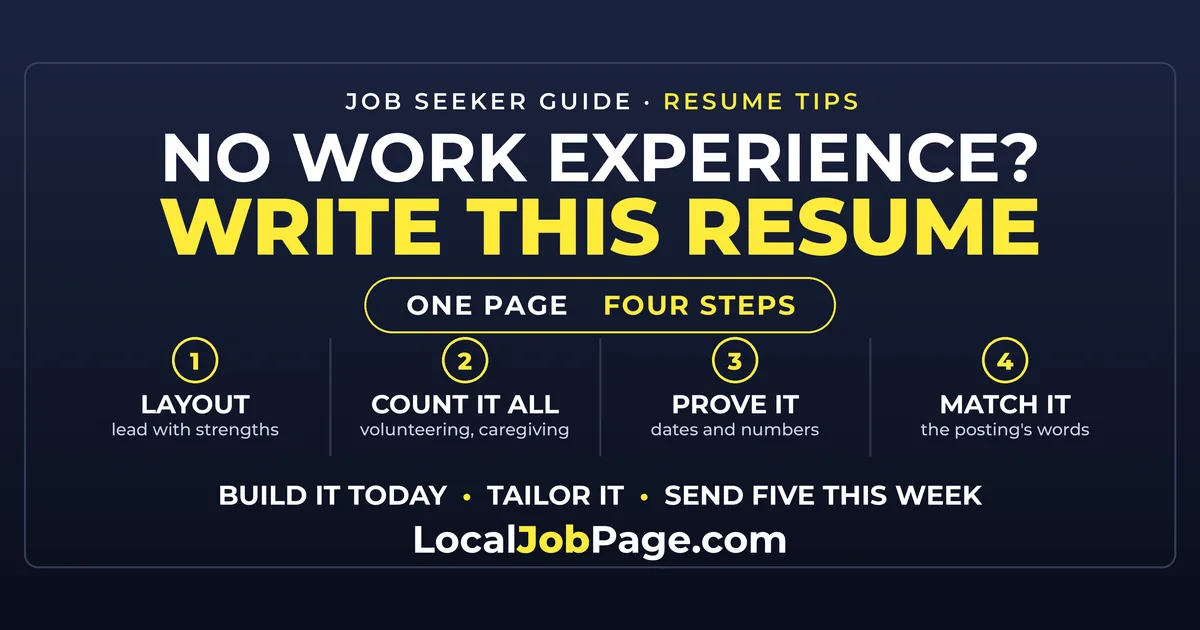
How to Write a Resume With No Work Experience
Published: September 23, 2026 | By LocalJobPage Team
The application asks for a resume, and the Work Experience section is the part you would rather leave blank. So you stall, or you send a page that is mostly your name. Both lose you jobs you could have gotten.
A resume with no work experience is not an empty resume. It is a list of proof that you show up, learn fast, and handle people, and four steps will build one this afternoon.
Just want the openings? Skip straight to the job links and begin searching now →
📊 Why No Experience Is Less of a Wall Than It Looks
Plenty of big occupations do not expect any. The Bureau of Labor Statistics lists the typical work experience needed for each job in its Occupational Outlook Handbook. For retail sales workers, it is none, with no formal educational credential and training on the job lasting from a few days to a few months. Those workers held about 4.3 million jobs in 2025 and earned a median of $17.10 an hour in May 2025.
For hand laborers and material movers, the warehouse and stocking workforce, the entry bar is the same: no credential, no prior experience, short-term training. BLS projects about 904,200 openings a year in that group, on average, from 2025 to 2035. The median was $18.38 an hour in May 2025, meaning half earned less.
For these jobs the resume is not asking what you have done for pay. It is asking whether you will be reliable. That you can prove.
1. Use a Layout That Leads With Strengths
Keep it to one page, in this order:
- Contact line. Name, city and state, phone, and a plain email built from your name. No street address needed.
- Summary. Two lines on what you want and what you bring. Example: "Dependable student seeking a part-time retail role. Comfortable with cash handling, busy weekends and early shifts."
- Skills. Six to eight you can back up: bilingual Spanish, cash handling, Microsoft Excel, forklift-ready, food safety basics, customer service.
- Experience. Unpaid counts. Label the section "Experience," not "Work History," and step 2 fills it.
- Education. School, expected graduation or completion year, and any certificate.
2. Count Everything You Have Actually Done
Employers hiring entry-level staff are screening for habits, and habits show up outside paid work. Each of these can be an entry with a title, an organization and dates:
- Babysitting, pet sitting, lawn care or tutoring for neighbors
- Volunteering at a food bank, shelter, church or school event
- Caring for a family member or running a household
- A sports team, band, club or student government role
- Selling things online, reselling, or a small side business
- A class project with a real deliverable, such as an event or a budget
Caregiving deserves special mention. Scheduling, medication reminders, managing a budget and staying calm under pressure are exactly what a front desk or a pharmacy counter wants.
3. Write Bullets That Prove Reliability
Start each bullet with an action verb and end with a result or a number, even a small one. Compare:
- Weak: "Helped at the food bank."
- Strong: "Sorted and shelved donations for three-hour Saturday shifts over eight months; trained four new volunteers."
- Weak: "Babysat for neighbors."
- Strong: "Provided after-school care for two children, three days a week, for one school year; handled pickup, homework and dinner."
Dates, frequencies and counts do the heavy lifting. "Eight months of Saturdays" says you show up. Only use numbers that are true; an interviewer will ask.
4. Match Each Posting Before You Send It
Read the listing and pull its key words: "cash handling," "stocking," "customer-focused," "able to lift 50 pounds." Where they honestly describe you, use the same words in your skills and bullets. Many large employers run applications through screening software first, and matching language helps a human see yours.
Add an availability line under your summary if the job is shift work: "Available evenings and weekends; reliable transportation." For hourly roles, that line can matter more than anything else on the page.
✅ Before You Send It
- Save as a PDF named with your name, such as Jordan_Lee_Resume.pdf.
- Record a plain voicemail greeting. Recruiters call.
- Read it aloud once. It catches errors spell check misses.
- Line up two references who are not relatives: a teacher, coach, volunteer coordinator or family you babysat for. Ask them first.
🔎 Where to Aim First
Start with roles built for first jobs, where training is on the job and the resume above is exactly what a manager expects to see.
Start here:
- Entry-level jobs
- Jobs that need no experience
- Retail sales associate jobs
- Warehouse associate jobs
- Cashier jobs
- Part time jobs
- Seasonal jobs
- Target jobs
- Walmart jobs
🗺️ Where to Look in Your City
A spread of large markets across the South, Midwest and West, each with its own local listings.
- Entry-level jobs in Houston
- Entry-level jobs in Atlanta
- Entry-level jobs in Memphis
- Entry-level jobs in Indianapolis
- Entry-level jobs in Columbus
- Entry-level jobs in Louisville
- Entry-level jobs in San Antonio
- Entry-level jobs in Phoenix
- Entry-level jobs in Las Vegas
- Entry-level jobs in Charlotte
Not on the list? Find your city.
Questions About a First Resume
Should I leave the Experience section off entirely?
No. Rename it "Experience" and fill it with volunteer work, caregiving, school roles and side jobs. An empty section reads as nothing to offer. A full one reads as someone who shows up.
Is it okay to stretch the truth to fill space?
No. Anything on the page can come up in an interview or a reference call. Honest, specific and short beats inflated every time.
Do I need a cover letter?
For most hourly roles, no, unless the posting asks. If there is a box for one, three sentences work: the job you want, why you fit, and your availability.
Should I list my high school?
Yes, if it is your highest level of education. Once you have a college credential or a certificate, it can come off.
How do I explain a gap?
Briefly and truthfully. "Family caregiver, 2024 to 2026" is a complete answer, and the skills from it belong in your bullets.
🧭 Send Your First Five This Week
A good first resume only works once it is out the door. Build it today, tailor it five times, and apply to five openings this week. Create a free job seeker account or browse every open job.
Employers: first-time applicants are a large pool for trainable roles. Say "no experience needed" in the posting when it is true. Post a job or review pricing.
Related Reading
- Retail Jobs: What They Pay and Which Ones Lead Somewhere
- Restaurant Jobs: What They Pay and How to Move Up
- Warehouse and Logistics Jobs: What They Pay and How to Get Hired
- How to Spot a Job Scam Before You Apply
Nobody's first resume has a first job on it. Yours just has to show the habits that get you one.