Retail Jobs: What They Pay and Which Ones Lead Somewhere
Published: September 21, 2026 | By LocalJobPage Team
RETAIL HIRING — Retail is the easiest large sector in the country to get hired into and one of the hardest to build a career in by accident. Both are true at once, and the federal data says why.
Retail trade employed 15.5 million people in August 2026, but the Bureau of Labor Statistics projects sales occupations to shrink over the next decade. The openings are real. The growth is not. Which job you take inside retail decides which of those facts applies to you.
Need work now? Skip straight to the job links and begin searching now →
📊 The Numbers Behind Retail Hiring
Retail trade employed 15,488,200 people in August 2026, seasonally adjusted, according to the Bureau of Labor Statistics Current Employment Statistics survey. That is one of the largest employers of people without a college degree nationally.
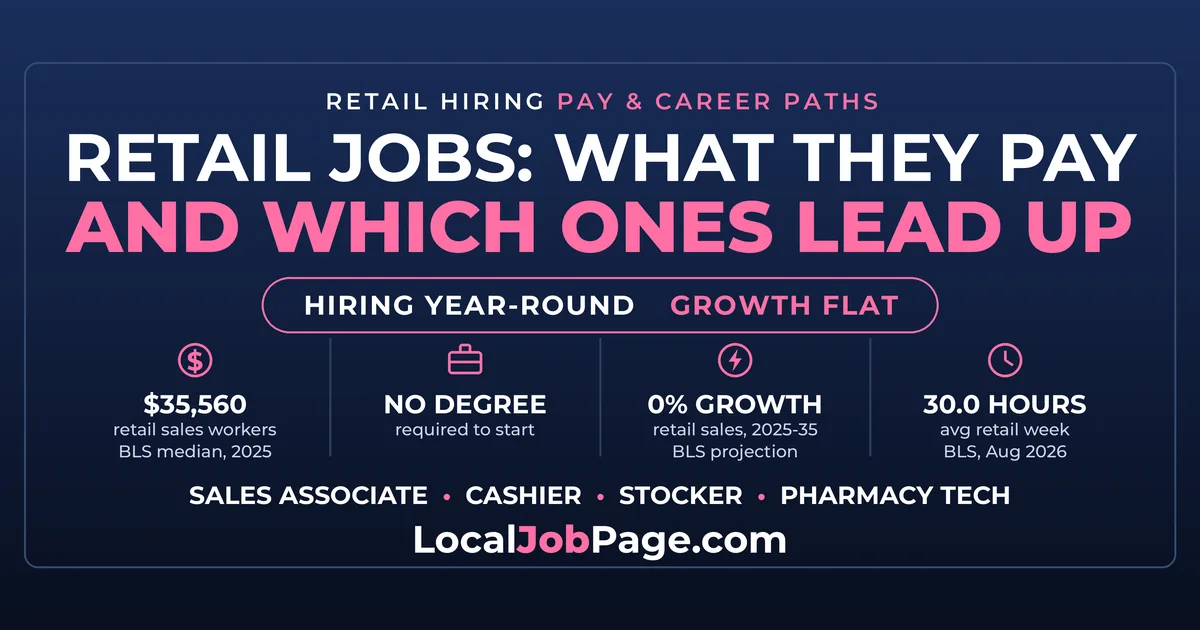
Two figures from that same August 2026 survey matter more to your paycheck than the headline count. Average hourly earnings across all retail trade employees were $26.38, in current dollars and not adjusted for inflation; for production and nonsupervisory employees, the store-floor majority, it was $22.41. And the average retail workweek was 30.0 hours. An hourly rate only becomes an income once you multiply it by the hours you actually get.
The outlook is where retail splits in two. BLS projects employment in sales occupations overall to decline between 2025 and 2035, while still generating roughly 1.7 million openings a year on average across the decade. Those openings come from turnover, not expansion. Projections are a model, not a forecast of next year, but the direction is clear: retail keeps hiring constantly without growing.
💼 The Jobs
Retail salespersons and other retail sales workers. BLS counted 4,271,400 in 2025. The work is customer-facing: greeting shoppers, explaining products, ringing sales, keeping the floor stocked. No formal education requirement, and training usually runs a few days to a few months on the job.
Cashiers. 3,106,300 jobs in 2025, short-term on-the-job training, no credential required. BLS notes part-time work is common and schedules routinely include early mornings, late evenings, weekends and holidays.
Stockers and order fillers. The back-of-house role that keeps the floor full, counted by BLS inside the hand laborers and material movers group. It is the natural bridge between a store job and a warehouse job.
Pharmacy technicians. A retail job most people do not think of as one. BLS counted 471,200 in 2025, many behind the counter at chain drugstores and grocery pharmacies.
Supervisors and store management. The step where retail stops being a job and starts being a career. More on that below.
💵 What It Pays
The figures below are national medians from the May 2025 Occupational Employment and Wage Statistics survey, as published by BLS. A median means half the people in that occupation earned less, so treat these as the middle of the market, not a going rate.
| Occupation | Median pay, 2025 |
| Cashiers | $32,880 a year ($15.81/hr) |
| Retail sales workers (all) | $35,560 a year ($17.10/hr) |
| Retail salespersons | $17.03/hr |
| Stockers and order fillers | $37,330 a year |
| Parts salespersons | $18.57/hr |
| Customer service representatives | $44,770 a year ($21.53/hr) |
| Pharmacy technicians | $45,750 a year ($22.00/hr) |
| Food service managers | $69,390 a year |
The spread inside one occupation is wider than most postings admit. For retail salespersons in 2025, the lowest-paid 10 percent earned under $13.08 an hour and the highest-paid 10 percent over $23.02: about ten dollars an hour between the bottom and the top of the same job title. What you sell explains most of it: commission categories, specialty goods and big-ticket departments sit at the top end.
🎓 Training and Credentials
Most retail work has no educational entry bar at all. BLS lists no formal educational credential for retail sales workers and for cashiers, with training delivered on the job.
The paid credentials in retail are narrow and specific, which is what makes them worth having. Pharmacy technician is the clearest example: BLS lists a high school diploma or equivalent plus moderate-term on-the-job training, and notes most states regulate the role in some way, commonly through a training program, an exam, fees, continuing education, a background check and a minimum age. Licensure is a state question, not a national one, so check your own state board before paying for anything.
🧭 Which Retail Jobs Lead Somewhere
BLS projects three of the largest retail-adjacent occupations to shrink between 2025 and 2035: cashiers by 6 percent, about 200,600 jobs; customer service representatives by 5 percent, about 141,800; and retail sales workers flat at 0 percent, a change of about negative 5,700. Two nearby occupations are projected to grow 6 percent over the same decade: pharmacy technicians, up about 30,100, and food service managers.
That is the map. Aim at the growing squares.
The supervisory step is the other reliable move, and the August 2026 earnings data hints at its size: all retail trade employees averaged $26.38 an hour against $22.41 for production and nonsupervisory staff, a gap of $3.97. Those are two BLS series, not a before-and-after of one promotion, so read it as the shape of the gap rather than a raise you are owed.
Three moves, in order of how fast they pay off: get onto a commission or specialty floor, where the top decile actually lives; ask to be trained on inventory, scheduling or opening and closing, which is what supervisor postings screen for; or step sideways into pharmacy or warehouse work, which hires retail people precisely because they have survived a holiday season.
⚠️ Who Retail Is Not For
Hours are the first filter. A 30.0-hour average workweek in August 2026 means a large share of retail staff are scheduled part time, often below the threshold for employer health coverage. If you need full-time hours and benefits, ask for the guaranteed weekly minimum before you accept, not after.
Schedules are the second. Nights, weekends and holidays are the core of the job, not the exception, and the fourth quarter demands the most coverage. Anyone with fixed childcare hours or a second job should get the availability requirement in writing.
Physical demands are the third. BLS notes retail sales work involves standing for long periods; stocking adds lifting and carrying, and pharmacy roles add a background check and a state application. None of that rules retail out. All of it is better known before you apply.
🔎 Where to Aim Right Now
Stores staff up before the fourth quarter rather than during it, which makes late September the strongest window retail has all year. Search the specific role rather than the word "retail," and search by employer name too, since the big chains post under their own brands.
Start here:
- Retail sales associate jobs
- Cashier jobs
- Stocker and overnight stocking jobs
- Retail store manager jobs
- Assistant store manager jobs
- Pharmacy technician jobs
- Customer service representative jobs
- Visual merchandiser jobs
- Target jobs
- Walmart jobs
🗺️ Where to Look in Your City
Retail employment tracks population and consumer spending, so the largest metros carry the most openings and the widest pay spread within the same job title. These are the biggest consumer markets on the LocalJobPage network.
- Retail jobs in New York
- Retail jobs in Los Angeles
- Retail jobs in Chicago
- Retail jobs in Houston
- Retail jobs in Phoenix
- Retail jobs in Philadelphia
- Retail jobs in San Antonio
- Retail jobs in Dallas
- Retail jobs in Atlanta
- Retail jobs in Miami
Not on the list? Find your city.
Questions People Ask About Retail Jobs
Do you need experience to get a retail job?
No. BLS lists no formal educational credential and no prior work experience as the typical entry requirement for retail sales workers and cashiers. Training happens on the job.
What is the highest-paying entry point in retail?
Of the roles above, pharmacy technician had the highest 2025 median at $45,750 a year, followed by customer service representative at $44,770. Both list a high school diploma or equivalent as typical entry education, and the pharmacy role adds state requirements.
Is retail a shrinking field?
By headcount, parts of it are. BLS projects sales occupations overall to decline between 2025 and 2035, with cashiers down 6 percent and retail sales workers flat. By openings, it is not: roughly 1.7 million sales openings a year are projected on average over that decade, driven by people leaving rather than by new positions.
How many hours will I actually get?
The average retail trade workweek was 30.0 hours in August 2026, per BLS. Individual schedules vary widely, so ask for the guaranteed weekly minimum in the interview rather than assuming full time.
Does retail experience transfer anywhere else?
Yes. Inventory, scheduling, cash handling, loss prevention and de-escalation all map onto warehouse, hospitality, logistics and call-center roles. Put numbers on your resume: transactions handled, shrink reduced, departments covered.
When is the best time to apply?
Now through late October. Stores hire ahead of the fourth quarter, and a seasonal badge in October is the most common route to a permanent retail job in February.
Start Applying This Week
Retail rewards people who apply early and ask specific questions. Create a free job seeker account to save searches and catch new postings as they land: register here, then browse every open job on the site.
Employers: fourth-quarter staffing is decided in September and October, not November. Create an employer account to post openings across the LocalJobPage network, and see pricing for volume hiring.
Related Reading
- Holiday Seasonal Jobs 2026: When to Apply and Where to Look
- Warehouse and Logistics Jobs: What They Pay and How to Get Hired
- Healthcare Jobs Without a Bachelor's Degree
- How to Spot a Job Scam Before You Apply
- Minimum Wage 2027: Which States Have Set Their January 1 Rate
The retail job you can get this week and the retail job worth keeping are rarely the same posting. Take the first one, then spend ninety days finding out which department in the building pays the most, and ask to be trained there.