Legal Jobs: What They Pay and How to Get In Without Law School
LEGAL JOBS — Most of the people who keep a law office running never went to law school. They draft the documents, file them on deadline and take down every word of the deposition. Federal data on those jobs shows a real side door into the field, and a few honest warnings.
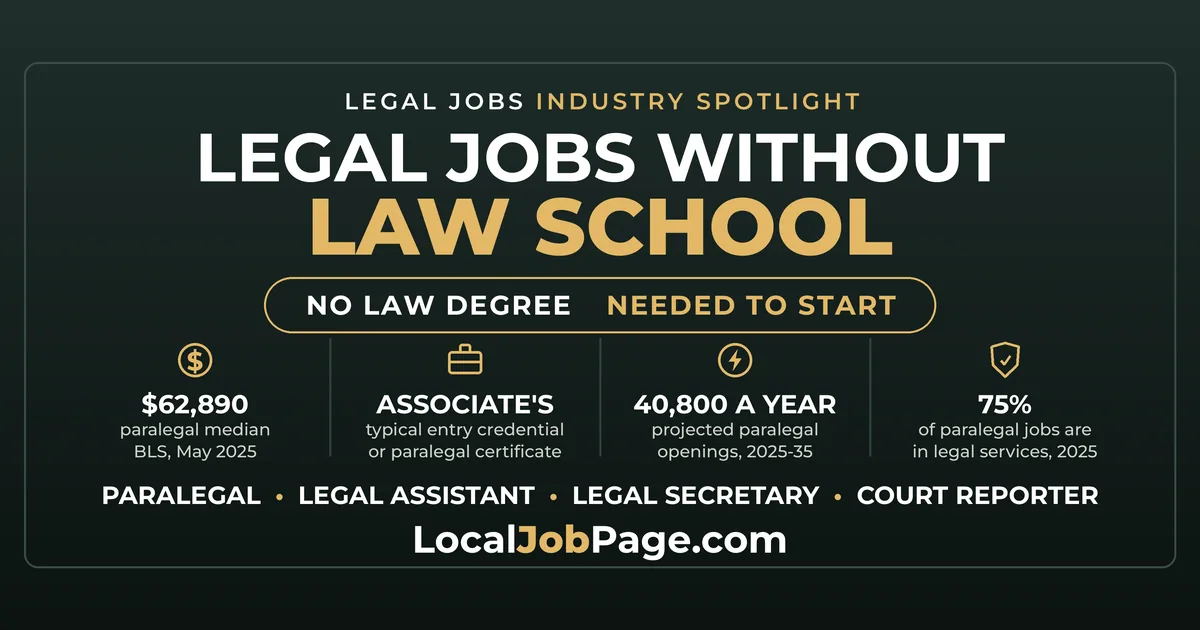
Four of the five legal jobs in this guide need no law degree by the federal government's own entry-level standard, and paralegals alone are projected to see about 40,800 openings a year through 2035 even though the field is not expected to grow.
Need work now? Skip straight to the job links and begin searching now →
Every wage below is a national median annual wage for May 2025 from the U.S. Bureau of Labor Statistics, as published in the Occupational Outlook Handbook updated August 27, 2026. Growth figures are BLS Employment Projections for 2025 to 2035. A median means half the people in that job earned less, and a projection is a ten-year model, not a forecast of next year.
💼 The Jobs
Paralegals and legal assistants are the core of the field and the realistic entry point. BLS counted about 404,900 of them in 2025. The work is investigating case facts, researching laws and regulations, drafting contracts and correspondence, collecting affidavits, filing with courts and agencies, and sitting beside the attorney at trial with the exhibits and the transcript. BLS describes it as fast-paced, deadline-driven office work, mostly full time.
Legal secretaries and administrative assistants run the front of the operation: scheduling, correspondence, document formatting and filing in a vocabulary that general office work does not use. BLS lists a high school diploma as the typical entry-level education and notes that legal secretaries may train for several months to learn the terminology.
Court reporters and simultaneous captioners produce word-for-word transcripts of trials and depositions, or live captions of broadcasts and events for deaf and hard-of-hearing viewers. It is a skills job measured in speed and accuracy, and a third of the people doing it in 2025 were self-employed, according to BLS.
Arbitrators and mediators resolve disputes outside court, and BLS lists a bachelor's degree as the typical way in. Lawyers sit at the top of the pay scale and at the end of the longest path: BLS describes about seven years of full-time study after high school, then a state bar exam.
💵 What Legal Jobs Pay
National median annual wages, May 2025, Bureau of Labor Statistics, with the typical entry-level education BLS assigns each occupation.
| Occupation | Median (May 2025) | Typical entry-level education |
| Lawyers | $159,670 | Doctoral or professional degree |
| Arbitrators, mediators and conciliators | $75,530 | Bachelor's degree |
| Court reporters and simultaneous captioners | $72,420 | Postsecondary nondegree award |
| Paralegals and legal assistants | $62,890 | Associate's degree |
| Legal secretaries and administrative assistants | $55,570 | High school diploma or equivalent |
The spread inside each job is wide. For paralegals, the lowest-paid 10 percent earned less than $44,740 in May 2025 and the highest-paid 10 percent earned more than $101,500. For court reporters, the same range ran from under $42,130 to over $130,560.
Where you work moves the number too. BLS puts the May 2025 paralegal median at $81,470 in the federal government and $80,120 in finance and insurance, against $61,770 in legal services, the industry that employs the most of them. A paralegal title at an insurer, a bank or a federal agency is worth a search.
🎓 Training and Credentials
Paralegal: BLS says the typical route is an associate's degree in paralegal studies or a certificate in paralegal studies. People who already hold a bachelor's degree in another subject, often social science or business, commonly add a paralegal certificate rather than starting over. Some employers prefer a bachelor's degree; others hire on a high school diploma plus experience, and some will hire and train people with no legal background at all. Professional certification is not required nationally, though some employers prefer or require it, and it generally means passing an exam and keeping up continuing education.
One state sets a legal floor. California's Business and Professions Code section 6450 limits who may use the paralegal title there. The routes include a certificate from an American Bar Association-approved program, a certificate or degree from an accredited school that requires at least 24 semester units of law-related courses, or a bachelor's degree plus a year of law-related work under a qualified attorney who signs a declaration. Working paralegals in California must also complete eight hours of continuing legal education every two years, four of them in legal ethics. Elsewhere, check your state bar or court rules rather than assuming the California rules apply.
Court reporter: BLS says programs typically take two to three years at community colleges and technical institutes, as either a certificate or an associate's degree. Many states require a state license or a certification from a professional association, usually a written test plus a skills test of speed and accuracy. Your state's licensing board is the authority on which one you need.
Legal secretary: a high school diploma plus several months of training on the terminology, by BLS's description.
🔥 Who's Hiring
Law firms dominate. In 2025, BLS reports, legal services employed 75 percent of paralegals and legal assistants, with local government at 5 percent, the federal government at 4 percent, state government at 3 percent and finance and insurance at 3 percent.
Court reporting looks different. Self-employed reporters held 33 percent of those jobs, local government 24 percent, state government 20 percent and business support services 19 percent. In practice: courthouses, public agencies and the deposition firms that contract with attorneys.
⚠️ Who This Field Is Not For
Anyone counting on growth. BLS projects little or no change in paralegal employment from 2025 to 2035, flat employment for court reporters, and a 5 percent decline for legal secretaries. The openings are real, about 40,800 a year for paralegals and 1,800 for court reporters, but BLS says most come from replacing people who retire or change careers.
Anyone hoping technology passes it by. BLS names advances in technology, including artificial intelligence, as a limit on paralegal demand, because the tools make research and document preparation faster. The practical answer is to be the person in the office who runs those tools well.
Anyone planning to skip the bar. In general, only a licensed lawyer can give legal advice or represent a client. A paralegal certificate is a career in itself, not a shortcut to practicing law.
🔎 Search Legal Jobs Now
- Paralegal jobs
- Legal assistant jobs
- Litigation paralegal jobs
- Legal secretary jobs
- Court reporter jobs
- Court clerk jobs
- Legal receptionist jobs
- LegalZoom jobs
Search the exact title. Legal postings are written in role language, and "paralegal" and "legal assistant" are often used for the same job.
🗺️ Where to Look in Your City
Legal jobs follow courts, agencies and law firms, so these are large metros on the network plus the federal capital and two state capitals, where government legal work concentrates.
- Paralegal jobs in Washington, D.C.
- Paralegal jobs in New York
- Paralegal jobs in Los Angeles
- Paralegal jobs in Chicago
- Paralegal jobs in Houston
- Paralegal jobs in Dallas
- Paralegal jobs in Philadelphia
- Paralegal jobs in Boston
- Paralegal jobs in Miami
- Paralegal jobs in Atlanta
- Paralegal jobs in Sacramento
- Paralegal jobs in Austin
Not on the list? Find your city.
Frequently Asked Questions
Can you become a paralegal without a degree?
Sometimes. BLS says some employers accept a high school diploma plus experience, and some hire people with no legal background and train them. The more common route is an associate's degree or a certificate in paralegal studies. California sets its own minimum qualifications for anyone using the paralegal title.
How much do paralegals make?
The national median was $62,890 a year, or $30.24 an hour, in May 2025, according to BLS. Federal government and finance and insurance jobs posted higher medians than legal services, where most paralegals work.
What is the difference between a paralegal and a legal secretary?
Paralegals do substantive legal work: research, drafting and case preparation. Legal secretaries handle the administrative side. BLS lists an associate's degree as typical for paralegals and a high school diploma for legal secretaries, and the May 2025 medians were $62,890 and $55,570.
How long does court reporting school take?
Typically two to three years, according to BLS, through a certificate or associate's program. Many states also require a license or a professional certification that tests transcription speed and accuracy.
Will AI replace paralegals?
BLS does not project the job disappearing. It projects little or no change in employment through 2035, with about 40,800 openings a year, and names technology including AI as one reason growth will be limited.
🧭 Your Next Step This Week
Pick the role that matches the time you can invest: legal secretary now, a paralegal certificate or associate's degree next, or court reporting at two to three years. Then read ten real postings for that exact title and note what they ask for.
Create a free LocalJobPage account to save searches and catch new legal postings, or browse every open job on the board.
Employers: law firms, title companies and legal departments can post openings as an employer. See pricing.
Related Reading
- Customer Service and Office Jobs: What They Pay and How to Get Hired
- Insurance Jobs: What They Pay and How to Get Licensed
- How to Write a Cover Letter That Gets Read
- How to Write a Resume With No Work Experience
The law office side door is real, and it is open mostly through turnover rather than growth. Pick a title, earn the credential it asks for, and apply where the paralegal median runs highest.