How to Write a Cover Letter That Gets Read
You found a posting you actually want, and the application has a box marked "Cover letter (optional)." Most people either skip it or paste in a generic letter that could go to any employer. Both choices waste the one place where you get to explain, in your own words, why you fit this job.
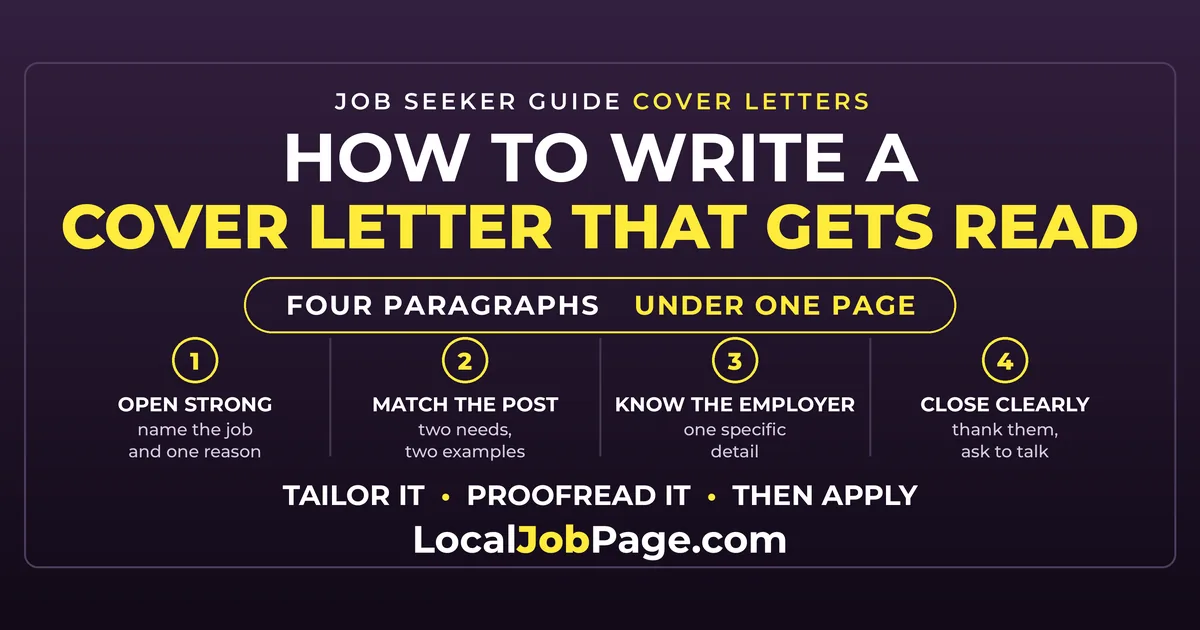
A strong cover letter is four short paragraphs, under one page, written for one specific job, and this guide walks through each one with an example you can adapt.
Ready to go? Skip straight to the job links and begin searching now →
When a Cover Letter Matters and When You Can Skip It
Not every job needs one. A quick-apply form for a seasonal warehouse or retail role often has no place to attach a letter, and nobody grades you for leaving it out.
Write one when any of these is true:
- The posting asks for it. Skipping a required letter can get you screened out before anyone reads the resume.
- The job is in an office, a school, a hospital front desk, a bank, a nonprofit or government, where written communication is part of the work.
- You are changing fields, coming back after a gap, or your resume doesn't explain itself on its own.
- You were referred by someone, and the letter is where you name them.
If the box says optional and you want the job, write it. It is the cheapest way to stand out.
Step 1: Open With the Job and One Real Reason
Skip "To Whom It May Concern" and skip "I am writing to express my interest." Address a person by name if the posting or the company site gives you one; "Dear Hiring Manager" is fine if it doesn't. Then say which job you are applying for and give one concrete reason you fit it.
Weak: "I am a hardworking team player who would be a great fit for your company."
Better: "I'm applying for the Front Desk Coordinator role at Riverside Family Clinic. For the past two years I've checked in about 60 patients a day at an urgent care, and I'd like to bring that pace to a practice where I can get to know the people coming through the door."
The better version names the job, gives a number, and says why this employer.
Step 2: Match Two Things They Asked For
Reread the posting and pick the two requirements that matter most, usually the ones listed first or repeated. Answer each with a short example: what you did, and what happened because you did it.
If the posting asks for "experience with scheduling software and strong customer service," a matching paragraph might read: "At my current job I manage the schedule for four providers in our booking system and handle reschedules when someone calls out. When we switched systems last spring, I trained the two newer front desk staff on it in their first week."
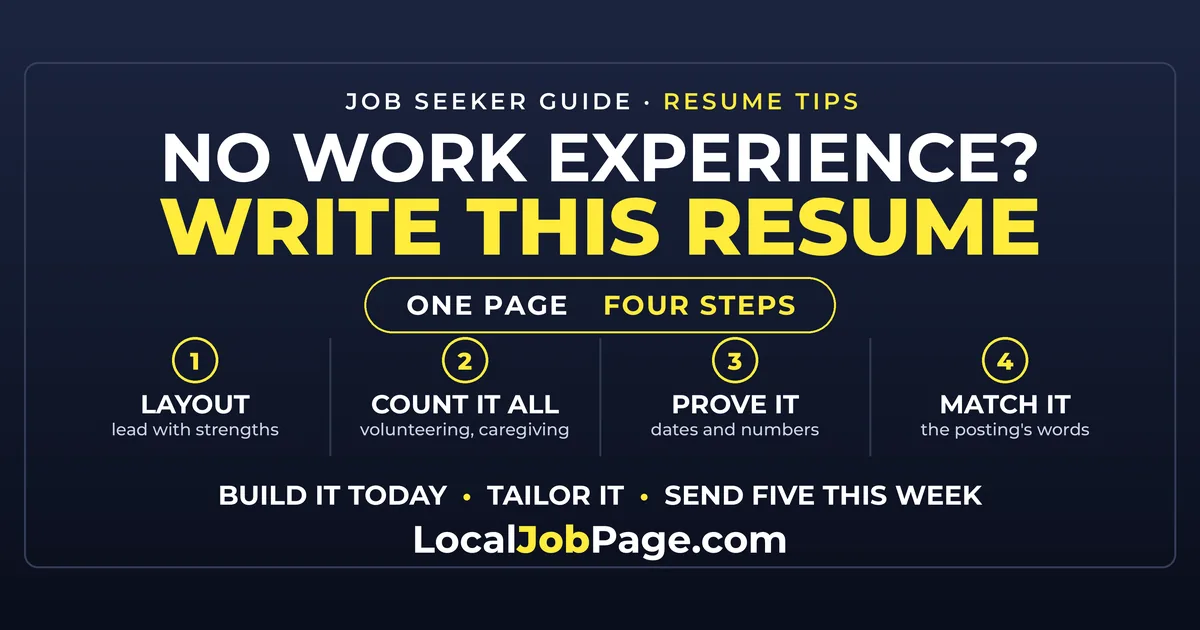
No experience in the field yet? Pull from school, volunteering, a family business, sports or a part-time job. Running a register, covering shifts and handling an upset customer are real examples. Our guide to writing a resume with no work experience has more ways to find them.
Step 3: Show You Know Who They Are
One or two sentences should prove you looked at the employer itself: a location that just opened, the people they serve, a program on their careers page. Flattery reads as filler; a specific detail reads as interest.
This is also where a gap or career change gets one plain sentence: "I stepped away from work in 2024 to care for a family member and am ready to return full-time."
Step 4: Close With a Clear Next Step
End by thanking them, restating your interest in one line, and saying how to reach you. "Thank you for considering my application. I'd welcome the chance to talk about the role, and I'm available by phone or email at the contact details above." Then sign off with your full name.
Before you send it, check the basics that sink otherwise good letters:
- The company name and job title are correct. A letter addressed to the wrong employer is an easy mistake when you reuse a draft.
- It fits on one page, with room to spare.
- It is a PDF with your name in the file name, unless the posting asks otherwise.
- You read it out loud once. Missing words are easier to hear than to see.
🚩 Mistakes That Get a Letter Skipped
Repeating the resume line by line. Talking only about what the job does for you, like pay or commute. Paragraphs too long to skim. And a letter written by a tool and never edited, which sounds like everyone else's.
🔎 Search Jobs Where a Cover Letter Counts
- Administrative assistant jobs
- Receptionist jobs
- Medical receptionist jobs
- Office manager jobs
- Customer service jobs
- Bank teller jobs
- Marketing coordinator jobs
- Bank of America jobs
Or browse every open job and filter from there.
🗺️ Where to Look in Your City
These are the largest job markets on the LocalJobPage network, each with its own local listings.
- Administrative assistant jobs in New York
- Administrative assistant jobs in Los Angeles
- Administrative assistant jobs in Chicago
- Administrative assistant jobs in Houston
- Administrative assistant jobs in Dallas
- Administrative assistant jobs in Phoenix
- Administrative assistant jobs in Philadelphia
- Administrative assistant jobs in Atlanta
- Administrative assistant jobs in Washington, D.C.
- Administrative assistant jobs in Boston
- Administrative assistant jobs in Seattle
- Administrative assistant jobs in Denver
Not on the list? Find your city.
Frequently Asked Questions
How long should a cover letter be?
Three to four short paragraphs, comfortably under one page. A tight letter is more likely to be read to the end.
Do I need a cover letter for an hourly job?
Usually not for quick-apply retail, warehouse or restaurant roles. Write one if the posting asks, if there is a place to attach it, or if you need to explain a gap or a change in direction.
Can I use the same cover letter for every job?
You can reuse the structure and some sentences, but the opening, the two matched requirements and the employer detail should change every time. Always double-check the company name before you send.
Who do I address it to if no name is listed?
"Dear Hiring Manager" is standard and safe. If the posting names a recruiter or a department head, use that person's name.
Should I mention pay in a cover letter?
Only if the posting asks you to. Otherwise, save pay for the conversation after an offer, when you have more room to negotiate.
Send a Letter That Sounds Like You
Pick one job you want this week, write the four paragraphs, and apply. Create a free LocalJobPage account and start applying.
Employers: reach candidates who write for the job, not just click apply. Post your openings on LocalJobPage.
Related Reading
- How to Write a Resume With No Work Experience
- Common Job Interview Questions and How to Answer Them
- How to Negotiate a Job Offer, Even for an Hourly Job
- How to Spot a Job Scam Before You Apply
The best cover letter isn't the longest or the most polished. It's the one that makes a hiring manager think you read their posting and wrote back.