Common Job Interview Questions and How to Answer Them
You got the interview. Now someone is going to ask "So, tell me about yourself," and the first thirty seconds of your answer will shape the rest of the conversation. Most job interview questions are not trick questions. They are the same dozen or so in slightly different words, and every one can be prepared the night before.
Here are the common job interview questions hiring managers actually ask, what each one is really testing, and sample answers you can adapt for retail, warehouse and customer service jobs.
Ready to go? Skip straight to the job links and begin searching now →
1. "Tell Me About Yourself"
This is not a request for your life story. Give a short pitch in three parts: what you do now, one thing you've done that fits this role, and why you want it.
Example for a retail cashier job: "I've worked weekends at a grocery store for a year, mostly on the register. I've learned to stay calm when the line is ten people deep. I want more hours somewhere I can move up to key holder, which is why this opening caught my eye."
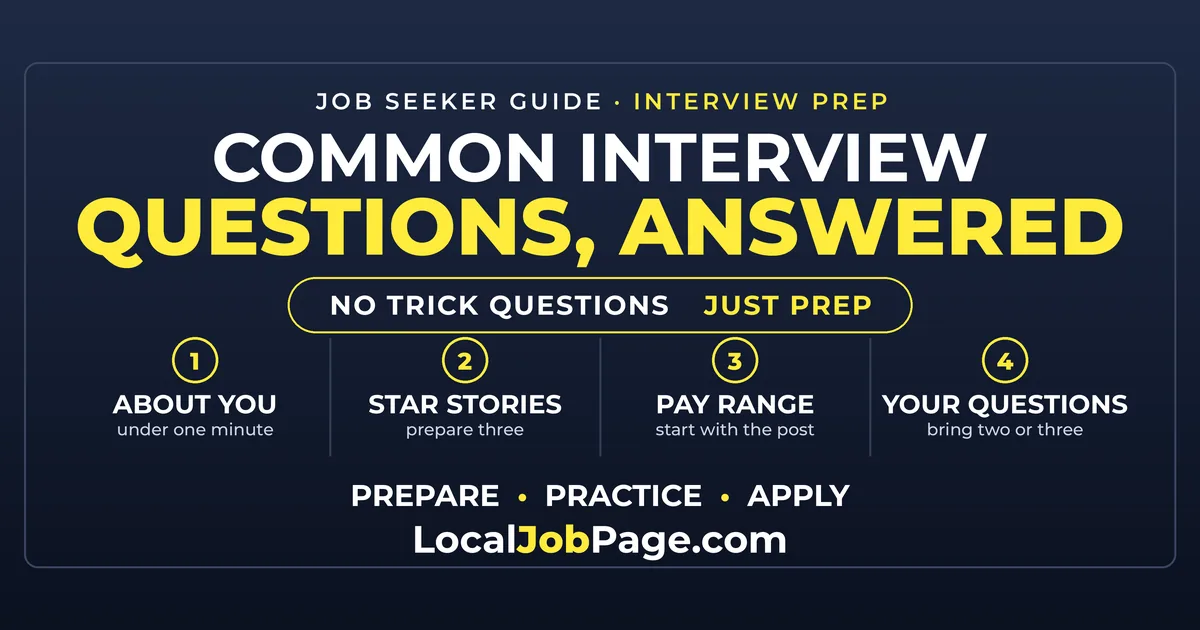
Keep it under a minute. No work experience? Use school, volunteering, sports or caring for family.
2. "Why Do You Want to Work Here?"
Generic answers ("it's a great company") lose ground. Spend ten minutes on the employer's website and find one real detail, like a training program or a promote-from-within policy. Then tie it to you.
Example: "I read that your warehouse leads mostly come up from the associate level, and that's the path I want."
3. "What Is Your Greatest Strength?" and "What Is Your Biggest Weakness?"
For strengths, pick one that matters for the job and back it up. "I'm reliable" means little. "I didn't miss a shift in eighteen months" means a lot.
For weaknesses, name a real one that won't disqualify you, then say what you're doing about it. Skip the fake weakness ("I work too hard").
Example: "I was slow with spreadsheets, so I took a free online Excel course this summer."
4. "Tell Me About a Time You Handled a Difficult Situation"
Any question starting "tell me about a time" is a behavioral question. Answer with the STAR method:
- Situation: where you were and what was going on.
- Task: what you were responsible for.
- Action: what you did, specifically. Say "I," not "we."
- Result: how it turned out, with a number if you have one.
Example for a customer service job: "A customer's online order shipped to the wrong store (situation). I was alone at the service desk (task). I found the order, arranged a transfer for the next morning and added a discount code (action). She came back and asked for me by name (result)."
Prepare three STAR stories before any interview: a conflict, a mistake you fixed, and a time you went beyond the job. One of them will fit most behavioral questions.
5. "Why Are You Leaving Your Current Job?" and the Gap Question
Stay positive, brief and forward-looking. "I want full-time hours and a path to supervisor" works. Criticizing a past boss never does.
For a gap in your work history, say what happened in one sentence and move on: caregiving, school, a layoff. You don't owe details. The interviewer wants to hear that you're ready now.
6. "What Are Your Pay Expectations?"
Know the range before you walk in, starting with the job post. Several states, including California, Colorado, Illinois, New York and Washington, require many employers to list pay in job ads, and when a range is posted, it is your anchor. Give a range of your own whose bottom is a number you'd accept.
Example: "Based on the posting and what similar roles pay around here, I'm looking for $18 to $20 an hour. I'm flexible depending on the schedule and benefits."
⚠️ Questions an Employer Should Not Ask
The U.S. Equal Employment Opportunity Commission says pre-employment questions should be limited to what's needed to judge whether you can do the job. Federal law, which generally covers employers with 15 or more employees (20 or more for age), bars hiring decisions based on race, color, religion, sex, national origin, age (40 or older), disability or genetic information. The EEOC's guidance says employers are explicitly barred from asking about disability before making a job offer.
If you're asked "Are you planning to have kids?" or "How old are you?", steer back to the job: "Nothing in my personal life would keep me from meeting this schedule." State laws can add protections, so check your state labor department if something felt wrong.
7. "Do You Have Any Questions for Us?"
Always say yes. No questions reads as no interest. Two or three are plenty:
- "What does a typical shift or day look like in this role?"
- "What do people in this job usually move into next?"
- "What are the next steps, and when should I expect to hear back?"
🔎 Put It to Work: Find Your Next Interview
Practice works best with a real job post in front of you. Pull up two or three openings and match a STAR story to each listed duty.
Start here:
- Entry-level jobs
- Customer service jobs
- Retail associate jobs
- Warehouse associate jobs
- Administrative assistant jobs
- Medical assistant jobs
- Part-time jobs
- Amazon jobs
- Target jobs
🗺️ Where to Look in Your City
Our city sites list openings near you. Here is a spread across every region of the network:
- Entry-level jobs in New York
- Entry-level jobs in Philadelphia
- Entry-level jobs in Atlanta
- Entry-level jobs in Chicago
- Entry-level jobs in Houston
- Entry-level jobs in Denver
- Entry-level jobs in Phoenix
- Entry-level jobs in Seattle
Not on the list? Find your city.
FAQ
How long should my answers be?
One to two minutes for behavioral questions, under a minute for "tell me about yourself." If you're running long, state your result and stop.
What should I wear to a job interview?
Dress one step above what people wear in the job itself. For warehouse or retail, clean slacks and a collared shirt or neat top work. For an office role, business casual is safe.
How should I prepare for a video interview?
Test your camera, microphone and link the day before. Face a window or lamp, put the camera at eye level and log in five minutes early.
Should I send a thank-you note after an interview?
Yes. A short same-day email that mentions one thing you discussed keeps your name in front of them.
Line Up Your Next Interview
Create your job seeker account and keep the search going. Sign up here, or browse all jobs now.
Employers: Reach candidates who are preparing to interview right now. Post a job on LocalJobPage.
Related Reading
- How to Write a Resume With No Work Experience
- How to Spot a Job Scam Before You Apply
- Customer Service and Office Jobs: What They Pay and How to Get Hired
- Retail Jobs: What They Pay and Which Ones Lead Somewhere
Prepare three stories, know your number, and bring two questions of your own. That covers most of what any interviewer will throw at you.