Customer Service and Office Jobs: What They Pay and How to Get Hired
OFFICE & CUSTOMER SERVICE — Customer service jobs are one of the few doors in the U.S. job market that open with a high school diploma, a few weeks of on-the-job training and no prior experience. They are also a field the Bureau of Labor Statistics expects to shrink, and both of those things are true at once.
Six office and customer service occupations pay national medians between $38,010 and $53,040 a year, and BLS projects they will add up to more than 1.1 million openings a year through 2035, even though five of the six are expected to shrink.
Just want the openings? Skip straight to the job links and begin searching now →
💼 The Jobs
Six occupations cover much of the entry-level office market. All figures below come from the Bureau of Labor Statistics Occupational Outlook Handbook.
Customer service representatives answer questions, take orders, fix account problems and handle complaints by phone, email, chat and social media. BLS counted 2,666,000 of these jobs in 2025, making it one of the largest occupations in the country. Retail employs 15 percent of them and insurance carriers 12 percent.
Receptionists run the front desk: greeting visitors, answering phones, scheduling and checking people in. Healthcare and social assistance employs 42 percent of the 947,500 receptionists BLS counted in 2025, so for most people this is a clinic or medical office job.
Secretaries and administrative assistants handle scheduling, documents, records and the phones for a team or an executive. At 3,515,600 jobs, this is the biggest occupation on the list, and healthcare employs 32 percent of it.
General office clerks do a bit of everything: filing, data entry, answering phones, sorting mail. BLS counted 2.6 million of these jobs in 2025.
Bookkeeping, accounting and auditing clerks record transactions, reconcile accounts and produce financial reports, mostly in accounting software.
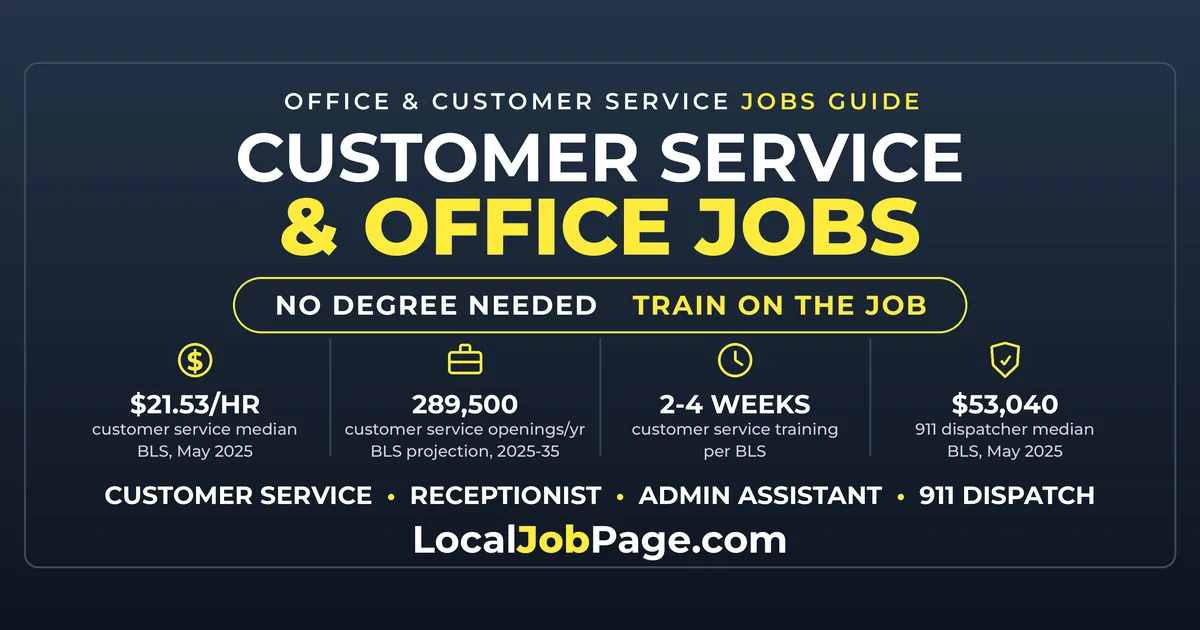
Public safety telecommunicators are 911 and emergency dispatchers. They take calls, work out what is happening and send police, fire or ambulance crews. It is the smallest group here, with 105,600 jobs, and the only one BLS expects to grow.
💵 What It Pays
These are national medians for May 2025, from BLS; the openings column is BLS's projected annual average for 2025–35, and the 1.1 million figure above is the sum of those six rows. A median is the midpoint: half the people in the job earned less, half earned more. For comparison, the median for all occupations was $50,980.
| Occupation | Median pay, May 2025 | Projected change, 2025–35 | Openings per year |
| Public safety telecommunicators | $53,040 ($25.50/hr) | +4% | about 9,000 |
| Bookkeeping, accounting and auditing clerks | $50,670 ($24.36/hr) | −6% | about 144,100 |
| Secretaries and administrative assistants | $48,310 ($23.23/hr) | −2% | about 314,400 |
| General office clerks | $45,010 ($21.64/hr) | −6% | about 249,000 |
| Customer service representatives | $44,770 ($21.53/hr) | −5% | about 289,500 |
| Receptionists | $38,010 ($18.27/hr) | −2% | about 105,100 |
The spread inside each job is wide. For customer service representatives, BLS reports the lowest-paid 10 percent earned under $15.27 an hour and the highest-paid 10 percent more than $30.57. The industry you work in explains a lot of that gap: the median was $23.41 an hour in wholesale trade and $22.47 at insurance carriers, against $17.96 in retail and $17.68 in business support services, the industry that includes outsourced call centers.
The same pattern shows up among assistants. Executive secretaries and executive administrative assistants had a median of $76,590 in May 2025, legal secretaries $55,570, and medical secretaries $45,930.
📊 Why the Openings Outnumber the Decline
BLS projects employment of customer service representatives to fall 5 percent over the 2025–35 decade, a loss of 141,800 jobs. Its explanation is plain: self-service systems, social media and mobile apps let customers handle simple tasks on their own, and automated systems will gradually take on more.
That same projection still calls for about 289,500 customer service openings every year. None of them come from growth. They come from people moving into other jobs or leaving the workforce, which happens constantly in a field this large. The work that stays with people is the harder work, which BLS describes as complex inquiries like refunding accounts or confirming insurance coverage.
For a job seeker, that means plenty of openings, and the better-paid ones will go to people who can handle the calls a chatbot can't: billing disputes, claims, benefits questions, angry customers.
🎓 Training and Credentials
This is the field's real selling point. Five of the six occupations list a high school diploma as the typical entry education, and most training happens on the job, on the clock.
- Customer service: BLS says training typically lasts 2 to 4 weeks and covers the company's products, procedures and phone and computer systems. Finance and insurance roles can take several months, and some representatives in those industries need a state license, which usually means passing an exam. Requirements vary by state.
- Receptionists and office clerks: short-term on-the-job training, about a month or less.
- Administrative assistants: several weeks of on-the-job training, with additional months for medical and legal roles to learn the terminology.
- Bookkeeping clerks: BLS lists some college, no degree, as the typical entry level. Optional professional certification can help show you know the work.
- 911 dispatchers: the most regulated of the group. BLS says many states and localities require certification, and standards vary widely: some states require 40 or more hours of training, others require continuing education every 2 to 3 years, and some mandate nothing specific. Check your own state's requirements before you apply.
The skills that get people hired are the ones BLS lists for customer service: communication, listening, patience and problem-solving.
🔥 Who's Hiring
Healthcare is the biggest employer of front-desk and assistant work. It employs 42 percent of receptionists and 32 percent of secretaries and administrative assistants, so much of the front-desk work in this field is in clinics, hospitals and medical offices. Insurance carriers and wholesalers pay customer service reps above the occupation's median. Retail is the largest single employer of reps, at lower pay. For office clerks, schools employ 14 percent, and construction firms and government 10 percent each. Emergency dispatch centers are run by cities, counties and states.
⚠️ Who This Field Is Not For
- Anyone who needs a fixed weekday schedule. BLS says many customer service reps work evenings, weekends and holidays, and dispatchers work 8- to 12-hour shifts around the clock.
- Anyone counting on remote work. BLS says some customer service jobs can be done from home, but call-center and in-store roles remain common. Be wary of any "work from home" listing that sends you a check to deposit or asks you to buy equipment before you start. That is a scam pattern, not a job.
- Anyone who can't clear screening for dispatch. Candidates may face a background check, a lie detector test, drug tests and hearing and vision tests, per BLS.
- Anyone who drains fast on conflict. Handling complaints is the job, not a side part of it.
🔎 Where to Aim Right Now
Search several titles, not one. The same front desk job is a receptionist, a patient access representative or a front office coordinator depending on the employer, and customer service work hides under support, care and member services titles.
Start here:
- Customer service representative jobs
- Call center jobs
- Medical receptionist jobs
- Receptionist jobs
- Administrative assistant jobs
- Office clerk jobs
- Bookkeeper jobs
- 911 dispatcher jobs
- Amazon customer service jobs
🗺️ Where to Look in Your City
These network cities are regional hubs for insurance, banking, healthcare and shared-service operations, the employers that run large in-house service and office teams.
- Customer service jobs in Jacksonville
- Customer service jobs in Tampa
- Customer service jobs in Columbus
- Customer service jobs in Omaha
- Customer service jobs in San Antonio
- Customer service jobs in Louisville
- Customer service jobs in Charlotte
- Customer service jobs in Phoenix
- Customer service jobs in Dallas
- Customer service jobs in Kansas City
Not on the list? Find your city.
Frequently Asked Questions
How much do customer service jobs pay?
The national median for customer service representatives was $44,770 a year, or $21.53 an hour, in May 2025, according to BLS. Insurance and wholesale employers paid more than retailers and outsourced call centers.
Do I need a degree to work in customer service or an office?
No. BLS lists a high school diploma or equivalent as the typical entry education for customer service reps, receptionists, administrative assistants, office clerks and 911 dispatchers. Bookkeeping clerks typically have some college.
Is customer service a dying field?
It is shrinking, not disappearing. BLS projects a 5 percent decline from 2025 to 2035 but still expects about 289,500 openings a year from people leaving the job. The complex calls stay with people.
Which office job pays the most without a degree?
Among these six, 911 dispatchers had the highest median at $53,040 in May 2025. Executive secretaries and executive administrative assistants earned more, a $76,590 median, but that is one specialty within the assistant occupation, not a separate entry-level job.
How long does training take?
For most customer service jobs, 2 to 4 weeks on the job, per BLS. Insurance and financial roles can take several months and may require a state license. Dispatch training depends on your state.
Start Your Office Job Search
Create a free LocalJobPage account to save searches and set alerts, or browse all jobs open now.
Employers: Hiring for the front desk or the phones? Post your openings on LocalJobPage and reach candidates in all 50 network cities. See pricing.
Related Reading
- Healthcare Jobs Without a Bachelor's Degree: What They Pay and How Long Training Takes
- Banking Jobs: What They Pay and How to Get In Without a Degree
- Remote Jobs in 2026: Who Actually Works From Home and What They Pay
- How to Write a Resume With No Work Experience
- How to Spot a Job Scam Before You Apply
If you want an office job without a degree, aim for the desk a machine can't replace: a medical front office, an insurance service team or a 911 center, where the calls are harder and the pay is higher.