Banking Jobs: What They Pay and How to Get In Without a Degree
Published: September 26, 2026 | By LocalJobPage Team
BANKING HIRING — Bank of America said on September 24 that it plans to hire 1,000 additional apprentices over the next two years, part of a push toward careers that do not require a bachelor's degree. It is a useful moment to look at banking jobs as a whole: what they pay, which ones you can walk into with a high school diploma, and which ones are shrinking.
Banking still hires tens of thousands of people a year without a degree, but the entry point is moving from the teller window to the phone, the back office and formal training programs.
Just want the openings? Skip straight to the job links and begin searching now →
🔥 What Bank of America Announced
In a September 24 release, the Charlotte-based bank said it plans to hire 1,000 additional apprentices over two years. Those come on top of the more than 800 apprentices it says it already hires each year across Consumer Banking, Technology, Operations and other business areas. The bank described the programs as paid, work-based learning for people entering through nontraditional pathways.
Three other numbers from the same release matter to a job seeker. The bank said about 40 percent of its current hires do not hold a bachelor's degree. It said it pays a minimum of at least $50,000 a year. And it committed $150 million over five years to workforce development organizations, on top of existing pledges to hire 10,000 more people with military backgrounds over five years and 8,000 people from community colleges.
What the release does not include: a list of cities, a per-role pay rate or an application deadline. The bank said it will expand existing programs and explore new roles. Treat it as a signal to watch the company's careers site, not as 1,000 openings posted today.
💼 The Jobs
Most banking jobs a newcomer can get fall into five groups. The pay figures below are national medians from the Bureau of Labor Statistics for May 2025. A median is the midpoint, so half the people in each job earned less.
Tellers. The classic starting job: cash deposits and withdrawals, cashing checks, verifying identity, balancing a drawer at the end of the shift. BLS counted 339,200 teller jobs in 2025, 96 percent of them in banks, credit unions and related lenders.
Loan interviewers and clerks, and new accounts clerks. The paperwork side of lending and account opening: collecting applicant information, checking documents, and moving files to the people who make the decision.
Customer service representatives. Banks run large call centers for card, account and fraud questions. BLS counted 2,666,000 customer service jobs across all industries in 2025, so this is the broadest door into financial services, even though most of those jobs are outside banking.
Loan officers. They evaluate and approve loans for people and businesses. BLS counted 283,000 jobs in 2025, 80 percent of them in banks, credit unions, mortgage lenders and similar firms.
Financial managers. This is the BLS group that includes bank management. It typically asks for a bachelor's degree and five or more years of related experience, so it is where a banking career can lead, not where it starts.
💵 What Banking Jobs Pay
| Job | Median pay, May 2025 | Typical entry education |
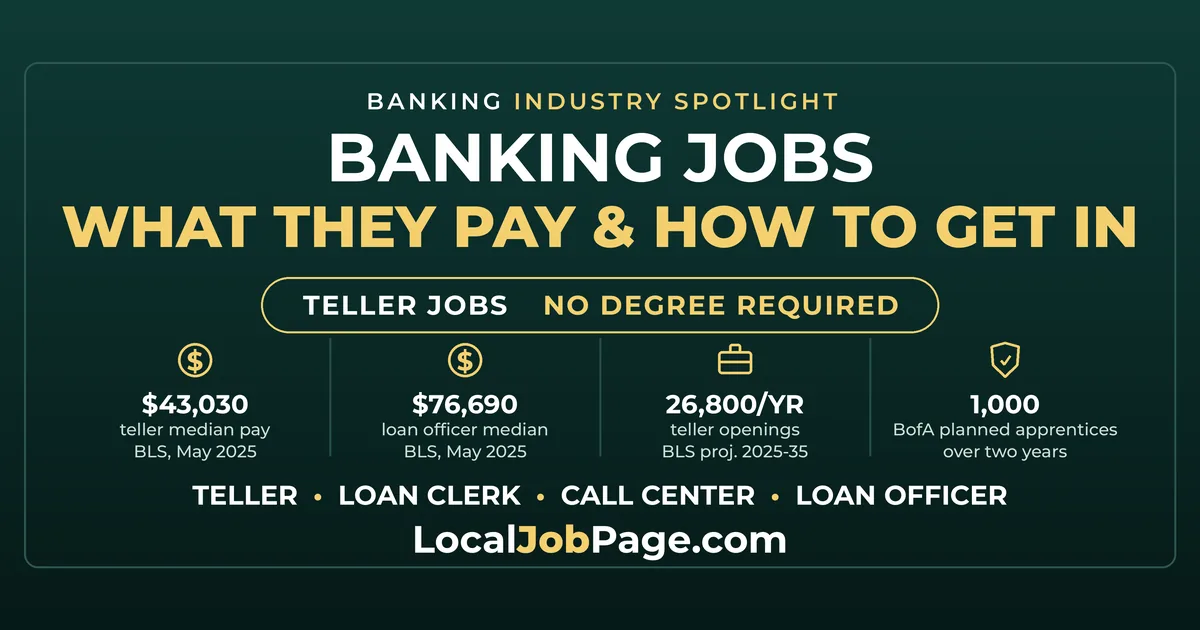
| Teller | $43,030 ($20.69/hr) | High school diploma |
| Customer service representative | $44,770 ($21.53/hr) | High school diploma |
| New accounts clerk | $47,670 | High school diploma |
| Loan interviewer and clerk | $50,020 | High school diploma |
| Loan officer | $76,690 ($36.87/hr) | Bachelor's degree |
| Financial manager | $166,570 | Bachelor's degree plus experience |
For comparison, the median across all occupations was $50,980 in May 2025. Teller pay is fairly tight: the lowest-paid 10 percent earned less than $34,360 and the top 10 percent more than $49,680. Loan officer pay varies more by employer, because some are paid on commission and many earn bonuses tied to the loans they close.
Bank of America's stated floor of at least $50,000 a year sits above the national teller median. That is one company's policy, not a banking-wide rate. Check the pay on each posting.
🎓 Training and Credentials
This is where banking differs from most white-collar fields: the entry jobs are trained on the job, not in school.
- Tellers need a high school diploma or equivalent. A head teller or experienced teller trains new hires on balancing a cash drawer, verifying signatures and the bank's own systems. BLS classifies the training as short term.
- Customer service and financial clerk roles also start from a high school diploma with on-the-job training.
- Mortgage loan officers go through the Nationwide Multistate Licensing System (NMLS). BLS describes prelicensing coursework, a national exam and a background check. Requirements vary by state and type of employer, so check the rules where you would work.
- Apprenticeships are paid from day one. That is the draw of programs like Bank of America's: you earn while you train, and the employer decides what credential it needs.
The path up is real. BLS notes that experienced tellers can move to head teller or supervisor, and some advance to loan officer or into sales roles at the bank. Those later jobs often expect a degree, but in-house experience can count for a lot.
⚠️ Who Banking Is Not For
Be clear-eyed about the teller job itself. BLS projects teller employment to fall 13 percent from 2025 to 2035, a loss of about 44,700 jobs, as mobile deposits, smarter ATMs and video kiosks cut branch traffic. BLS still projects about 26,800 teller openings a year, all from people retiring or changing careers. Customer service jobs are projected to shrink 5 percent over the same decade, with about 289,500 openings a year.
Also expect a background check. BLS says tellers may need to pass one, and loan officers who need a mortgage license go through one as part of NMLS. Most tellers work full time during business hours, but some branch schedules include evenings and weekends.
The takeaway: a teller job is a good way in, but plan to move on from it rather than stay.
🔎 Where to Aim Right Now
Search by the job, not only by the bank. Credit unions, mortgage lenders and card companies hire for the same roles, and job titles vary: a teller at one bank may be a "banker" or "client associate" at another. Set alerts on several of these.
Start here:
- Bank teller jobs
- Personal banker jobs
- Bank customer service jobs
- Loan processor jobs
- Mortgage loan officer jobs
- Credit union jobs
- Apprenticeship jobs
- Bank of America jobs
For the apprenticeship programs themselves, go to Bank of America's careers site.
🗺️ Where to Look in Your City
These large metro job markets have big bank headquarters, operations centers or branch networks. Charlotte is Bank of America's home base.
- Banking jobs in Charlotte
- Banking jobs in New York
- Banking jobs in Dallas
- Banking jobs in Chicago
- Banking jobs in Jacksonville
- Banking jobs in Phoenix
- Banking jobs in Columbus
- Banking jobs in Minneapolis
- Banking jobs in Tampa
- Banking jobs in San Francisco
Not on the list? Find your city.
Frequently Asked Questions
Can I work at a bank without a college degree?
Yes. Tellers, customer service representatives and most financial clerks typically need a high school diploma or equivalent, and banks train new hires on the job. Loan officer and management jobs usually expect a bachelor's degree.
How much do bank tellers make?
The national median was $43,030 a year, or $20.69 an hour, in May 2025, according to BLS. The lowest-paid 10 percent earned less than $34,360 and the top 10 percent more than $49,680.
Are bank teller jobs going away?
They are shrinking, not disappearing. BLS projects a 13 percent decline from 2025 to 2035 but still about 26,800 openings a year as people retire or change careers.
How many apprentices is Bank of America hiring?
The bank said on September 24, 2026 that it plans to hire 1,000 additional apprentices over the next two years, on top of the more than 800 it already hires each year. It did not publish a list of cities.
Do I need a license to be a loan officer?
Mortgage loan officers go through the NMLS, which BLS says includes prelicensing courses, a national exam and a background check. Requirements vary by state and employer type.
Start Your Banking Job Search
Create a free job seeker account on LocalJobPage, set alerts for teller, personal banker and loan processor roles, and browse what is open now at all jobs.
Employers: banks and credit unions compete for the same entry-level candidates. Post your openings and reach job seekers across all 50 cities in the network.
Related Reading
- IT Jobs: What They Pay and How to Break In Without a Degree
- Retail Jobs: What They Pay and Which Ones Lead Somewhere
- How to Write a Resume With No Work Experience
- How to Spot a Job Scam Before You Apply
A teller or call-center job is a proven way into banking. Get in, learn the systems, and aim for the lending or operations job one step up.