IT Jobs: What They Pay and How to Break In Without a Degree
Published: September 24, 2026 | By LocalJobPage Team
IT HIRING — Tech jobs have a reputation problem in both directions. One camp says a six-week course gets you a six-figure salary. The other says the field is closed to anyone without a computer science degree. The federal numbers support neither. Computer and information technology occupations paid a median of $109,470 in May 2025, more than double the $50,980 median for all occupations, according to the Bureau of Labor Statistics. But the first rung, help desk and IT support, pays far less than that, and BLS projects it to shrink over the next decade.
IT jobs pay well and hire every year, but the entry rung is shrinking and the growth is at the top, so the smart move is to take the help desk job as a launch point, not a destination.
Ready to go? Skip straight to the IT job links and start searching →
💼 The IT Jobs, From Help Desk to Security
For someone coming in without a four-year degree, the realistic starting point is one of two jobs that BLS groups together as computer support specialists. There were 903,100 of those jobs in 2025.
Computer user support specialists are the help desk. They take the call or the ticket when a laptop won't connect, a password is locked, or a printer has stopped talking to the network. They diagnose the problem, walk the user through the fix, and escalate what they can't solve. Titles include help desk technician, desktop support technician and IT support specialist.
Computer network support specialists sit one step back. They test, troubleshoot and maintain the network itself, so that the help desk has fewer calls to take. This is usually the second job, not the first.
Above those two sit the roles that most people picture when they hear "tech job." Network and computer systems administrators run an organization's servers, networks and user accounts day to day. Information security analysts protect those systems from attack, monitor for breaches and respond when one happens. Both typically require a bachelor's degree, and BLS notes that many security analysts get there by working first in an IT department, often as a systems administrator.
That is the ladder: help desk, then network support or systems administration, then security or another specialty. Each rung is a real job that pays a living, and each one teaches what the next one needs.
💵 What IT Jobs Pay
All figures below are national medians from the BLS Occupational Outlook Handbook, based on May 2025 wage data. A median is the midpoint: half the people in the job earned less.
| Job | Median pay, May 2025 | Typical entry education |
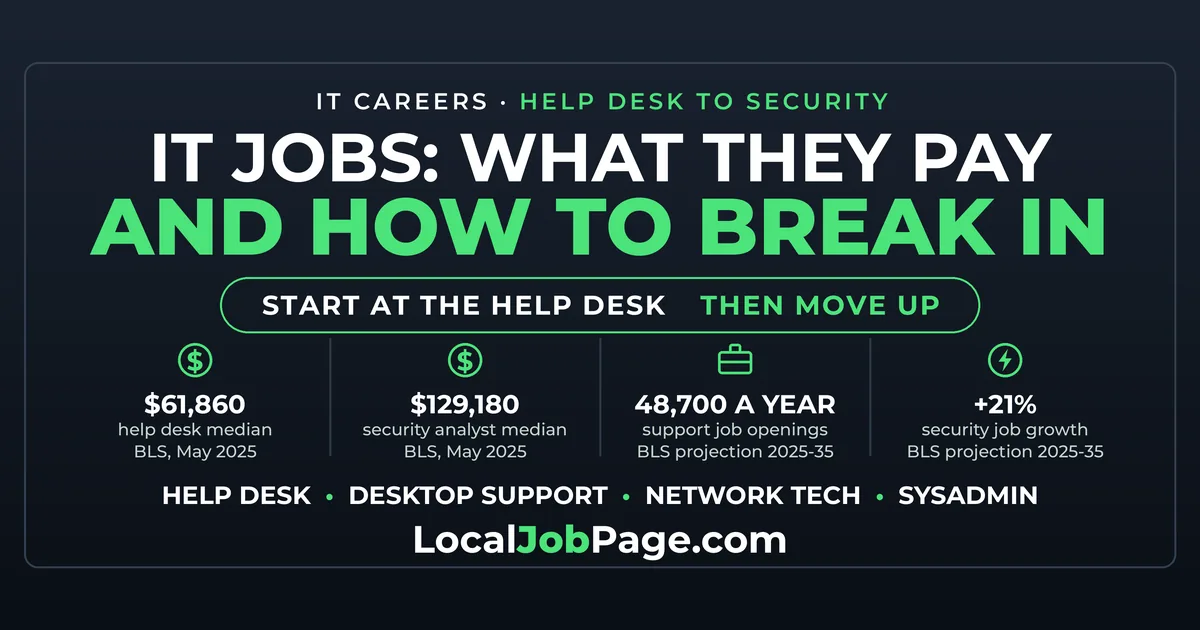
| Computer user support specialist | $61,860 | Some college, no degree |
| Computer network support specialist | $76,220 | Associate's degree |
| Network and computer systems administrator | $99,130 | Bachelor's degree |
| Web developer and digital designer | $99,520 | Bachelor's degree |
| Computer systems analyst | $105,850 | Bachelor's degree |
| Information security analyst | $129,180 | Bachelor's degree |
The spread inside each job matters as much as the median. The lowest-paid 10 percent of user support specialists earned under $40,980, while the top 10 percent earned over $100,540. For network support specialists the range ran from under $47,120 to over $127,780. Where you work moves that number. BLS reports that user support specialists in government earned a median of $77,180, well above the occupation's overall median, while network support specialists in finance and insurance earned $82,640.
The jump from the first rung to the third is the part worth noticing. Moving from help desk to systems administration adds roughly $37,000 to the median. Moving on to security adds about $30,000 more.
📊 Where IT Hiring Is Growing, and Where It Isn't
BLS projects overall employment in computer and IT occupations to grow faster than the average for all occupations from 2025 to 2035, with about 280,000 openings a year on average. Those are projections from an economic model, not a forecast of next year's hiring.
Inside that total, the picture splits. Computer support specialist jobs are projected to decline 3 percent over the decade, a loss of 24,300 positions. Systems administrator jobs are projected to decline 4 percent. Information security analyst jobs, by contrast, are projected to grow 21 percent, adding 40,600 jobs, which BLS classifies as much faster than average.
A shrinking occupation still hires. BLS projects about 48,700 openings for computer support specialists every year, on average, almost all of them from people retiring or moving into other jobs. That is the opening for a newcomer: every worker who moves up or moves on leaves a seat behind. The takeaway is to treat it as a place to learn, not a place to stay.
🎓 Training and Certifications
This is where IT differs from most well-paid fields. BLS says user support specialists typically need some college coursework, and network support specialists typically need an associate's degree, but applicants can qualify for many of these jobs with a high school diploma plus relevant IT certifications. The job itself comes with moderate-term on-the-job training.
Certifications come in two kinds: vendor-neutral credentials that cover the basics, and vendor credentials tied to one company's products. The best-known entry credential is CompTIA A+, which requires passing two exams, Core 1 and Core 2, and which CompTIA itself pitches at help desk support roles. Check CompTIA for current exam fees before you budget, and ask a prospective employer whether it pays for certification after you are hired, since BLS notes that systems administrators are expected to keep taking courses throughout their careers.
The U.S. Department of Labor's CareerOneStop certification finder lets you search credentials by occupation or industry.
For the higher rungs, the degree comes back into the picture. Systems administrators and security analysts typically hold a bachelor's degree in computer or information science. BLS notes that some security analysts enter with a high school diploma plus training and certifications, but that is the exception. Some workers finish the degree part time while working the help desk, which is one more reason the first job matters.
⚠️ Who IT Support Is Not For
Help desk work is customer service with a technical core. You will spend most of the day helping frustrated people, often on the phone, and you need patience as much as skill. BLS notes that support services may need to run around the clock, so some specialists work nights or weekends. Some employers run background checks, and some government and contractor roles require a security clearance, which rules out some applicants. If you want a quiet job alone with a keyboard, the help desk is not it.
🔎 Where to Aim Right Now
Search the entry titles first, then the next rung up, so you can see what the second job asks for before you take the first one. Remote help desk roles exist too, so search both.
Start here:
- Help desk jobs
- IT support jobs
- Desktop support jobs
- IT technician jobs
- Network technician jobs
- Systems administrator jobs
- Cybersecurity analyst jobs
- Remote help desk jobs
- Best Buy jobs
🗺️ Where to Look in Your City
Every office, hospital, school district and government agency needs IT support, so these jobs exist in every market. These are some of the network's largest job markets and best-known tech centers, plus Washington, where government employers, the highest-paying industry for user support in the BLS data, are concentrated.
- IT support jobs in Washington, DC
- IT support jobs in San Jose
- IT support jobs in Seattle
- IT support jobs in Austin
- IT support jobs in Dallas
- IT support jobs in New York
- IT support jobs in Chicago
- IT support jobs in Atlanta
- IT support jobs in Raleigh
- IT support jobs in Denver
Not on the list? Find your city.
Frequently Asked Questions
Can you get an IT job without a degree?
Yes, at the entry level. BLS says applicants can qualify for many computer support jobs with a high school diploma plus relevant IT certifications, though user support specialists typically have some college and network support specialists typically have an associate's degree. Higher-paying roles such as systems administrator and security analyst usually require a bachelor's degree.
How much does an entry-level IT job pay?
Computer user support specialists, the help desk role, earned a national median of $61,860 in May 2025, according to BLS. The lowest-paid 10 percent earned under $40,980. Pay varies by employer type and location.
Are IT support jobs disappearing?
BLS projects computer support specialist employment to decline 3 percent from 2025 to 2035. It also projects about 48,700 openings a year over that period, mostly to replace workers who leave or move up, so the jobs are still being filled.
Which IT job is growing fastest?
Among the jobs in this guide, information security analyst. BLS projects 21 percent growth from 2025 to 2035. The typical entry route is a bachelor's degree and some prior IT experience, often as a systems administrator.
What certification should I get first?
CompTIA A+ is the best-known entry credential for help desk work. Before paying for any course, check the job postings in your area to see which certifications employers actually ask for, and use CareerOneStop's certification finder to compare options.
Start Your IT Job Search
Create a free profile on LocalJobPage so employers can find you, and browse all current openings to see which IT titles are hiring near you.
Employers: Hiring help desk or IT staff? Post your openings on LocalJobPage and reach job seekers across 50 city sites.
Related Reading
- Remote Jobs in 2026: Who Actually Works From Home and What They Pay
- Where the Jobs Will Be by 2035: BLS Projects 5.9 Million New Ones
- How to Write a Resume With No Work Experience
- How to Spot a Job Scam Before You Apply
The help desk pays a median of about $62,000 and is shrinking; security pays a median of about $129,000 and is growing. The first job is how you get from one to the other.