Where the Jobs Will Be by 2035: BLS Projects 5.9 Million New Ones
Published: September 17, 2026 | By LocalJobPage Team
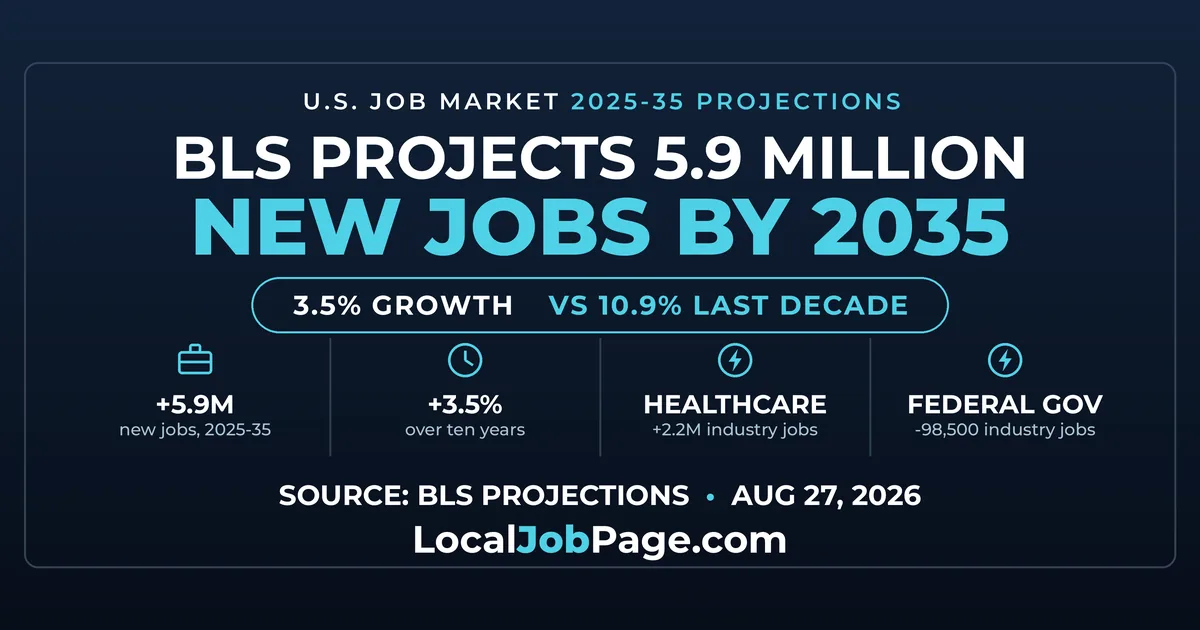
NATIONWIDE — The Bureau of Labor Statistics published its 2025–35 employment projections on August 27, 2026, and the top line is a slowdown. Total employment is projected to rise from 170.3 million to 176.2 million, a gain of 5.9 million jobs and 3.5 percent growth, against 10.9 percent over the 2015–25 decade.
Slower growth does not mean the growth is spread evenly. In the BLS model, roughly a third of every new job in the country lands in healthcare, and the single occupation adding the most positions pays a median of $35,800 a year.
Just want the openings? Skip straight to the job links and begin searching now →
📊 What the Numbers Say
Read the projections for what they are. BLS says plainly that they focus on long-term structural trends and do not try to anticipate business cycles, and that the model assumes full employment in the projected year. This is a ten-year model, not a forecast of what hiring looks like next spring.
What it does tell you is where the structural demand sits. Over 2025–35, BLS projects private healthcare and social assistance to add 2.2 million jobs on 9.5 percent growth, which is about 37 percent of all the new jobs in the projection. Utilities is the fastest-growing sector by rate at 9.8 percent, but that rate buys only 58,800 jobs, because the sector is small. Professional, scientific and technical services grows 8.6 percent and adds 926,700 jobs, which BLS attributes in part to AI-based systems, research and development, and the consulting work around them.
Construction is projected to grow 5.0 percent and information 5.3 percent. The fastest-growing detailed industry is services for the elderly and persons with disabilities, at 625,400 new jobs.
💼 The Occupations Adding the Most Jobs
Sector growth is context. Occupation counts are what you apply to. These are the ten occupations BLS projects to add the most positions between 2025 and 2035, with the 2025 median annual pay BLS publishes for each in the Occupational Outlook Handbook. A median is a median: half the people in that occupation earned less.
| Occupation | New jobs, 2025–35 | 2025 median pay |
| Home health and personal care aides | 847,300 | $35,800 |
| Stockers and order fillers | 250,700 | $37,330 |
| Fast food and counter workers | 223,300 | $31,200 |
| Registered nurses | 194,700 | $97,550 |
| General and operations managers | 181,300 | $105,770 |
| Software developers | 174,700 | $135,980 |
| Cooks, restaurant | 171,400 | $37,390 |
| Medical and health services managers | 155,100 | $123,860 |
| Nurse practitioners | 137,800 | $132,300 |
| Construction laborers | 109,300 | $47,120 |
Further down the list, BLS projects 107,600 new medical assistant jobs at a $45,690 median, 83,800 heavy and tractor-trailer truck driver jobs at $58,640, and 75,900 electrician jobs at $63,190.
The credential picture matters more than the pay column when you are deciding what to do next. BLS lists a high school diploma or equivalent as the typical entry education for home health and personal care aides, electricians and solar photovoltaic installers. Medical assistants and heavy truck drivers typically enter with a postsecondary nondegree award, usually a certificate rather than a degree. Registered nurses, software developers and medical and health services managers typically enter with a bachelor's degree, and nurse practitioners with a master's.
📈 Fastest Growing Is Not the Same List
The two lists people mix up are percent growth and job volume, and they point at different jobs. By rate, BLS projects nurse practitioners to grow 41 percent, solar photovoltaic installers 37 percent, data scientists 35 percent, wind turbine service technicians 30 percent, and medical and health services managers 24 percent. Median pay on those runs from $53,140 for solar installers and $64,120 for wind turbine technicians up to $132,300 for nurse practitioners and $120,230 for data scientists.
A 30 percent gain on a small occupation is still a small number of jobs. Home health and personal care aides grow 18 percent and add 847,300 positions, more than three times the next occupation. The growth rate tells you about direction; the job count tells you your odds of finding a posting near you.
⚠️ What the Projections Show Shrinking
Three major occupational groups are projected to lose employment over the decade: office and administrative support, down 4.0 percent and 752,100 jobs; sales and related, down 1.4 percent; and production occupations, down 0.4 percent. On the industry side, federal government is projected down 3.4 percent and 98,500 jobs, and retail trade down 0.2 percent and 27,500 jobs. BLS also notes that generative AI, which can automate repetitive tasks, may limit demand for some jobs in the arts, design, entertainment, sports and media group.
Read those as net figures, not closed doors. A shrinking occupation still hires, because people retire and move on faster than the headcount falls. Decline changes how much competition you face and how far your experience travels, not whether the work exists.
🔎 What This Means for Your Search
The practical use of a projections release is search terms. Direct care, food service, logistics, construction trades and healthcare management are the words to put in the box, and the certificate-entry roles are where the gap between what you have now and what a posting asks for is smallest.
Start here:
- Home health aide jobs
- Personal care aide jobs
- Medical assistant jobs
- Registered nurse jobs
- Stocker and order filler jobs
- Truck driver jobs
- Electrician jobs
- Solar installer jobs
- Software developer jobs
- Amazon jobs
🗺️ Where to Look in Your City
Each of these metros anchors one of the sectors the projections put in front: hospital and home-care systems, distribution, construction and professional services. Each link searches that city's own board.
- Home health aide jobs in Houston
- Registered nurse jobs in Philadelphia
- Medical assistant jobs in Phoenix
- Warehouse jobs in Memphis
- Stocker jobs in Dallas
- Electrician jobs in Charlotte
- Construction laborer jobs in Denver
- Software developer jobs in Austin
- Data scientist jobs in Seattle
- Nurse practitioner jobs in Atlanta
Not on the list? Find your city.
Frequently Asked Questions
Are these projections a prediction of what hiring looks like next year?
No. BLS states that the projections focus on long-term structural trends and do not try to anticipate business cycle activity, and that the model assumes full employment in the projected year. They describe the shape of the labor market in 2035, not the state of it next quarter.
Which occupation is projected to add the most jobs?
Home health and personal care aides, at 847,300 new positions between 2025 and 2035. BLS lists the 2025 median pay for that occupation at $35,800 a year and the typical entry education as a high school diploma or equivalent.
What is the difference between the fastest-growing list and the most-new-jobs list?
One is a percentage, the other a count. Wind turbine service technicians are projected to grow 30 percent, but the occupation is small enough that the gain is a fraction of what home health aides add at an 18 percent rate. Both lists are useful.
Do the fastest-growing jobs require a degree?
Some do and some do not. BLS lists a master's degree as the typical entry education for nurse practitioners and a bachelor's for data scientists, but a high school diploma or equivalent for solar photovoltaic installers. Licensure and certification rules are set state by state, so check your state's board before you enroll in anything.
Where do the pay figures on this page come from?
All of them are 2025 median annual pay as published by BLS in the Occupational Outlook Handbook, released alongside the 2025–35 projections on August 27, 2026. They are national figures, and pay in your metro can sit well above or below them.
🧭 What to Do Next
Projections are worth exactly one decision: what you learn next. Pick the occupation on this page that is closest to what you already do, look at what it asks for at entry, and close that one gap. Create a free LocalJobPage account to save searches and get new postings in the fields above as they go up, or browse every open job on the site right now.
Employers: the same projections describe your hiring pool for the next decade, and the direct care, food service and logistics roles at the top of the list will be the hardest to fill. Post a job on LocalJobPage or see pricing.
Related Reading
- Healthcare Jobs Without a Bachelor's Degree: What They Pay and How Long Training Takes
- Skilled Trades Jobs: What They Pay and How to Get In Without a Degree
- Warehouse and Logistics Jobs: What They Pay and How to Get Hired
- 7.3 Million Job Openings: What July's Numbers Mean for Your Search
A ten-year projection cannot tell you who is hiring on your street this week. It can tell you which certificate is still worth something in 2035, and the answer keeps coming back the same: direct patient care, the trades that keep buildings and machines running, and the logistics work that moves everything else.