Pay Raises Slowed to 3.1% This Year: Which Jobs Got the Biggest Bumps
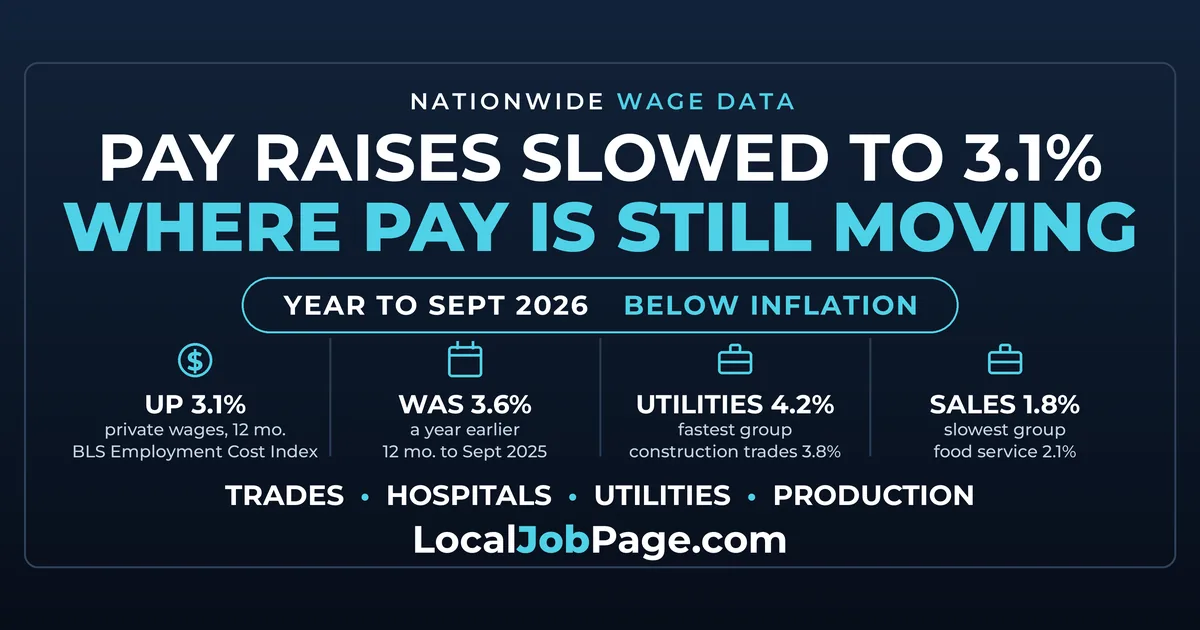
NATIONWIDE — Pay raises cooled over the past year. Private-sector wages and salaries rose 3.1% in the 12 months ending September 2026, down from 3.6% a year earlier, the Bureau of Labor Statistics reported Friday, October 30, in its quarterly Employment Cost Index. Some fields did much better than that, and some much worse.
Paychecks grew 3.1% over the year, prices grew faster, and the gap between the best-raising fields and the slowest is now more than two percentage points.
Need work now? Skip straight to the job links and begin searching now →
📊 What the Numbers Say
The Employment Cost Index tracks what employers pay for the same set of jobs over time. That makes it the cleanest read on raises, because it is not thrown off by people moving into higher- or lower-paid work. The figures below are 12-month changes, not seasonally adjusted, from the release covering the 12 months ending September 2026.
- Wages and salaries, civilian workers: up 3.1%.
- Private industry wages: up 3.1%, compared with 3.6% for the 12 months ending September 2025.
- State and local government wages: up 3.2%.
- Benefit costs, civilian workers: up 3.9%, outpacing wages.
- After inflation: BLS calculated that private-industry wages fell 0.6% in constant dollars over the year.
On a quarterly basis, civilian wages and salaries rose 0.7% from June to September 2026, seasonally adjusted.
The inflation figure is the one most people feel: on average, raises over this period did not keep up with prices. One reading does not make a trend, and BLS will publish the next reading, for the quarter ending December 2026, on January 29, 2027.
Which Jobs Got the Biggest Raises
The spread inside the national number is where the job-search angle lives. Here is private-industry wage growth over the 12 months ending September 2026, by industry or occupational group, as reported in the BLS release.
| Group | 12-month wage change |
| Utilities | 4.2% |
| Construction, extraction, farming, fishing and forestry occupations | 3.8% |
| Hospitals | 3.8% |
| Real estate and rental and leasing | 3.8% |
| Health care and social assistance | 3.7% |
| Educational services | 3.6% |
| Production occupations | 3.5% |
| Transportation and warehousing | 3.4% |
| Retail trade | 3.4% |
| Office and administrative support | 3.1% |
| Service occupations | 2.8% |
| Wholesale trade | 2.3% |
| Accommodation and food service | 2.1% |
| Sales and related occupations | 1.8% |
Three patterns stand out. Hands-on fields held up: construction trades, production work and utilities all beat the national figure. Hospitals and the wider health care sector kept raising pay, as they did a year earlier. And customer-facing work slowed hardest. Restaurants and hotels came in near 2%, and sales jobs at 1.8%.
The sales figure comes with a caveat. It includes commission and bonus pay, which swings with how much gets sold. With incentive-paid jobs stripped out, BLS put sales wage growth at 2.1%, still at the bottom of the table alongside food service.
Retail is the surprise. Retail trade wages rose 3.4%, slightly faster than the national figure, even as sales occupations slowed. Those are different cuts of the data: one is the industry, which includes stockers, cashiers and warehouse staff, and the other is a type of job across every industry.
🔎 What This Means For Your Search
If you are choosing a field, the trades and health care are where pay is still moving. Electricians, maintenance technicians, production workers, lineworkers and hospital staff from patient care techs to sterile processing all sit in groups that beat 3.1%. Some need a license or certificate first; the trades and healthcare guides under Related Reading cover which ones.
If you are in hospitality, food service or sales, a raise at your current job is likely to be small this year. The faster route to more money is often a move. Switching employers, or switching into a related field like hospital food service, property leasing or a warehouse lead role, is not captured in this index at all, because it measures the same job over time.
If you are asking for a raise, 3.1% is a fair reference point for what employers paid on average, and your field's figure in the table above is a better one. Bring both. It is a reasonable, sourced number to put on the table.
If you are comparing offers, look past the wage. Benefit costs rose faster than pay, at 3.9%. An offer with stronger health coverage can be worth more than a slightly higher hourly rate.
🔎 Search Jobs Now
- Hospital jobs
- Electrician jobs
- Construction jobs
- Maintenance technician jobs
- Production worker jobs
- Lineworker and utility jobs
- Leasing agent jobs
- HCA Healthcare jobs
- Amazon jobs
Want everything in one place? Browse all jobs.
🗺️ Where to Look in Your City
This is national data, so there is no city ranking behind it. These links pair the fields at the top of the table with network cities, and each search runs on that city's own site.
- Hospital jobs in Houston
- Hospital jobs in Boston
- Hospital jobs in Nashville
- Construction jobs in Phoenix
- Electrician jobs in Dallas
- Construction jobs in Charlotte
- Production jobs in Detroit
- Manufacturing jobs in Milwaukee
- Maintenance technician jobs in Columbus
Not on the list? Find your city.
FAQ
How much did wages go up in 2026?
Private-industry wages and salaries rose 3.1% in the 12 months ending September 2026, according to the Bureau of Labor Statistics Employment Cost Index released October 30, 2026. That is down from 3.6% for the 12 months ending September 2025.
Did pay keep up with inflation?
No, not on average. BLS calculated that private-industry wages fell 0.6% after adjusting for inflation over the 12 months ending September 2026.
Which jobs got the biggest raises?
Among the private-industry groups BLS reports, utilities led at 4.2%. Construction, extraction, farming, fishing and forestry occupations, hospitals, and real estate and leasing each rose 3.8%, and health care and social assistance rose 3.7%.
Which jobs had the smallest raises?
Sales and related occupations rose 1.8%, accommodation and food service 2.1%, and wholesale trade 2.3% over the same period.
Is a 3% raise good this year?
It is close to the national figure, so it is roughly average. Whether it is good depends on your field. Compare it with your group in the table above, and remember that prices rose faster than the average raise.
When is the next Employment Cost Index?
BLS has scheduled the next release, covering the quarter ending December 2026, for Friday, January 29, 2027, at 8:30 a.m. ET.
Find a Job Where Pay Is Still Moving
Search openings in the fields that beat the average and apply today. Create your free LocalJobPage account or browse all jobs.
Employers: If you are raising pay to compete for workers, say so in the posting. Post your openings on LocalJobPage.
Related Reading
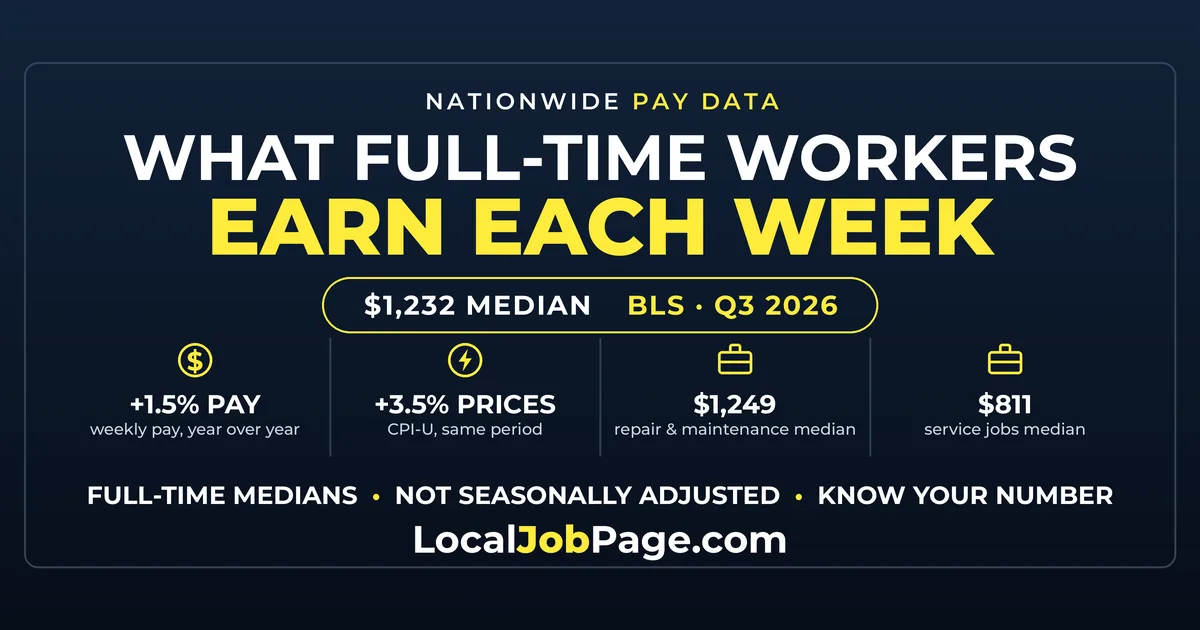
- What Full-Time Workers Earn: Median Weekly Pay by Job, Q3 2026
- How to Negotiate a Job Offer, Even for an Hourly Job
- Skilled Trades Jobs: What They Pay and How to Get In Without a Degree
- Healthcare Jobs Without a Bachelor's Degree
The average raise this year was 3.1%, and it lost ground to prices. The fastest way past that number is a field where pay is still climbing, or a new employer willing to pay more.