What Full-Time Workers Earn: Median Weekly Pay by Job, Q3 2026
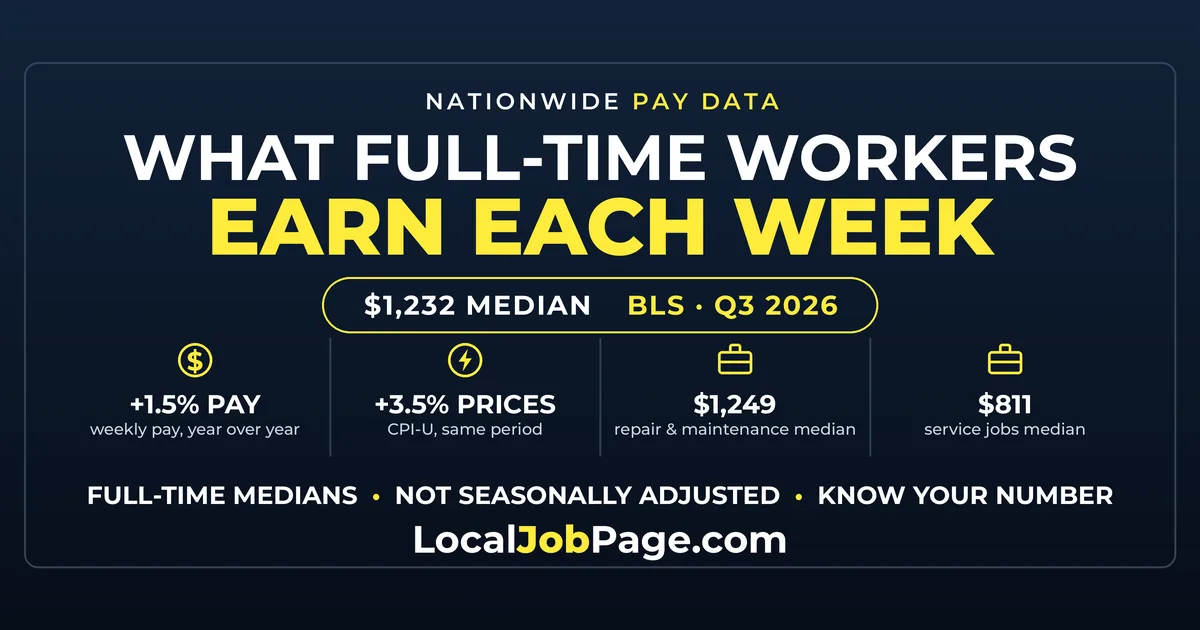
NATIONWIDE — The typical full-time worker in the U.S. earned $1,232 a week in the third quarter of 2026, according to the Bureau of Labor Statistics. That paycheck was 1.5% bigger than a year earlier. Prices rose faster, up 3.5% over the same stretch, so for a lot of people the raise did not keep up with the grocery bill.
The new BLS weekly earnings numbers show full-time pay grew more slowly than prices in the third quarter, and they show exactly which kinds of jobs pay above the national median.
Ready to go? Skip straight to the job links and begin searching now →
📊 What the Numbers Say
The Bureau of Labor Statistics released its Usual Weekly Earnings report for the third quarter of 2026 on Wednesday, October 21. It covers 122.2 million full-time wage and salary workers. Self-employed people are not included.
The headline median of $1,232 a week is not seasonally adjusted. It is a median, which means half of full-time workers earned less and half earned more. Multiply it by 52 weeks and you get about $64,000 a year. That annual figure is our arithmetic, not a BLS number, and it assumes steady full-time work all year.
The comparison that matters most comes straight from the release: weekly pay was up 1.5% from the third quarter of 2025, while the Consumer Price Index for All Urban Consumers rose 3.5% over the same period. In plain terms, the typical full-time paycheck bought less than it did a year ago.
On a seasonally adjusted basis, BLS put the median at $1,239 for the third quarter, down from $1,258 in the second quarter. One quarter is a short window in a survey-based series, so treat that dip as something to watch rather than a turning point.
These figures come from the Current Population Survey, a monthly survey of households. That makes them a different measurement from the payroll numbers in the monthly jobs report, and from the state and metro rates you may see elsewhere.
💵 What Full-Time Workers Earn by Type of Job
The occupation detail is where this report becomes useful for a job search. Here are the BLS medians for the third quarter of 2026, both sexes combined, not seasonally adjusted:
| Occupation group | Median weekly pay |
| Management, business and financial operations | $1,823 |
| Professional and related | $1,594 |
| Installation, maintenance and repair | $1,249 |
| Construction and extraction | $1,172 |
| Sales and related | $1,141 |
| Production | $1,027 |
| Office and administrative support | $1,011 |
| Transportation and material moving | $936 |
| Service | $811 |
| Farming, fishing and forestry | $753 |
The standout for anyone without a four-year degree is installation, maintenance and repair. Its median of $1,249 sits slightly above the all-worker median. This group covers HVAC technicians, industrial maintenance mechanics, auto technicians and line installers, and most of those jobs are learned through apprenticeships, trade school or on-the-job training. Construction and extraction, at $1,172, is not far behind.
Sales is the other surprise. A median of $1,141 a week puts it above office support and production, and because many sales jobs pay commission, two people with the same title can earn very different amounts.
At the other end, service jobs, which include restaurant, cleaning, personal care and protective service roles, had a median of $811. Those jobs are often the fastest way into work, but the report is a reminder that staying in them long term usually means a lower ceiling unless you move into supervision or pick up a credential.
🎓 Education, Age and the Pay Gaps
Among full-time workers age 25 and older, BLS reported these medians for the quarter:
- No high school diploma: $819 a week
- High school diploma, no college: $993
- Some college or an associate degree: $1,140
- Bachelor's degree or higher: $1,752
The jump from a high school diploma to some college or an associate degree is worth about $147 a week at the median. That is the tier where a one- or two-year credential in nursing support, IT, welding or electrical work lands, and it is usually the cheapest raise available.
Age matters too. Full-time workers 16 to 24 had a median of $773 a week, and workers 25 to 34 had $1,173. Earnings peaked between ages 35 and 64.
Women working full time had median weekly earnings of $1,127, which BLS calculated as 83.4% of the $1,352 median for men. That ratio varied by age: it was 88.6% for workers 16 to 24 and 78.1% for workers 55 and older.
🔎 What This Means for Your Search
Three practical takeaways from the third-quarter numbers:
Know the median for your field before you negotiate. If you are offered a full-time maintenance job at well under $1,249 a week, you now have a national benchmark to bring up. Local pay varies a lot, so check postings in your own area too.
If your raise was under 3.5%, you lost ground. That is a fair point to raise in a review, or a reason to see what other employers are paying for the same work.
The trades and sales are the clearest above-median paths without a degree. Both groups paid more than office support, production and transportation in this report.
Start here:
- Maintenance technician jobs
- HVAC technician jobs
- Electrician jobs
- Plumber jobs
- Sales representative jobs
- Registered nurse jobs
- Accountant jobs
- CDL driver jobs
- UPS jobs
🗺️ Where to Look in Your City
These are national medians, and pay runs higher or lower depending on the metro, so compare the numbers above with real postings in large job markets across every region of the country.
- Maintenance technician jobs in New York
- Electrician jobs in Chicago
- HVAC technician jobs in Houston
- Sales representative jobs in Atlanta
- Maintenance technician jobs in Phoenix
- Registered nurse jobs in Philadelphia
- Electrician jobs in Denver
- Plumber jobs in Seattle
- CDL driver jobs in Charlotte
Not on the list? Find your city.
Frequently Asked Questions
What is the median weekly pay for full-time workers in 2026?
The Bureau of Labor Statistics reported median usual weekly earnings of $1,232 for full-time wage and salary workers in the third quarter of 2026, not seasonally adjusted.
Did wages keep up with inflation in 2026?
Not for the typical full-time worker in the third quarter. BLS reported weekly earnings up 1.5% from a year earlier, while the CPI-U rose 3.5% over the same period.
Which jobs pay above the national median without a degree?
In this report, installation, maintenance and repair occupations had a median of $1,249 a week, just above the $1,232 overall median. Construction and sales also paid more than office support, production and transportation jobs.
How much more do college graduates earn?
Among full-time workers 25 and older, the median was $1,752 a week with a bachelor's degree or higher, compared with $993 for high school graduates with no college.
When does BLS release the next weekly earnings report?
BLS publishes this report every quarter. The next one covers the fourth quarter of 2026; check the BLS release calendar for the exact date.
Put the Numbers to Work
A national median is a starting point. The real number is what employers near you are posting right now. Create a free LocalJobPage account to save searches and get new listings, or browse all jobs.
Employers: Competing for workers who know these numbers? Post your openings on LocalJobPage.
Related Reading
- How to Negotiate a Job Offer, Even for an Hourly Job
- Skilled Trades Jobs: What They Pay and How to Get In Without a Degree
- Healthcare Jobs Without a Bachelor's Degree
- September 2026 Jobs Report: 29,000 Jobs Added and Where the Hiring Is
- Minimum Wage 2027: Which States Have Set Their January 1 Rate
If your paycheck grew less than 3.5% this year, you are not imagining the squeeze. Find the median for your field, then go see who is paying above it.