Minimum Wage 2027: Which States Have Set Their January 1 Rate
Published: September 20, 2026 | By LocalJobPage Team
NATIONWIDE — The August inflation numbers are out, and that is the switch that sets next year's pay floor in most of the states that raise theirs. Seven states have now published what their minimum wage will be on January 1, 2027. Seven more have confirmed an increase is coming and have not yet named the number.
If you work an hourly job in California, Colorado, Connecticut, Michigan, Minnesota, Rhode Island or Virginia, your legal pay floor goes up on January 1. The exact figures are below, each one taken from the state's own agency or statute.
Just want the openings? Skip straight to the job links and start searching now →
| What changed | Seven states published their January 1, 2027 minimum wage |
| Who it covers | Hourly workers paid at or near the state floor in those states |
| Effective date | January 1, 2027 |
| Confirmed so far | California, Colorado, Connecticut, Michigan, Minnesota, Rhode Island, Virginia |
| Still pending | Arizona, Maine, Nebraska, New York, Ohio, South Dakota, Washington |
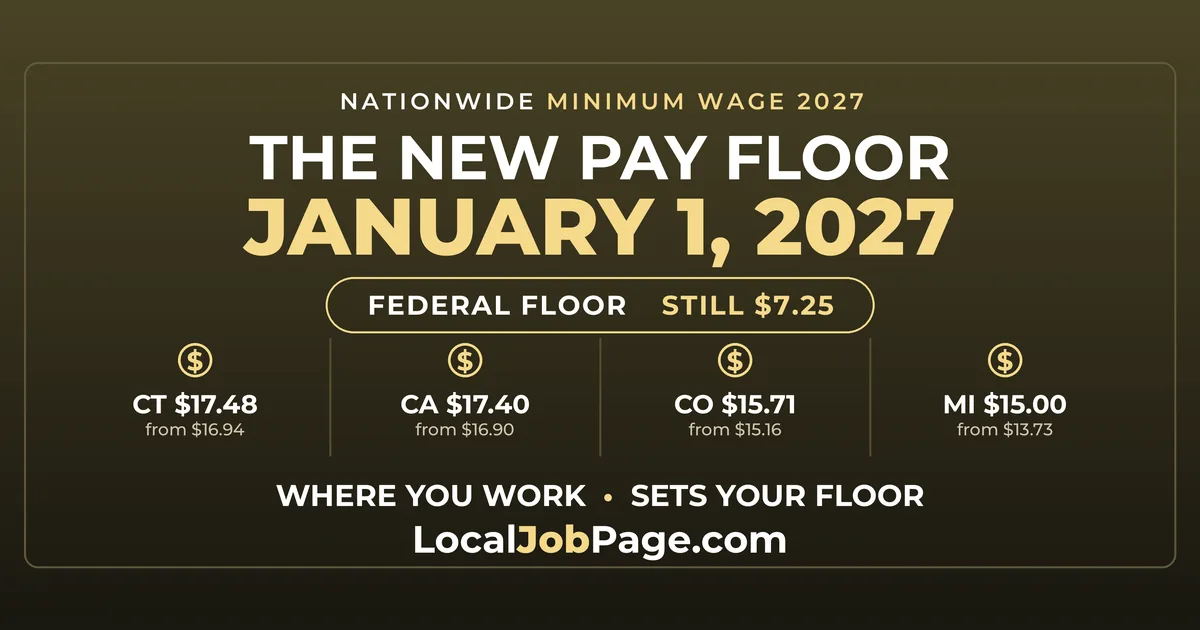
| Federal floor | $7.25 an hour, effective July 24, 2009, per the U.S. Department of Labor |
| Where to read the rule | Your state labor agency's own wage notice or the statute, not a summary |
🏛️ The Seven States That Have Set Their Rate
Every figure in this table comes from the state agency that administers the wage or from the statute itself. The 2026 column is the rate in force right now, and it matches the U.S. Department of Labor's state minimum wage table as updated July 1, 2026.
| State | Now | Jan 1, 2027 | How it was set |
| California | $16.90 | $17.40 | Inflation adjustment certified by the Department of Finance on July 31, 2026; announced by the Department of Industrial Relations |
| Colorado | $15.16 | $15.71 | Constitutional CPI adjustment, 3.6 percent, announced by the Department of Labor and Employment on August 13, 2026. Tipped rate goes to $12.69 |
| Connecticut | $16.94 | $17.48 | Employment cost index adjustment of 3.2 percent for the year ending June 30, announced August 5, 2026 |
| Michigan | $13.73 | $15.00 | Set in statute, not indexed. The last scheduled step under Senate Bill 8 |
| Minnesota | $11.41 | $11.87 | Inflation adjustment of 3.99 percent announced by the Department of Labor and Industry on August 19, 2026. Training wage for under-20s goes to $9.68 |
| Rhode Island | $16.00 | $17.00 | Set in statute under R.I. Gen. Laws § 28-12, not indexed |
| Virginia | $12.77 | $13.75 | Set in statute under Va. Code § 40.1-28.10, not indexed. A further step to $15.00 is written into the same section for January 1, 2028 |
Two different things are happening in that table. California, Colorado, Connecticut and Minnesota are indexed states: their rates move automatically with a price or wage index, and nobody votes on it. Michigan, Rhode Island and Virginia are on fixed statutory ladders, where a legislature wrote specific dollar figures and dates into law years ago. Indexed states keep rising by small amounts indefinitely. Ladder states stop when the ladder runs out, which is why Michigan's jump of $1.27 is the biggest increase on the list and also its last scheduled one.
📅 Who Announces Next, and When
Seven more states have a 2027 increase locked in as a matter of law but have not published the dollar figure yet. That is normal. Most indexed states measure inflation as of August and publish in late September or October, so the next few weeks will fill in most of the map.
Washington is the biggest one outstanding. The Department of Labor and Industries says on its own minimum wage page that it makes the cost-of-living adjustment beginning mid-September, announces the new rate on September 30, and puts it into effect January 1. Washington's current rate is $17.13, the highest statewide figure in the country right now.
Ohio runs on a constitutional clock. Article II, Section 34a of the Ohio Constitution says the rate is increased "on the thirtieth day of each September" by the prior twelve months of inflation, effective the following January 1, rounded to the nearest five cents. Ohio also adjusts the gross-receipts threshold that decides which small employers are exempt.
South Dakota publishes later than most. Its Department of Labor and Regulation says the adjusted rate is posted "no later than Oct. 15 of each year."
Arizona adjusts under A.R.S. § 23-363, which keys the January 1 increase to the consumer price index as of August of the preceding year. Maine adjusts under 26 M.R.S. § 664, using the CPI-W for the Northeast region measured August over August and rounded to the nearest five cents. Nebraska reaches the end of its ballot-measure ladder at $15.00 in 2026, and its Department of Labor has said the rate then rises annually with the consumer price index starting in 2027. New York is the other big one: the state labor department says that starting in 2027 the minimum wage is tied to inflation, using a three-year average of the consumer price index for the Northeast, and that planned increases can be affected by certain economic and budget conditions.
The index most of these run on is not a mystery. The Bureau of Labor Statistics released the August 2026 Consumer Price Index on September 11, 2026, reporting that the CPI-U for all items rose 3.4 percent over the previous twelve months before seasonal adjustment. That is the raw material the indexed states are working from, which is why the announcements that have landed so far cluster in the three to four percent range.
🏙️ When a City Rate Sits on Top
A state minimum wage is a floor, not a ceiling, and in several states a city or county can set a higher one. Where both apply, the employer pays the higher figure. California's Division of Labor Standards Enforcement puts the principle plainly in its own guidance: when two wage rules cover the same job, the employer must follow "the stricter standard; that is, the one that is the most beneficial to the employee."
Other states prohibit local minimum wages outright, so a city ordinance there has no effect on what you are owed. There is no national pattern to it, and it is the most common thing people get wrong about their own pay. Look up your own city and county rather than assuming.
One rule cuts through all of it: the address where the work is actually performed decides which floor applies. Not where you live, not where the company is headquartered, not where the paycheck is issued. If you live in one state and commute into another, the state you drive to is the one that sets your minimum.
⚠️ What These Numbers Do Not Cover
The headline rate is the rate for a standard adult hourly employee. Several categories sit outside it, and every one of them is state-specific.
Tipped work. Most states allow an employer to count tips toward the minimum, so the cash wage on your check can be legally lower than the headline number. Colorado's 2027 tipped rate, for example, is $12.69 against a $15.71 standard rate. A handful of states allow no tip credit at all. Your state's wage order is the place to check.
Youth and training wages. Minnesota's 90-day training wage for workers under 20 goes to $9.68 on January 1, 2027, well under the $11.87 standard rate. Several other states have something similar.
Employer size. Ohio's constitution exempts employers under a gross-receipts threshold, who then pay the federal rate instead. Other states carve out by headcount or by industry.
Salaried exempt thresholds move too. In California, the overtime exemption salary is pinned to the minimum wage: at $17.40, the annual salary floor for an exempt employee becomes $72,384 in 2027. If you are salaried and near that line, a minimum wage increase is your business.
And twenty states still sit at the federal floor. That is a count off the U.S. Department of Labor's state minimum wage table as updated July 1, 2026: twenty states have no state rate above the federal one. The federal minimum wage is $7.25 an hour and has not moved since July 24, 2009, according to the Department of Labor's own history chart. If your state has not set a higher rate, nothing about January 1 changes your legal minimum.
🔎 Where to Aim Right Now
A wage floor going up mostly tells you something about the bottom of the market. Employers paying at or just above the minimum have to move their whole entry band in January, and the postings that show it appear in November and December, as new-year hiring gets budgeted. These are the roles where the floor actually bites.
Start here:
- Cashier jobs
- Retail associate jobs
- Fast food jobs
- Warehouse associate jobs
- Customer service jobs
- Home health aide jobs
- Security guard jobs
- Server and restaurant jobs
- Target jobs
- Starbucks jobs
🗺️ Where to Look in Your City
These are the network cities in the seven states that have already set a January 1, 2027 rate, so a raise to the legal floor is confirmed in every one of them.
- Hourly jobs in Los Angeles
- Hourly jobs in San Diego
- Hourly jobs in San Jose
- Hourly jobs in Sacramento
- Hourly jobs in Fresno
- Hourly jobs in Denver
- Hourly jobs in Colorado Springs
- Hourly jobs in Detroit
- Hourly jobs in Minneapolis
- Hourly jobs in Virginia Beach
Not on the list? Find your city.
Frequently Asked Questions
When do the 2027 minimum wage increases take effect?
All seven confirmed increases take effect January 1, 2027. A few states raise on other dates instead: Florida's next step is September 30, and Oregon and Nevada move on July 1, so a January list is not the whole year.
Why do the announcements come out in September?
Most indexed states measure inflation as of August. The Bureau of Labor Statistics published the August 2026 Consumer Price Index on September 11, 2026, so the arithmetic only becomes possible in mid-September. Washington and Ohio both announce on September 30; South Dakota publishes by October 15.
My employer already pays above minimum wage. Does this matter to me?
Often yes, indirectly. When the floor moves, employers who were paying a dollar or two above it usually have to move their whole entry band to stay competitive for the same applicants. It is not automatic and it is not owed to you, but it is the most common time of year for an hourly pay band to get reset.
What if my city has a higher minimum wage than my state?
You are owed the higher one. Where a local ordinance and a state rate both apply, the employer follows whichever is more beneficial to the employee. Some states prohibit local minimum wages entirely, so check your own city and county rather than assuming either way.
I work remotely for an out-of-state company. Which rate applies?
Generally the rate where the work is performed, which for a remote worker is usually where you sit, not where the employer is based. If you are near a state line or you split time between locations, ask your employer in writing which rate they are applying and check it against your state labor agency's own notice.
Will this page be updated?
Yes. The remaining states publish their 2027 rates between late September and October, and we will add each one as its own agency posts it.
🧭 Get Ahead of the January Pay Reset
The practical move is to be in the market before the January postings go up, not after. Create a free LocalJobPage account and save the searches that match the roles you want, so a posting reaches you the day it lands.
Create a free job seeker account or browse every open job now.
Employers: if your entry rate is within a dollar of your state's new floor, January is when your postings start losing to the business down the street. Post a job on LocalJobPage or see plans and pricing.
Related Reading
- Florida Minimum Wage Hits $15 on September 30, 2026
- What Your Job Post Must Include: Pay Transparency Rules by State
- Which States Are Adding Jobs: The August 2026 State Numbers
- Warehouse and Logistics Jobs: What They Pay and How to Get Hired
Check the number yourself before January. Your state labor agency posts a one-page wage notice every year, and it is the only version that settles an argument with a payroll department.