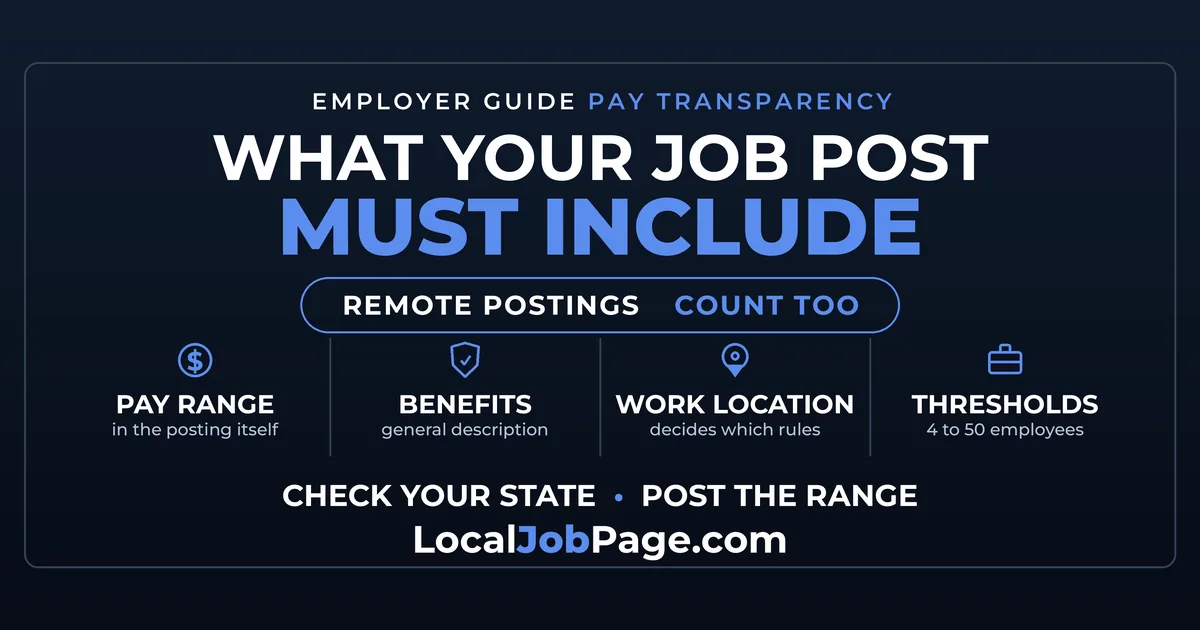
What Your Job Post Must Include: Pay Transparency Rules by State
Published: September 13, 2026 | By LocalJobPage Team
You wrote the job post in four minutes, pasted it everywhere, and got eleven applications you cannot use. Meanwhile a competitor down the road filled the same role in a week. Part of that gap is pay, part of it is the post itself, and a growing part of it is a legal requirement you may not know applies to you.
Twelve states and the District of Columbia now require a pay figure in the job post itself, and the newest of them, Virginia, started on July 1, 2026. If you hire in any of them, a post without a number is not just weak. It is out of compliance.
Just want the job links? Skip to what candidates are actually searching for →
This is general information for employers, not legal advice. Rules change, and the details below are the posting requirement only. Check with your state labor agency or your own counsel before you rely on it.
🏛️ Where the Law Already Requires a Pay Range
The thresholds vary a lot: a four-employee shop in New York is covered, while a forty-employee shop in Hawaii is not. Each row below was checked against that jurisdiction's own statute or labor agency guidance.
| Jurisdiction | Covered employers | The posting must include |
| California | 15 or more employees | The pay scale for the position |
| Colorado | All employers | Compensation, a general description of benefits, and how to apply |
| District of Columbia | All employers with District employees | Minimum and maximum salary or hourly pay |
| Hawaii | 50 or more employees | Hourly rate or salary range |
| Illinois | 15 or more employees | Pay scale and benefits |
| Maryland | All employers | Wage range, a general description of benefits, and other compensation |
| Massachusetts | 25 or more employees | The pay range for the position |
| Minnesota | 30 or more employees at one or more Minnesota sites | Starting salary range and a general description of benefits |
| New Jersey | 10 or more employees | Wage or salary, or a range, plus benefits and other compensation programs |
| New York | 4 or more employees | Compensation range, and whether the role is commission based |
| Vermont | 5 or more employees | The expected range of compensation |
| Virginia | All employers | A wage or salary range |
| Washington | 15 or more employees | Wage scale or salary range, benefits, and other compensation |
This table covers one specific obligation: a pay figure in the posting itself. Some states require a range at a different point instead, on request or before an offer, and several cities have added their own rules on top of their state's. Neither is covered here.
📅 The Rules Arrived in Waves, and They Are Still Arriving
This is not a settled area, which is why an employer who checked two years ago may be out of date. Hawaii's requirement began January 1, 2024. Maryland followed on October 1, 2024, Illinois on January 1, 2025, New Jersey on June 1, 2025, and Vermont on July 1, 2025. Massachusetts took effect October 29, 2025. Virginia's, under section 40.1-28.7:12, applies to postings beginning July 1, 2026, and the same Virginia law bars asking applicants for their wage history.
If you post in more than one state, assume the list grows again next year and build the range into your template now.
⚠️ The Part That Trips Up Remote Postings
The address where the work is performed decides which rules apply. Not where your company is headquartered, and not where the applicant lives. That single sentence is what catches out-of-state employers.
Remote roles are where it bites. Maryland's Division of Labor and Industry says its requirement reaches work performed in Maryland even when the role is remote. California's Labor Commissioner's Office reads Labor Code section 432.3 to cover any position that may ever be filled in California, in person or remotely. Illinois applies 820 ILCS 112/10 to work performed in Illinois. Post one open remote role and you may have quietly opted into several states at once.
California adds a second trap worth knowing: if you use a third party to post the job, you have to give that third party the pay scale, and they have to include it.
✅ What Else Belongs in the Post
Compliance gets you a legal posting. It does not get you applicants. A few things do most of the work:
A real range, not a wide one. A posting that says $45,000 to $120,000 tells a candidate nothing and reads as evasive even where it is legal.
The schedule, in the first three lines. Shift, days, and whether it is part time. Bury it and good applicants drop out late instead of early.
Benefits in plain terms. Several states above require a general description, and New Jersey's guidance says "great benefits" does not qualify. Name the health coverage, the paid time off, the retirement plan.
A title people search. Internal titles do not get found. "Customer Experience Advocate II" is a search dead end; "Customer Service Representative" is not.
🔎 See What Candidates Are Actually Searching
There were 7.3 million job openings in the United States on the last business day of July 2026, seasonally adjusted, and 5.1 million hires that month, according to the Bureau of Labor Statistics Job Openings and Labor Turnover Survey released September 1, 2026. Candidates have options, and they find roles by typing plain words.
Start here:
- Warehouse associate
- Customer service
- Medical assistant
- CDL driver
- Administrative assistant
- Maintenance technician
- Part time work
- Remote roles
- Amazon
🗺️ Where to Look in Your City
These are the LocalJobPage cities that sit in the jurisdictions listed above, so a posting aimed at any of them carries a disclosure requirement.
- Jobs in Los Angeles
- Jobs in San Francisco
- Jobs in San Diego
- Jobs in Denver
- Jobs in Colorado Springs
- Jobs in Chicago
- Jobs in Baltimore
- Jobs in Boston
- Jobs in Minneapolis
- Jobs in New York
- Jobs in Seattle
- Jobs in Virginia Beach
Not on the list? Find your city.
Questions Employers Ask
My company is based out of state. Do these rules still apply?
If the work is performed in a covered jurisdiction, generally yes. Maryland, California and Illinois all tie their requirements to where the work happens rather than to where the employer sits.
What about a fully remote role?
The hardest case, and the one most often missed. If your remote posting is open to applicants anywhere, treat the strictest applicable state as your baseline.
How wide can the range be?
Narrower than most employers want. Washington asks for the range you most reasonably and genuinely expect to pay at the time of posting, and Minnesota prohibits open-ended ranges.
Do part time and seasonal postings count?
In Illinois, yes explicitly: the state's guidance covers temporary, part time, seasonal and union positions. Other states word it differently, so do not assume a short-term role is exempt.
What happens if I leave the pay out?
Civil penalties, generally per violation and escalating on repeat. Maryland provides for up to $300 per employee for a first violation after a compliance order and up to $600 per employee for further violations within three years. New Jersey sets up to $300 for a first violation and up to $600 after that.
📢 Post It Right the First Time
Employers: put the range in the template once and stop rewriting it per state. Create an employer account to post your opening across the LocalJobPage network, and see pricing for what a listing costs.
Looking for work rather than hiring? Create a free job seeker account or browse open jobs to see how the postings in your state stack up.
Related Reading
- August 2026 Jobs Report Breakdown
- Warehouse Jobs: Pay and Training
- Skilled Trades Jobs: Pay and Entry
- Healthcare Jobs Without a Degree
The employers who adapted first stopped treating the range as a concession. Put a number people can believe at the top of the post, and you will spend less time sorting applications that were never going to work.