7.3 Million Job Openings: What July's Numbers Mean for Your Search
Published: September 14, 2026 | By LocalJobPage Team
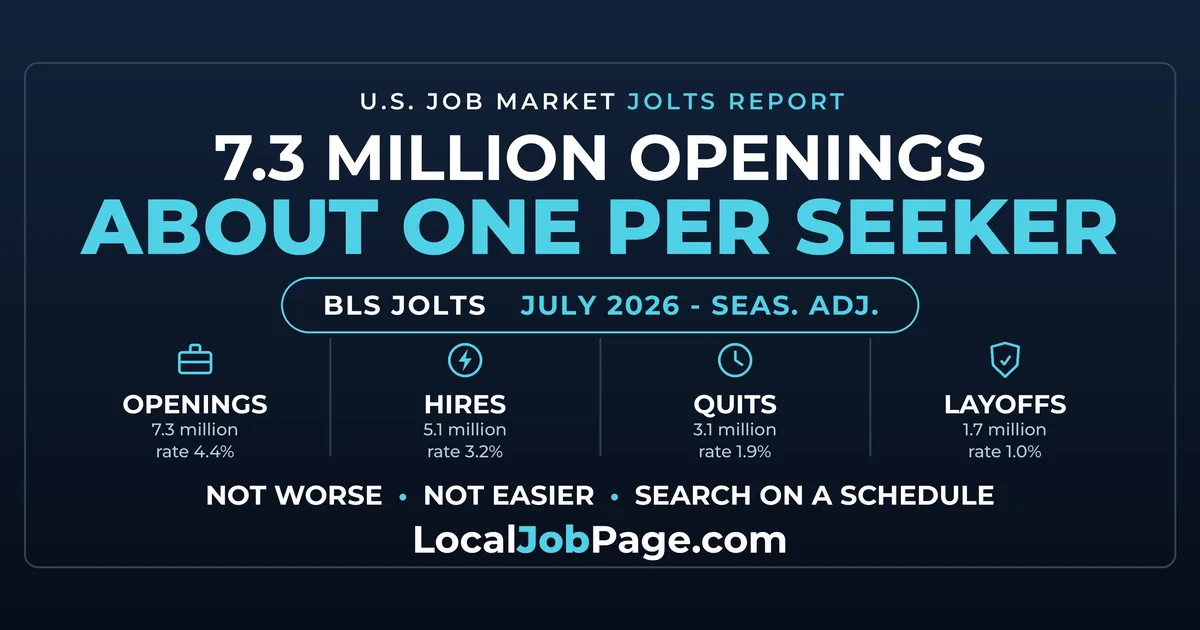
NATIONWIDE — At the end of July 2026 there were about 7.3 million job openings in the United States. That same month, about 6.9 million people were counted as unemployed. That is roughly one posted opening for every person looking for work. It is a tidy number, and on its own it tells you almost nothing about your search.
The Bureau of Labor Statistics put job openings at 7.3 million for July 2026, seasonally adjusted, little changed from June. Hires, quits and layoffs barely moved either. A steady market is not the same thing as an easy one, and the reason has more to do with who is not quitting than with who is hiring.
Just want the openings? Skip straight to the job links and begin searching now →
📊 What the Numbers Say
The Job Openings and Labor Turnover Survey, or JOLTS, is the federal monthly count of jobs employers say they are trying to fill, people they hired, people who quit and people who were let go. The Bureau of Labor Statistics released the July 2026 figures on September 1, 2026. Every number below is seasonally adjusted and refers to July 2026.
| Job openings | 7.3 million, a rate of 4.4 percent |
| Hires | 5.1 million, a rate of 3.2 percent |
| Total separations | 5.1 million, a rate of 3.2 percent |
| Quits | 3.1 million, a rate of 1.9 percent |
| Layoffs and discharges | 1.7 million, a rate of 1.0 percent |
BLS described all five measures as little changed from June. That is the headline: nothing moved.
One thing did move, and it moved backward. June's openings figure was revised down 177,000, to 7.2 million, with June hires down 16,000, quits down 19,000 and layoffs up 19,000. Revisions that size are routine here, because more employers report late than on time. Worth remembering the next time a first-print number gets called a turning point.
The Arithmetic on Your Competition
That one-per-seeker figure is our own arithmetic, not a number BLS publishes, and it comes from two different surveys: the 7.3 million openings from JOLTS, which asks employers, and the 6.9 million unemployed in July from the Current Population Survey, which asks households. Different instruments, different sides of the market. Treat it as a sense of scale, not a calculation of your odds.
Even taken loosely it says something: on paper, supply and demand are close to even. What it does not say is that every opening is reachable by every seeker. An opening for a machinist in Wichita does nothing for an unemployed marketing coordinator in Phoenix, and the national ratio averages those two people together.
Which Sectors Moved
Underneath the flat headline, BLS singled out four industry movements in July, each of them an over-the-month change:
- Openings rose in durable goods manufacturing, up 76,000. Vehicles, machinery, appliances, aircraft, fabricated metal. The clearest place employers added postings.
- Hires fell in professional and business services, down 188,000. The white-collar service block: consulting, accounting, legal support, advertising, engineering services, staffing and temp help. Openings there may still exist; the hiring is what dropped.
- Quits fell in other services, down 46,000. Repair and maintenance, personal care, laundry, membership organizations.
- Layoffs and discharges fell in finance and insurance, down 22,000. Fewer people let go is the good kind of flat.
Put those together and July tilts toward things that get built and away from things that get billed by the hour. One month of a noisy series is not a trend, but it is more useful than the headline.
Why a Low Quits Rate Makes Your Search Longer
The quits rate held at 1.9 percent. It gets less attention than openings and may matter more.
Most openings are not new jobs. They are backfills, created when somebody employed leaves for something else. Fewer quits means fewer backfills, and the vacancies that exist sit in a smaller pool that turns over slowly. Workers staying put usually means they are not confident about the alternative, and the cost of that lands on everyone outside a job looking in.
The flip side: layoffs are low too, at a 1.0 percent rate. Employers are not shedding staff at anything like crisis pace. If you are employed and weighing a jump, July says the ground under you is solid and the landing spot is harder to find. If you are already searching, patience is a strategy, not a failure.
🔎 What This Means For Your Search
Widen the job title, not the standard. When hiring slows in one block of the economy, the same skills often still sell in another. Scheduling, procurement, quality documentation and customer escalation look different on a factory floor than in a consulting office, but the work transfers. Search the function, not the industry you came from.
Apply in the first few days. With hires flat and postings turning over slowly, a listing that has been up three weeks already has a stack behind it. Set an alert and treat new postings as the priority.
Expect it to take a while. Nothing in July sped up. Budget for that rather than reading a slow month as a verdict on you.
Search terms below are built from the sectors that added openings in July, plus a brand query.
Start here:
- Manufacturing jobs
- Machine operator jobs
- CNC machinist jobs
- Maintenance technician jobs
- Quality inspector jobs
- Assembler jobs
- Production supervisor jobs
- Warehouse associate jobs
- Caterpillar jobs
🗺️ Where to Look in Your City
Durable goods is where openings grew in July, and it does not spread evenly across the map. These network metros carry real concentrations of vehicle, machinery, aerospace and fabricated metal production.
- Manufacturing jobs in Detroit
- Manufacturing jobs in Milwaukee
- Manufacturing jobs in Wichita
- Manufacturing jobs in Indianapolis
- Manufacturing jobs in Columbus
- Manufacturing jobs in Louisville
- Manufacturing jobs in Charlotte
- Manufacturing jobs in Nashville
- Manufacturing jobs in Kansas City
- Manufacturing jobs in Phoenix
Not on the list? Find your city.
Frequently Asked Questions
How many job openings are there in the U.S. right now?
The most recent federal count is 7.3 million for July 2026, seasonally adjusted, published by the Bureau of Labor Statistics on September 1, 2026. That is an end-of-month figure, not a running total of everything posted during the month.
Is about one opening per unemployed person good or bad?
Neutral on its face, and it depends on your field and your city. The ratio compares an employer survey to a household survey and averages every occupation and metro together, so it describes the country, not your search.
Why does a low quits rate make it harder to find a job?
Most openings are backfills for people who left. At a 1.9 percent quits rate fewer people are leaving, so fewer vacancies open behind them. Low quits and low layoffs together make a market with very little movement in either direction.
Which industries added job openings in July 2026?
BLS called out durable goods manufacturing, where openings rose 76,000 over the month. The release also noted hires falling in professional and business services by 188,000, quits falling in other services by 46,000, and layoffs falling in finance and insurance by 22,000.
Does a flat JOLTS report mean layoffs are coming?
Nothing in the July 2026 release points that way. Layoffs and discharges held at 1.7 million, a rate of 1.0 percent. Flat is flat, and one month of a survey that gets revised every month is not a forecast.
When does the next job openings report come out?
The Bureau of Labor Statistics has scheduled the August 2026 JOLTS release for Tuesday, September 29, 2026, at 10:00 a.m. Eastern. It will also carry revisions to the July figures in this article.
🧭 What to Do Next
A flat month is a reason to be systematic, not a reason to wait. Run alerts on two or three search terms rather than one, apply early in a posting's life, and watch the sectors still creating openings when the national headline does not move.
Create a free LocalJobPage account to save searches and catch new postings as they go up, or browse everything currently listed.
Employers: a low-churn market is the cheapest hiring market you will get, because the people you hire are more likely to stay. Post a job on LocalJobPage or see pricing.
Related Reading
- August 2026 Jobs Report: Where the 162,000 New Jobs Actually Are
- Warehouse and Logistics Jobs: What They Pay and How to Get Hired
- Skilled Trades Jobs: What They Pay and How to Get In Without a Degree
- Healthcare Jobs Without a Bachelor's Degree: What They Pay and How Long Training Takes
July describes a market that is not getting worse and is not getting easier. That combination rewards people who search on a schedule instead of on a mood.