Which States Are Adding Jobs: The September 2026 State Numbers
NATIONWIDE — Three states moved enough jobs in September to clear the government's bar for a real change. New Jersey and South Carolina added jobs, Wisconsin lost them, and the other 47 states plus the District of Columbia were essentially flat for the month. Over the full year, the picture is busier: seven states are measurably ahead of where they were in September 2025, led again by Texas, California and North Carolina.
The September 2026 state jobs numbers show 2 states adding jobs over the month, 1 losing them, and 7 states ahead over the year, all seasonally adjusted and preliminary.
Just want the openings? Skip straight to the job links and begin searching now →
📊 What the September State Numbers Say
The Bureau of Labor Statistics released its State Employment and Unemployment report for September 2026 on Tuesday, October 20. Every figure in this article comes from that release and its tables. All of them are seasonally adjusted, and the September numbers are preliminary, which means they will be revised next month.
One thing to keep straight before the details: the report carries two different measurements. The job counts come from a survey of employers and count payroll jobs located in each state. The unemployment rates come from a separate household-based model and describe residents. The two can move in different directions in the same month, and that is normal, not an error.
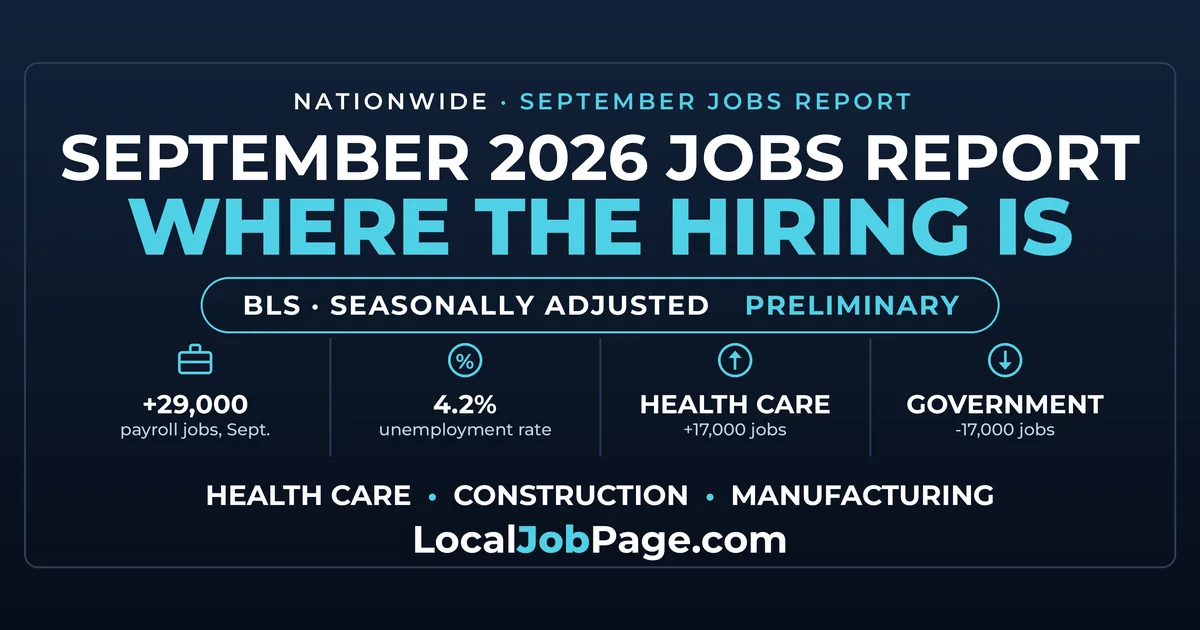
Nationally, the BLS put the September unemployment rate at 4.2 percent. Against that benchmark, 20 states had rates significantly below the national figure, 28 were not meaningfully different, and only California, Michigan and the District of Columbia were significantly higher.
Which States Added and Lost Jobs in September
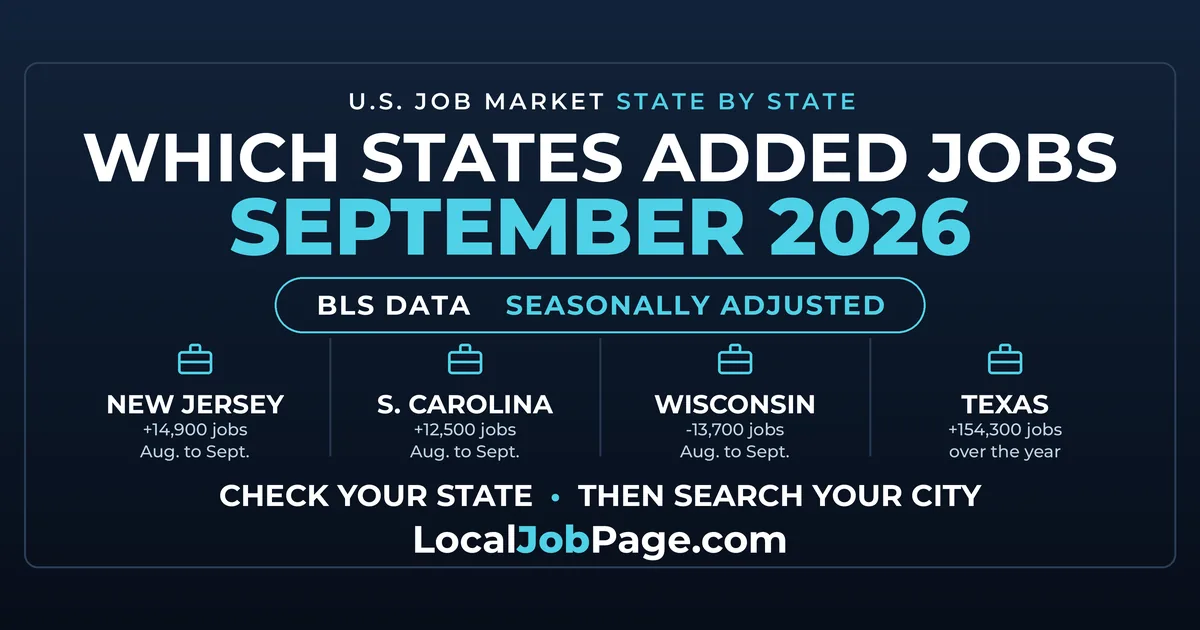
Only three states had a statistically significant change in payroll jobs from August to September:
| New Jersey | +14,900 jobs (+0.3%) |
| South Carolina | +12,500 jobs (+0.5%) |
| Wisconsin | −13,700 jobs (−0.4%) |
Wisconsin is the turn worth noticing. In the August report it was one of the states adding jobs. One month does not make a trend, and the September figure will be revised, so treat it as a reason to watch the October numbers rather than a verdict on the state.
South Carolina, on the other hand, keeps showing up. It posted a significant gain in August too, and over the past year it has grown faster than any other state.
Texas is a good example of why "essentially unchanged" matters. The table shows Texas down 11,100 jobs from August, but a move that size in a state with about 14.5 million payroll jobs falls inside the survey's margin, so the BLS does not count it as a real change.
Where Jobs Grew Over the Year
The year-over-year view, September 2025 to September 2026, is steadier and more useful for anyone deciding where to look. Seven states had significant gains, and only the District of Columbia had a significant decline.
| Most jobs added | Texas +154,300 · California +129,300 · North Carolina +67,000 |
| Fastest growth | South Carolina +2.3% · Louisiana +1.8% · Utah +1.5% |
| Only significant decline | District of Columbia −25,800 (−3.5%) |
Raw totals favor big states, so the percentage list is the fairer read on momentum. South Carolina added about 55,000 jobs on a base of roughly 2.4 million, which is our arithmetic from the BLS table. The release gives no reason for the District's decline, and we are not going to supply one.
Unemployment Rates: Who Moved and Who Is Lowest
Unemployment rates fell over the month in five states and held steady everywhere else. Maryland and New Hampshire each dropped 0.2 percentage point, to 3.9 and 2.6 percent. Florida, Nevada and Pennsylvania each dropped 0.1 point, to 4.4, 4.7 and 3.6 percent. No state had a significant increase.
South Dakota had the lowest rate at 2.0 percent, followed by North Dakota at 2.2 percent. The District of Columbia had the highest at 5.6 percent, with California at 5.1 percent and Michigan at 5.0 percent.
Over the year, New Jersey's rate fell the most, 1.3 points to 4.2 percent, and Ohio's fell 0.9 point to 3.4 percent. Connecticut's rose the most, 0.9 point to 5.1 percent, while Alabama and Hawaii each rose 0.7 point. Those are percentage points, not percent: a rate going from 5.5 to 4.2 percent is a drop of 1.3 points.
🔎 What This Means for Your Search
A low unemployment rate means less competition for each opening, not more openings. South Dakota and North Dakota are tight markets, but they are small ones. The states adding the most jobs, Texas, California and North Carolina, are also big, busy markets where a strong application stands out quickly because employers are filling a lot of roles at once.
If you live in a state that went flat or slipped, the advice is the same as it would be in any month: widen the title you search under, and look at the parts of the economy that kept hiring nationally. The state release does not break jobs out by industry, so for that we lean on the national September jobs report, which showed health care, construction, leisure and hospitality, and manufacturing adding jobs. Seasonal hiring is also in full swing, with Amazon and UPS among the national employers staffing up for the holidays.
The address where the job is located is what puts it in a state's count, so a job across a state line counts there, not where you live. If you are near a border, as many people in the Charlotte area are with South Carolina, search both sides.
Start here:
- Registered nurse jobs
- Medical assistant jobs
- Construction laborer jobs
- Manufacturing jobs
- Warehouse jobs
- Restaurant jobs
- Customer service jobs
- Amazon jobs
- UPS jobs
🗺️ Where to Look in Your City
These cities sit in the states this month's report singled out: the biggest year-over-year gainers, the states whose rates fell, and the places where the numbers turned.
- Jobs in Houston
- Jobs in Dallas
- Jobs in Los Angeles
- Jobs in Charlotte
- Jobs in Raleigh
- Jobs in Milwaukee
- Jobs in Baltimore
- Jobs in Philadelphia
- Jobs in Miami
- Jobs in Columbus
- Jobs in Detroit
- Jobs in Washington, DC
Not on the list? Find your city.
Frequently Asked Questions
Which states added the most jobs in September 2026?
Over the month, only New Jersey (+14,900) and South Carolina (+12,500) had statistically significant gains, according to the BLS. Over the year, Texas added the most jobs, at 154,300.
Which state has the lowest unemployment rate?
South Dakota, at 2.0 percent in September 2026, seasonally adjusted. North Dakota was next at 2.2 percent.
Why did Texas lose jobs in September if it is the top gainer for the year?
The 11,100-job dip from August is too small to be statistically significant in a state that size, so the BLS treats Texas as unchanged for the month. Over the year it is up 154,300.
Are these numbers final?
No. September figures are preliminary and will be revised when the October data come out.
When is the next state jobs report?
Metro-area numbers for September come out Wednesday, October 28, 2026. State numbers for October follow on Friday, November 20, 2026, both at 10 a.m. ET.
Find the Job That Fits Where You Live
State numbers tell you where hiring is steady. Your next job still comes down to one application. Create a free LocalJobPage account to save searches and get new listings first, or browse all jobs now.
Employers: hiring in a growing state means competing for the same candidates. Post your openings on LocalJobPage and reach job seekers in your city.
Related Reading
- Which States Are Adding Jobs: The August 2026 State Numbers
- September 2026 Jobs Report: 29,000 Jobs Added and Where the Hiring Is
- Job Openings at 7.1 Million in August: What It Means for Your Search
- Minimum Wage 2027: Which States Have Set Their January 1 Rate
Check your state's line, then search your city: a flat month statewide still has employers hiring every day.