Railroad Jobs: What They Pay and How to Get Hired
RAILROAD HIRING — Railroad jobs are one of the few places left where a high school diploma and a clean record can lead to a paycheck near $80,000 a year, with the training paid for by the employer. The catch is the lifestyle: trains run around the clock, and new hires work the schedules nobody else wants.
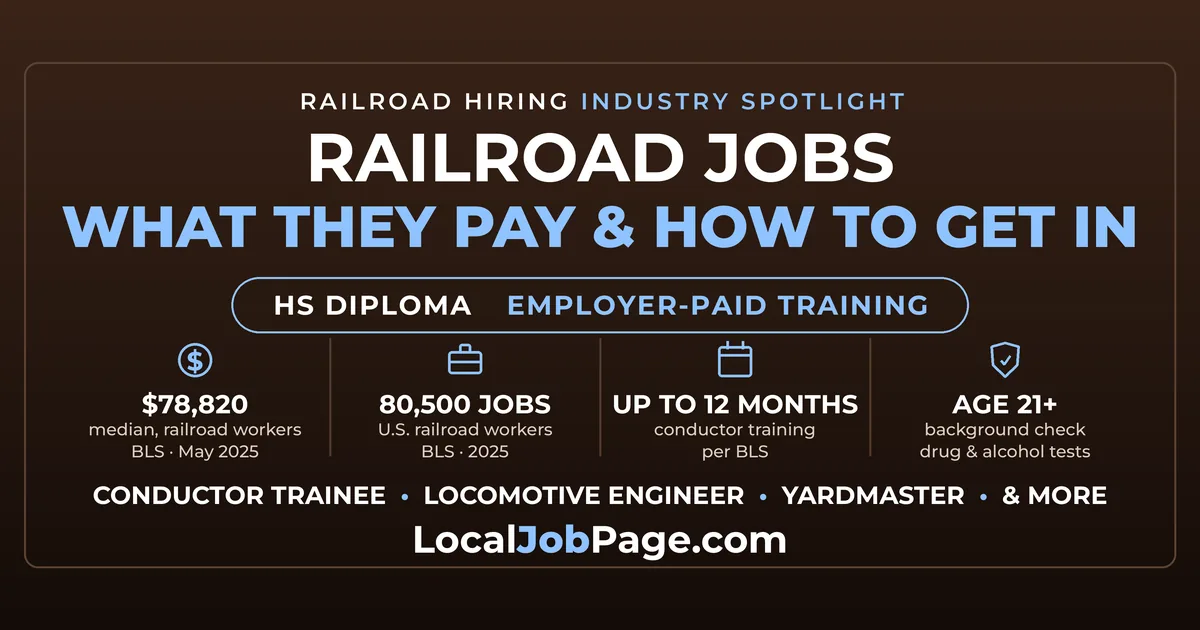
Railroad workers earned a national median of $78,820 in May 2025, and most entry-level train crew jobs require no railroad experience.
Ready to go? Skip straight to the job links and begin searching now →
| Median pay, railroad workers | $78,820 a year, about $37.90 an hour (BLS, May 2025) |
| Typical entry education | High school diploma or equivalent |
| Training | Employer-provided, from a few weeks to about a year depending on the role |
| Federal certification | Required for conductors and locomotive engineers |
| Minimum age | 21 for train crew roles, per BLS |
| Jobs and openings | 80,500 jobs in 2025; about 6,100 openings a year projected through 2035 |
💼 The Railroad Jobs Most People Start In
The Bureau of Labor Statistics groups the people who run trains into four occupations. Almost everyone in the field starts in one of the first two.
Conductors and yardmasters. The conductor is in charge of the train and its crew: checking the cars and paperwork before departure, coordinating with dispatchers, and making sure the train is assembled and handled safely. Yardmasters run the switching work inside a rail yard. Freight railroads hire new conductors as trainees, and it is the usual front door to the industry.
Brake, signal and switch operators. These workers couple and uncouple cars, throw switches and help move cars around yards and industrial sidings. Some railroads use these roles as an entry point too.
Locomotive engineers. The engineer drives the train. According to BLS, engineers usually spend several years as conductors or yardmasters before they move up, so this is a promotion, not an entry-level job.
Rail yard engineers and hostlers. These workers move locomotives within yards and terminals rather than out on the main line.
Beyond train crews, railroads hire mechanics who repair locomotives and freight cars (often called carmen), track maintenance crews, signal maintainers, electricians and dispatchers. Those trades follow different pay scales and are worth searching on their own.
💵 What Railroad Jobs Pay
The figures below are national medians from the BLS Occupational Employment and Wage Statistics survey for May 2025, as reported in the Occupational Outlook Handbook. A median is the midpoint: half the workers in each job earned less.
| Locomotive engineers | $81,410 |
| Railroad conductors and yardmasters | $78,000 |
| Brake, signal and switch operators and locomotive firers | $68,840 |
| Rail yard engineers, dinkey operators and hostlers | $60,600 |
| All railroad workers | $78,820 |
The spread is wide. The lowest-paid 10 percent of railroad workers earned less than $56,050 and the highest-paid 10 percent earned more than $106,800. Where you work matters too: BLS put the median at $79,000 for workers at railroads themselves and $80,000 in local government, which covers commuter and transit rail, but $49,770 at companies that provide support services to railroads.
For comparison, BLS put heavy and tractor-trailer truck drivers at a $58,640 median and bus drivers at $49,390. That gap is a big part of why rail jobs draw so many applicants from trucking and logistics.
Railroad benefits also work differently. Rail workers are covered by the federal Railroad Retirement Board, which runs a separate retirement system closely coordinated with Social Security, along with its own unemployment and sickness benefits for railroad employees. The Railroad Retirement Board explains how it works.
🎓 Training, Certification and What It Takes
This is the part that makes railroading unusual: the employer trains you, and you are paid while you learn.
- Conductors: BLS says most railroads provide up to 12 months of training, mixing classroom work with time on the job.
- Locomotive engineers: typically 3 months or more of on-the-job training, usually riding with an experienced engineer.
- Yard engineers and signal and switch operators: a few weeks to a few months.
Conductors and engineers must be certified under Federal Railroad Administration rules. The railroad itself runs the certification, which includes a written knowledge test, a skills test and a supervisor's sign-off on route knowledge. Engineers also have to pass vision and hearing tests. Certification is renewed every few years and again when a worker changes routes.
Union Pacific's careers pages say train crew applicants need no railroad experience and that the company provides the training. Norfolk Southern lists train crews and dispatchers as their own hiring track on its careers site.
🔥 Who's Hiring
Most railroad workers, about 85 percent according to BLS, work for railroads directly. The rest are mostly in local government transit agencies and rail support companies.
- Freight railroads: Union Pacific, BNSF, CSX and Norfolk Southern are the four largest U.S. freight carriers. BNSF's conductor trainee listings in mid-November 2026 were concentrated in smaller terminal towns across the Plains and Northwest, plus the Minneapolis area.
- Passenger rail: Amtrak hires conductors, engineers and mechanical workers. Amtrak says assistant conductors usually become conductors at the end of a probationary period of about a year.
- Commuter and transit rail: regional transit agencies that run commuter trains, light rail and subways.
- Short lines and contractors: smaller railroads and companies that switch cars inside plants, ports and rail yards.
One industry note: Union Pacific's proposed merger with Norfolk Southern is still under review by the federal Surface Transportation Board, which set a November 18, 2026 deadline for public comments. Nothing about it changes how either railroad hires today.
⚠️ Who This Field Is Not For
Railroading pays well because the job asks a lot. Read this before you apply.
- The schedule. Trains run 24 hours a day, seven days a week. New hires often work nights, weekends and holidays, and freight crews can have irregular schedules. Seniority decides who gets the best shifts, and new workers are at the bottom.
- Time away. Crews on long freight routes can be away from home for long stretches. Passenger crews on short routes tend to have steadier hours.
- Age and screening. BLS says train crew workers must be at least 21, pass a background check and pass random drug and alcohol tests throughout their careers.
- Location. Freight jobs are posted where the terminals are, and many are in small towns. Be ready to relocate or commute.
- Slow growth. BLS projects railroad employment to grow just 1 percent from 2025 to 2035. Most of the roughly 6,100 openings a year will come from people retiring or leaving, not from new positions.
🔎 Search Railroad Jobs Now
- Railroad jobs
- Railroad conductor jobs
- Conductor trainee jobs
- Locomotive engineer jobs
- Rail car repair jobs
- Track maintenance jobs
- Train dispatcher jobs
- Union Pacific jobs
- Amtrak jobs
Search "conductor trainee" as well as "conductor." Railroads often post the entry job under the trainee title.
🗺️ Where to Look in Your City
These markets are home to freight railroad headquarters, big rail yards and interchange hubs, or busy Amtrak service.
- Railroad jobs in Chicago
- Railroad jobs in Omaha
- Railroad jobs in Fort Worth
- Railroad jobs in Jacksonville
- Railroad jobs in Atlanta
- Railroad jobs in Kansas City
- Railroad jobs in Memphis
- Railroad jobs in Houston
- Railroad jobs in Minneapolis
- Railroad jobs in Philadelphia
- Railroad jobs in Washington, DC
Not on the list? Find your city.
Railroad Jobs FAQ
Do you need experience to work for a railroad?
Not for most train crew jobs. The typical entry requirement is a high school diploma or equivalent, and railroads train new conductors themselves. Union Pacific, for example, says no railroad experience is needed for its train crew roles.
How much do railroad conductors make?
Conductors and yardmasters earned a national median of $78,000 in May 2025, according to BLS. Trainees usually start lower and move up as they finish training and gain seniority.
How long does it take to become a locomotive engineer?
Engineers usually spend several years as conductors or yardmasters first, then complete engineer training, which BLS says typically runs 3 months or more on the job. They must also be certified under Federal Railroad Administration rules.
How old do you have to be to work on a train crew?
At least 21, according to BLS. You also need to pass a background check and random drug and alcohol testing.
Are railroads hiring right now?
Yes, though hiring is uneven. In mid-November 2026, BNSF had conductor trainee openings posted in several states, and other railroads list openings on their own careers sites. Check the job links above and the railroads' careers pages for current postings.
Start Your Railroad Job Search
Create a free LocalJobPage account to save searches and get alerts when railroad jobs post near you, or browse all jobs.
Employers: Hiring conductors, mechanics or track crews? Post your openings on LocalJobPage.
Related Reading
- Truck Driving and Delivery Jobs: What They Pay and How to Get a CDL
- Warehouse and Logistics Jobs: What They Pay and How to Get Hired
- Skilled Trades Jobs: What They Pay and How to Get In Without a Degree
- Airline and Airport Jobs: What They Pay and How to Get Hired
If you can handle the hours and the time away, few jobs open without a degree pay as well as railroading. Start with a conductor trainee search and apply where the terminals are.