Airline and Airport Jobs: What They Pay and How to Get Hired
AIRLINE & AIRPORT HIRING — Airline and airport jobs run from the jet bridge to the hangar to the control tower, and the pay gap between them is enormous. A flight attendant, an aircraft mechanic and an air traffic controller all work the same flights, but they get in through completely different doors. Here is what each job pays, what it takes to get hired, and where to start looking.
Most airline and airport jobs need no four-year degree, but nearly all of them involve federal certification, a background check or an irregular schedule, so knowing which door you are walking through saves months.
Ready to go? Skip straight to the job links and begin searching now →
💼 The Jobs
Flight attendants handle passenger safety first and service second. They brief exits, run emergency procedures and manage the cabin. The Bureau of Labor Statistics counted 133,700 flight attendant jobs in 2025, and 97% of them were with scheduled airlines.
Aircraft mechanics and avionics technicians inspect, repair and sign off on airplanes. Mechanics work on engines, landing gear and airframes; avionics technicians handle the electronics, from navigation to communications. BLS counted 159,800 of these jobs in 2025, at airlines, cargo carriers, aircraft makers, repair stations and the federal government.
Pilots split into two groups. Airline pilots fly scheduled passenger and cargo routes. Commercial pilots fly charters, medical transport, crop dusting, tours and corporate jets. BLS counted 154,900 pilot and flight engineer jobs in 2025.
Air traffic controllers keep aircraft separated in the air and on the ground. It is a small field, about 24,000 jobs in 2025 according to BLS, and nearly all of it runs through the Federal Aviation Administration.
Ground and airport roles are the widest door in. Ramp agents load bags and cargo and guide aircraft at the gate. Customer service agents work ticket counters and gates. Transportation Security Officers screen passengers for the TSA. Airports also hire for concessions, cleaning, fueling, parking and maintenance.
💵 What It Pays
The figures below are national medians for May 2025 from the Bureau of Labor Statistics Occupational Outlook Handbook. A median is the midpoint: half the people in the job earned less, half earned more. New hires usually start well below it.
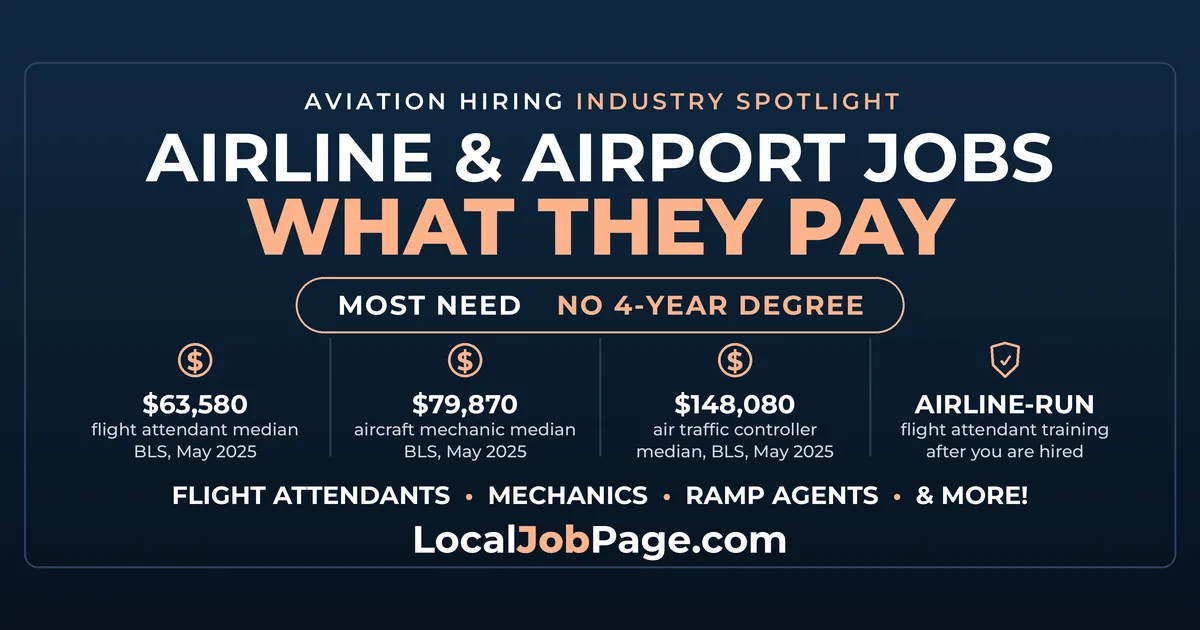
| Job | Median pay, May 2025 |
| Flight attendants | $63,580 a year |
| Aircraft mechanics and service technicians | $79,870 a year |
| Avionics technicians | $82,280 a year |
| Commercial pilots | $123,220 a year |
| Air traffic controllers | $148,080 a year |
| Airline pilots, copilots and flight engineers | $232,140 a year |
The spread inside each job matters as much as the median. For flight attendants, BLS reported that the lowest-paid 10% earned under $35,110 and the top 10% earned over $136,430. Expect to start toward the low end of that range and move up over time.
Where you work changes the number, too. BLS put the median for aircraft mechanics at $96,170 in air transportation, compared with $72,910 at companies providing support services to airlines and airports. The hangar at a major carrier and the hangar at a contractor down the road can pay very differently for similar work.
BLS does not publish a single figure that cleanly covers ramp agents or airline customer service agents, and pay for those jobs varies by carrier, airport and union contract. Check the posted range on each listing rather than relying on an average.
🎓 Training and Credentials
Flight attendant: a high school diploma is the typical entry requirement, and BLS notes airlines usually want one or two years of customer-facing service experience. Once hired, you go through the airline's own training program, which runs several weeks to a few months. Passing it earns the FAA Certificate of Demonstrated Proficiency. The airline provides that training after it hires you, so there is no course to take before applying.
Aircraft mechanic: the usual path is an FAA-approved aviation maintenance technician school, which leads to the mechanic certificate with airframe and powerplant ratings, the A&P. Under the FAA's rules in 14 CFR Part 65, you must be at least 18 and able to read, write, speak and understand English. Without a school, the alternative is documented hands-on experience: at least 18 months for one rating, or 30 months working on both for the pair. Military aviation maintenance is another common route in.
Pilot: the longest and most expensive path. A commercial pilot certificate requires flight hours, a medical exam and written and practical tests, and an instrument rating is needed to fly passengers for pay beyond 50 miles or at night. Flying for a scheduled airline requires the higher Airline Transport Pilot certificate, and BLS notes airline pilots typically also hold a bachelor's degree. Federal law sets the mandatory retirement age for airline pilots at 65.
Air traffic controller: applicants must be U.S. citizens, pass the FAA's pre-employment tests, including the Air Traffic Skills Assessment, clear a medical evaluation and background check, and complete training at the FAA Academy in Oklahoma City. The FAA also sets a maximum age to apply, so check the current announcement before you plan around it. BLS lists an associate's degree as typical, often through an FAA-approved Collegiate Training Initiative program, though qualifying work experience can substitute.
TSA and ground roles: no aviation credential is needed to start. TSA officer applications go through USAJOBS, per the agency's hiring process page, followed by an interview and additional clearances and evaluations. Airlines and ground-handling companies train ramp and gate staff on the job.
🔥 Who's Hiring
Five kinds of employers do most of the hiring. Passenger airlines hire flight attendants, gate and ramp agents, mechanics and pilots, with the biggest teams at their hub airports. Cargo carriers run their own fleets and sorting hubs and hire mechanics, ramp workers and pilots. Repair stations and aircraft manufacturers employ a large share of mechanics and avionics technicians. Ground-handling contractors and airport concession operators fill many of the ramp, fueling, cleaning and food service jobs. Federal agencies, the FAA and the TSA, hire controllers and security officers.
The growth outlook is solid for the cabin and the hangar. In its 2025–35 projections, BLS expects flight attendant jobs to grow 9%, pilot jobs 7% and aircraft mechanic and avionics jobs 6%, all faster than the average for all occupations. Air traffic controllers are projected at 2%, slower than average, though retirements still open seats. Projections are a model, not a promise about next year.
⚠️ Who This Field Is Not For
Anyone who needs a fixed schedule. Flights run nights, weekends and holidays. BLS notes that nearly all new flight attendants start on reserve, meaning on call, and that duty days can run 4 to 18 hours or longer.
Anyone who cannot clear screening. BLS lists a background check and a drug test for flight attendants, and the TSA adds clearances and evaluations before an offer is final. Controllers face a background check and medical evaluation as well.
Anyone counting on fast pilot pay. The airline pilot median is high, but reaching an airline cockpit takes years of training and flight time before the first airline paycheck.
🔎 Search Airline and Airport Jobs Now
- Flight attendant jobs
- Aircraft mechanic jobs
- Avionics technician jobs
- Ramp agent jobs
- Airline customer service jobs
- Transportation security officer jobs
- Airport jobs
- Pilot jobs
- Delta jobs
🗺️ Where to Look in Your City
These network cities are home to major airline hubs or large air-cargo operations, which is where most airline and airport hiring concentrates.
- Airport jobs in Atlanta
- Airport jobs in Dallas
- Airport jobs in Denver
- Airport jobs in Chicago
- Airport jobs in Charlotte
- Airport jobs in Houston
- Airport jobs in Phoenix
- Airport jobs in Los Angeles
- Aircraft mechanic jobs in Seattle
- Airport jobs in Miami
- Aircraft mechanic jobs in Memphis
- Ramp agent jobs in Louisville
Not on the list? Find your city.
Frequently Asked Questions
Do you need a degree to work for an airline?
For most jobs, no. Flight attendants typically need a high school diploma, mechanics need FAA certification rather than a degree, and ramp, gate and TSA jobs train on the job. Airline pilots are the main exception: BLS notes they typically hold a bachelor's degree.
How much do flight attendants make?
The national median was $63,580 a year in May 2025, according to BLS. New hires usually start well below the median.
How long does it take to become an aircraft mechanic?
Either complete an FAA-approved maintenance technician school or log at least 18 months of documented experience for one rating, or 30 months for both airframe and powerplant, under FAA rules. You must be at least 18.
What is the easiest way to start working at an airport?
Ramp, gate, customer service, concessions and TSA screening jobs have the lowest entry bar and train on the job. Many people use them to learn the operation before applying for cabin, maintenance or operations roles.
Find Your Way Into Aviation
Create a free LocalJobPage account to save searches and get new airline and airport postings as they go up. Sign up as a job seeker or browse all jobs.
Employers: hiring ramp, gate, maintenance or airport service staff? Post your openings on LocalJobPage.
Related Reading
- Bombardier Plans to Hire 800 in the U.S.: Where the Aircraft Service Jobs Are
- Phoenix Sky Harbor Airport Job Fair Returns at 44th Street Station
- Auto Mechanic Jobs: What They Pay and How to Get Hired
- Customer Service and Office Jobs: What They Pay and How to Get Hired
If you want into aviation without years of school, the ramp, the gate and the maintenance school are the fastest doors. Pick the one that fits your schedule and start applying at your nearest hub.