Insurance Jobs: What They Pay and How to Get Licensed
INSURANCE HIRING — Insurance is one of the few office careers where a high school diploma and a state exam can get you to a median paycheck above $60,000. The catch is the license, and the fact that a lot of the money in sales comes from commission.
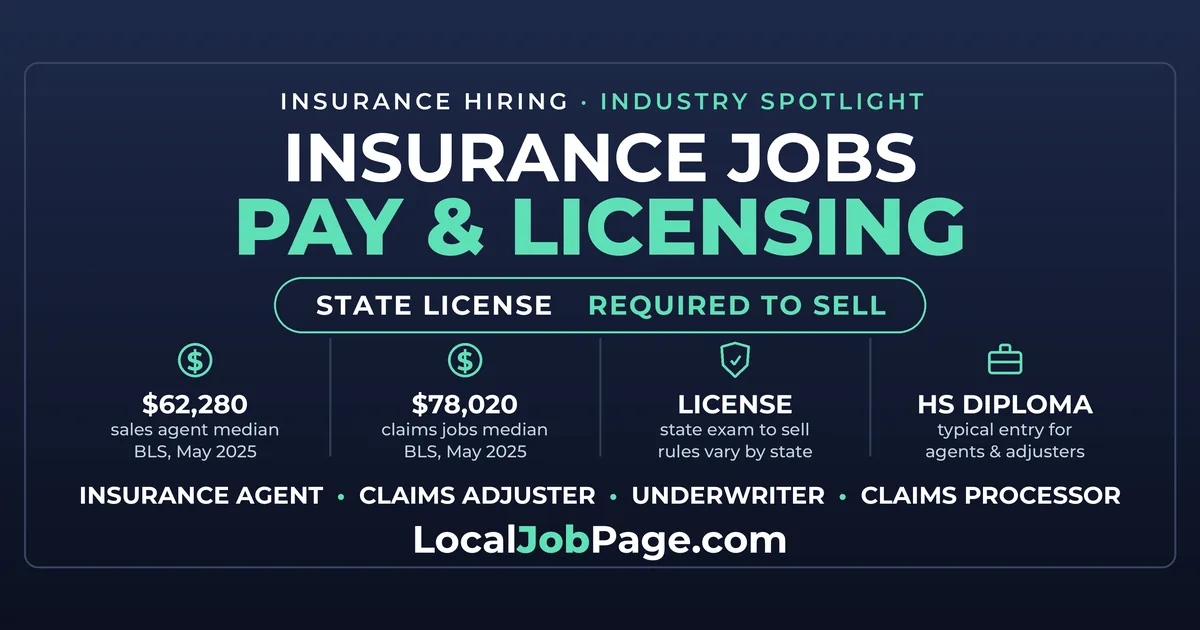
Insurance jobs pay a national median of $62,280 for sales agents and $78,020 for claims adjusters and their related roles, and most entry-level insurance jobs need a state license or on-the-job training rather than a four-year degree.
Just want the openings? Skip straight to the job links and begin searching now →
💼 The Jobs
Insurance work splits into two sides: the people who sell and service policies, and the people who decide what a policy pays out. Here is what the main entry points look like day to day.
Insurance sales agents find customers, explain coverage, recommend changes and handle renewals. They usually specialize in property and casualty (home, auto, business) or in life and health. According to the Bureau of Labor Statistics, about 63% of agents work for insurance agencies and brokerages, 12% are self-employed, and about 13% work directly for insurance carriers.
Claims adjusters, examiners and investigators decide whether a loss is covered and how much to pay. Adjusters inspect damage and interview claimants. Examiners review files for accuracy and policy rules. Investigators look into suspected fraud such as staged accidents. Field adjusters often work evenings and weekends, and natural disasters drive claim surges.
Auto damage appraisers inspect wrecked vehicles, often at body shops, and estimate the repair bill. Many arrive with experience estimating auto repair costs.
Insurance underwriters review applications and decide whether to approve them and at what premium. It is a desk job with regular business hours, and much of the day is spent with underwriting software.
Claims and policy processing clerks and customer service representatives are the back office: entering claims, updating policies, answering policyholder calls. They are a common way into a carrier without a license or a degree.
💵 What Insurance Jobs Pay
The figures below are national medians from the Bureau of Labor Statistics for May 2025, the most recent wage data available. A median is the middle: half the people in that job earned less, half earned more. The range columns show where the lowest-paid and highest-paid 10% start.
| Job | Median pay, May 2025 | Lowest 10% / Highest 10% |
| Insurance sales agents | $62,280 a year ($29.94/hr) | under $37,330 / over $138,140 |
| Claims adjusters, examiners and investigators | $78,000 a year | under $48,850 / over $117,040 |
| Auto damage appraisers | $78,240 a year | under $58,360 / over $101,590 |
| Insurance underwriters | $81,370 a year ($39.12/hr) | under $55,530 / over $145,160 |
| Insurance claims and policy processing clerks | $49,230 a year | not published in the summary |
For the claims group as a whole, adjusters, appraisers, examiners and investigators combined, BLS puts the May 2025 median at $78,020. Customer service representatives working for insurance carriers had a median of $22.47 an hour, ahead of the $21.53 median for customer service reps across all industries.
Sales pay is the one to read closely. BLS notes that commission is the most common form of pay for agents, especially experienced ones. Agents employed by an agency or carrier may get a salary, salary plus commission, or salary plus bonus, while independent agents may earn commission only. That is why the spread between the lowest and highest 10% is so wide. Ask any employer exactly how the first year is paid before you accept.
If you sell health coverage to older adults, the calendar matters: Medicare's annual open enrollment runs every year from October 15 to December 7, according to the Centers for Medicare & Medicaid Services.
🎓 Licensing and Training
This is where insurance differs from most office work. Licensing is set by each state, not nationally, so check your own state's rules before you pay for a course.
- Sales agents must be licensed in every state where they sell. Life and health is a separate license from property and casualty. Licensing generally means a prelicensing course and a state exam, and most states require continuing education to renew. Selling securities products adds a FINRA license (Series 6 or 7).
- Claims adjusters face rules that vary widely. BLS reports that some states require little, others require prelicensing education, an exam or both, and in some states an adjuster employed by an insurer works under the company's license. Public adjusters, who represent the policyholder, can face extra requirements.
- Underwriters typically need a bachelor's degree. Professional designations are optional but employers may expect coursework toward one.
- Customer service reps who give out insurance information may need a state license, depending on the state. Clerks generally learn on the job.
BLS lists a high school diploma as the typical entry-level education for sales agents and for claims adjusters, examiners and investigators, though some employers prefer a bachelor's degree, often in business. Most of the job is learned on the job, often by shadowing an experienced agent or working small claims under supervision. Ask whether an employer will cover the course and exam fee before you pay it yourself.
Your state's insurance department is the authority on what you need. The National Association of Insurance Commissioners keeps a directory of every state regulator.
📊 Where the Field Is Heading
Be realistic here: insurance is a steady field, not a fast-growing one. BLS projects employment of insurance sales agents to grow 3% from 2025 to 2035, about average, with roughly 43,100 openings a year, mostly from people retiring or changing careers. Growth is expected to be strongest among self-employed agents.
The claims and underwriting side is projected to shrink. BLS projects a 6% decline for claims adjusters, appraisers, examiners and investigators combined, a 4% decline for underwriters and a 2% decline for claims and policy processing clerks over the same ten years. These are model projections, not forecasts for next year, and people leaving the field still create openings. Sales has the most openings and the most room to grow.
🔥 Who's Hiring
Most insurance jobs sit with three types of employer:
- Insurance agencies and brokerages, from one-office independent agencies to national brokers. This is where most agents work.
- Carriers such as State Farm, Allstate, Progressive and GEICO, which employ adjusters, underwriters and large customer service and claims teams, and in some cases recruit agents to run their own offices.
- Health insurers, which hire for member services and claims processing.
Search by job title to see the full spread, then narrow down.
⚠️ Who This Field Is Not For
- If you need a guaranteed paycheck from week one, avoid commission-only agent roles. Look for salaried trainee or salary-plus-commission positions instead.
- If cold calling and rejection wear you down, sales will be hard. Claims, processing or service roles may fit better.
- If you can't work irregular hours, field adjusting may not suit you. It can mean evenings, weekends and surges after natural disasters.
- If you have a past fraud or financial-crime issue, ask your state insurance department how it affects licensing before you pay for a course.
🔎 Search Insurance Jobs Now
- All insurance jobs
- Insurance agent jobs
- Insurance sales jobs
- Claims adjuster jobs
- Claims processor jobs
- Underwriter jobs
- Insurance customer service jobs
- State Farm jobs
- Progressive jobs
New to the field? Start with the agent, processor and customer service searches. Those are the roles most open to beginners.
🗺️ Where to Look in Your City
Insurance jobs exist in every market, but these metros are home to big carrier headquarters or large regional claims and service centers.
- Insurance jobs in Columbus
- Insurance jobs in Omaha
- Insurance jobs in Chicago
- Insurance jobs in Louisville
- Insurance jobs in Indianapolis
- Insurance jobs in Minneapolis
- Insurance jobs in Boston
- Insurance jobs in Dallas
- Insurance jobs in Phoenix
- Insurance jobs in Atlanta
Not on the list? Find your city.
Frequently Asked Questions
Do you need a degree to work in insurance?
Not for most entry roles. BLS lists a high school diploma as the typical entry-level education for insurance sales agents and for claims adjusters, examiners and investigators. Underwriters are the main exception and typically need a bachelor's degree.
How much do insurance agents make?
The national median for insurance sales agents was $62,280 a year in May 2025, according to BLS. The lowest-paid 10% earned under $37,330 and the top 10% over $138,140, largely because so much agent pay is commission.
How long does it take to get an insurance license?
It depends on your state and the license line. Most states require a prelicensing course and a state exam. Check your state insurance department for the exact hours and exam schedule.
Is an insurance license good in every state?
No. Agents need a license in each state where they sell, and life and health is a separate license from property and casualty.
📢 Start Your Insurance Career
Create a free LocalJobPage account and start applying to insurance jobs near you, or browse all jobs.
Employers: Hiring agents, adjusters or service staff? Post your openings on LocalJobPage and reach job seekers in 50 cities.
Related Reading
- Sales Jobs: What They Pay and How Commission Really Works
- Customer Service and Office Jobs: What They Pay and How to Get Hired
- Banking Jobs: What They Pay and How to Get In Without a Degree
- How to Negotiate a Job Offer, Even for an Hourly Job
The fastest way into insurance is a salaried trainee or service role at an employer that pays for your license. Ask about that in the first interview.