Utility and Energy Jobs: What They Pay and How to Get In
UTILITY & ENERGY JOBS — The people who keep the lights on and the water running do some of the best-paid work in the country that doesn't require a college degree. The work ranges from climbing poles after a storm to watching a control room overnight.
Five utility and energy jobs, from lineworker to wind turbine technician, none of which require a four-year degree, with what each paid in May 2025 and how people actually get hired.
Ready to go? Skip straight to the job links and begin searching now →
💼 The Utility and Energy Jobs Worth Knowing
All figures below come from the Bureau of Labor Statistics Occupational Outlook Handbook, which reports May 2025 wages and 2025 job counts.
Lineworkers (electrical power-line installers and repairers)
Lineworkers build and fix the overhead and underground lines that carry electricity from power plants to homes and businesses. The day means climbing poles, working from bucket trucks and handling high-voltage equipment, and after a storm it means long stretches restoring power. BLS counted 131,900 of these jobs in 2025.
Power plant operators, distributors and dispatchers
These workers run the equipment that generates electricity and control how power moves across the grid, mostly from control rooms. The group includes nuclear reactor operators. BLS counted 43,700 jobs in 2025.
Water and wastewater treatment plant operators
Operators run the plants that clean drinking water and treat sewage before it goes back into rivers. They read gauges, take samples, adjust chemical treatment and keep pumps running. There were 131,000 jobs in 2025, and about three in four were with local governments.
Wind turbine technicians
Wind techs inspect, maintain and repair turbines, often working inside the nacelle at the top of towers that commonly run taller than 200 feet. It is the smallest field here, at 11,800 jobs, but one of the fastest growing.
Solar photovoltaic installers
Installers mount panels on rooftops and at ground-level solar farms and connect them to electrical systems, often alongside roofers and electricians. BLS counted 31,100 jobs in 2025.
💵 What Utility and Energy Jobs Pay
| Job | Median pay, May 2025 | Jobs, 2025 | Projected change, 2025–35 |
| Power plant operators, distributors and dispatchers | $105,080 | 43,700 | −4% |
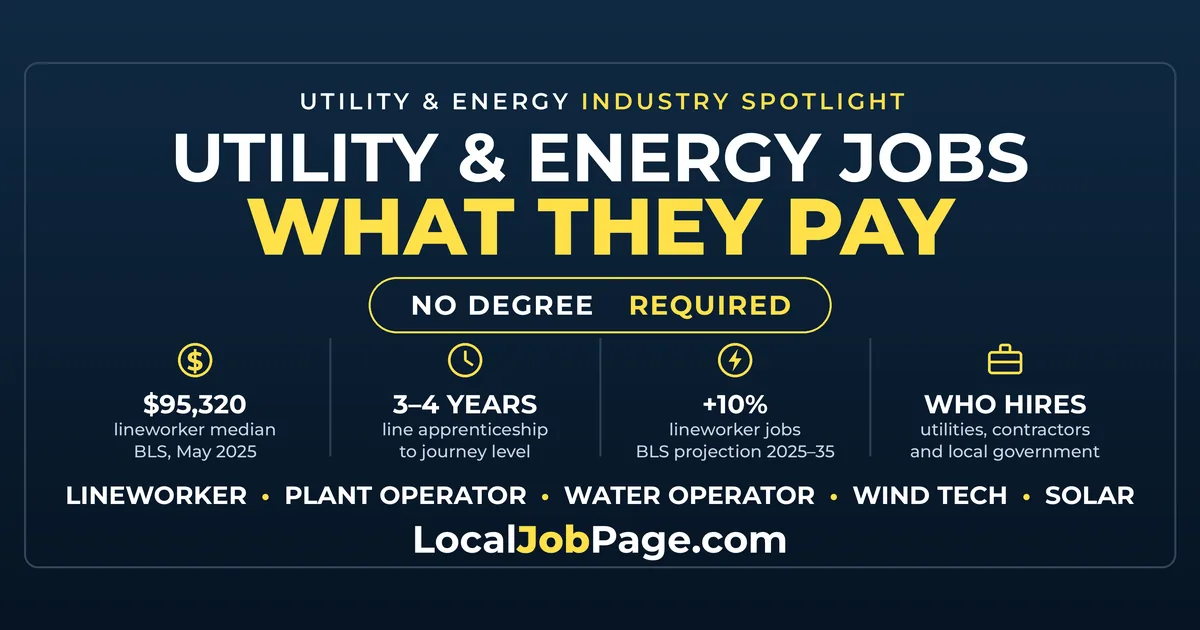
| Lineworkers (electrical power-line installers and repairers) | $95,320 | 131,900 | +10% |
| Wind turbine technicians | $64,120 | 11,800 | +30% |
| Water and wastewater treatment plant operators | $60,020 | 131,000 | −6% |
| Solar photovoltaic installers | $53,140 | 31,100 | +37% |
Source: Bureau of Labor Statistics, Occupational Outlook Handbook. Projections are BLS model estimates for 2025 to 2035, not a forecast of next year.
These are medians, so half the people in each job earned less. For comparison, BLS put the median for all U.S. workers at $50,980 in May 2025. The lineworker median is nearly double that.
The spread inside each job is wide. The lowest-paid 10 percent of lineworkers earned less than $51,470 and the top 10 percent earned more than $128,690. Where you work matters too: lineworkers employed directly by utilities had a median of $103,060, against $76,060 at utility construction contractors. Water operators ranged from under $39,110 at the bottom 10 percent to over $91,060 at the top. Nuclear reactor operators had the highest median in this group, $122,890.
Two of these jobs are projected to shrink, but that is not the same as closing. BLS still expects about 10,000 water operator openings and about 3,400 power plant openings a year, all of them from people retiring or changing fields. Lineworkers are projected to see about 10,900 openings a year, solar installers about 4,200 and wind techs about 1,500. BLS ties lineworker growth to rising electricity demand, including from data centers, and to grid upgrades.
🎓 Training and Credentials
Lineworkers. A high school diploma is the usual starting point, followed by an apprenticeship that employers and unions often run together. BLS says apprentices typically reach journey level after three or four years. Getting in can mean a year of high school algebra, an aptitude test, a substance screening and a fitness test. Some community colleges offer one-year certificates or two-year degrees that cover line construction and pole-top and bucket rescue. Most lineworkers who drive heavy trucks also need a commercial driver's license, and crews that cross state lines need an interstate CDL.
Power plant operators. A high school diploma with strong math and science is typical, and employers may give an aptitude exam covering reading, mechanical concepts, spatial ability and math. Expect several years of on-site training before you are fully qualified. Nuclear reactor operators must be licensed by the U.S. Nuclear Regulatory Commission, pass a medical exam and keep passing periodic exams, and the license does not move with you to another plant.
Water and wastewater operators. Most states require a license, usually in levels that rise with experience. Many entry-level operators earn their first license while training on the job. Rules vary widely by state, and a license from one state is not always honored in another, so check your state's licensing board before you plan around one.
Wind turbine technicians. Most enter through a postsecondary certificate or associate's degree in wind energy technology from a technical school or community college, then get turbine-specific training from the employer or manufacturer.
Solar installers. A high school diploma and on-the-job training are the norm, and BLS rates the training as moderate-term, from one month to a year. Short courses run from a few days to several months. Experience as an electrician, roofer, carpenter or construction laborer can shorten the learning curve. Some states require a license.
🔥 Who's Hiring Utility and Energy Workers
Utilities themselves employ half of all lineworkers. Another 29 percent work for utility construction contractors, 10 percent for local governments, including city-run utilities, and 2 percent for the federal government, where the median was $111,900.
Water and wastewater work is overwhelmingly a public job: local governments employ 74 percent of operators and utilities another 14 percent. That makes your city or county jobs page one of the best places to look.
Wind techs work mostly for wind power operators (42 percent), line construction firms (15 percent) and machinery repair companies (12 percent), and 15 percent are self-employed. Solar installers work mainly for electrical contractors (39 percent), but 17 percent are placed through temporary staffing agencies, so read the job post closely to see who the employer actually is.
⚠️ Who This Field Is Not For
- Anyone uneasy with heights or high voltage. Lineworkers, wind techs and solar installers work aloft, in harnesses, near live electricity.
- Anyone who needs predictable hours. Power and water plants run around the clock, so rotating 8- or 12-hour shifts, nights and weekends are common. Lineworkers may travel to storm zones and work long days for several days in a row.
- Anyone who can't pass the screening. Line apprenticeship applicants may face a substance screening and a fitness test, and nuclear plants operate under heightened security.
- Anyone who wants to stay indoors. Most of this work happens outside in all weather, and offshore wind jobs can mean days or weeks away from home.
Where to Aim Right Now
If the paycheck matters most and you can handle the physical side, a line apprenticeship is the strongest route without a degree. If you want steady public-sector work, look for water or wastewater operator trainee jobs with your city. If you want the fastest start, solar installation has the shortest training, and construction experience carries over. If you already turn wrenches and don't mind heights, wind is one of the fastest-growing fields, from a small base.
🔎 Search Utility Jobs Now
- Lineman and lineworker jobs
- Apprentice lineman jobs
- Power plant operator jobs
- Water treatment operator jobs
- Wastewater operator jobs
- Wind turbine technician jobs
- Solar installer jobs
- All utility jobs
- Duke Energy jobs
Prefer to browse? See every open job on LocalJobPage.
🗺️ Where to Look in Your City
These markets are home to large public power and water utilities, major utility headquarters, or the wind-heavy southern Plains.
- Utility jobs in Los Angeles
- Utility jobs in Sacramento
- Utility jobs in Seattle
- Utility jobs in Jacksonville
- Utility jobs in Omaha
- Utility jobs in Memphis
- Utility jobs in Charlotte
- Utility jobs in Atlanta
- Utility jobs in Houston
- Utility jobs in Oklahoma City
- Utility jobs in Wichita
Not on the list? Find your city.
Frequently Asked Questions
Do you need a college degree to work for a utility?
Not for these five jobs. BLS lists a high school diploma as the typical entry education for lineworkers, power plant operators, water operators and solar installers. Wind turbine technicians typically need a postsecondary certificate, not a degree.
How long does it take to become a lineworker?
BLS says apprentices typically reach journey level after three or four years of on-the-job training combined with technical instruction. Some community colleges also offer one-year certificates and two-year degrees in line work.
Do lineworkers need a CDL?
Usually. BLS says lineworkers who drive heavy vehicles generally need a state commercial driver's license, and crews that work across state lines need an interstate CDL.
Are water treatment jobs going away?
BLS projects a 6 percent decline from 2025 to 2035, but still expects about 10,000 openings a year as current operators retire or change careers.
Do I need a license to run a water or wastewater plant?
Usually yes, from your state. Licenses come in levels, many operators earn the first one during on-the-job training, and requirements differ by state.
Your Next Move: Get in Front of Utility Employers
Whether you're aiming for a line apprenticeship or a trainee spot at the water plant, start with a profile. Create your free LocalJobPage account, then browse every open job.
Employers: Hiring lineworkers, operators or installers? Post your jobs on LocalJobPage and reach job seekers in 50 cities.
Related Reading
- Skilled Trades Jobs: What They Pay and How to Get In Without a Degree
- Truck Driving and Delivery Jobs: What They Pay and How to Get a CDL
- Manufacturing Jobs: What They Pay and How to Get In
- Where the Jobs Will Be by 2035: BLS Projects 5.9 Million New Ones
Pick the job that fits how you want to work, up a pole, in a control room or at a treatment plant, and start with the search links above.