Manufacturing Jobs: What They Pay and How to Get In
Published: September 18, 2026 | By LocalJobPage Team
MANUFACTURING HIRING — American factories employed 12.6 million people in August 2026, and that number has barely moved in years. It reads like a closed door. The openings data says otherwise.
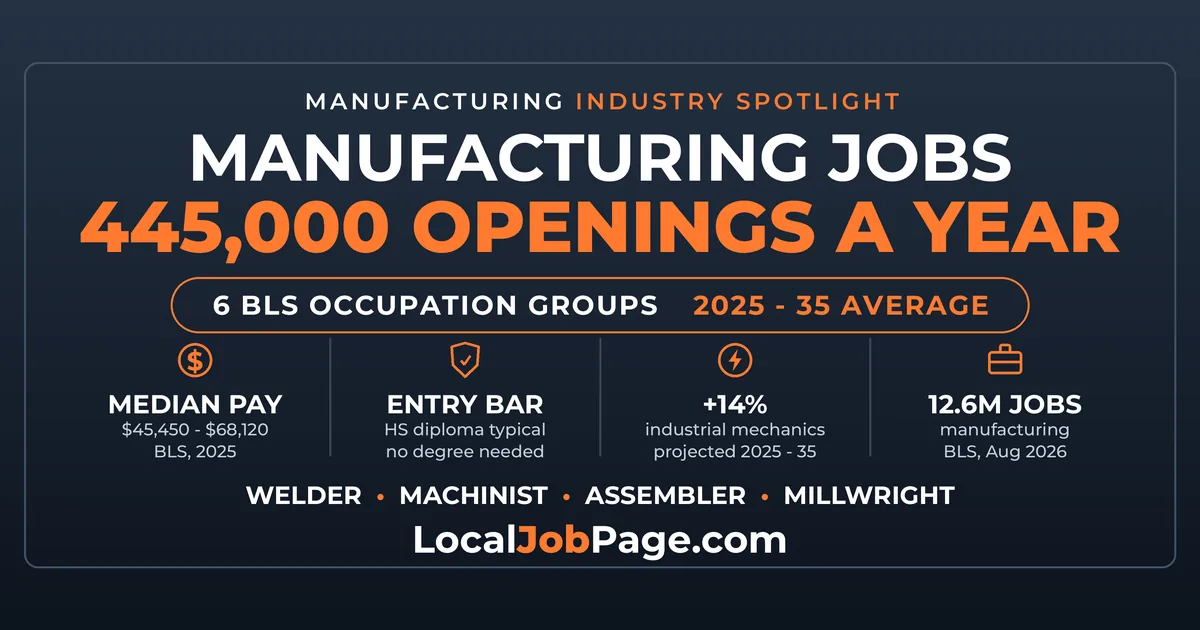
Six manufacturing occupation groups tracked by the Bureau of Labor Statistics are projected to average roughly 445,000 job openings a year through 2035, and most of those openings exist because workers are leaving, not because plants are expanding.
Just want the openings? Skip straight to the job links and begin searching now →
📊 Flat Employment, Steady Openings
Start with the number that scares people off. The Bureau of Labor Statistics counted 12,638,000 manufacturing jobs in August 2026, seasonally adjusted and preliminary, split between 7,891,000 in durable goods and 4,747,000 in nondurable goods, up 16,000 over the month. Looking further out, BLS projects little or no change in production employment between 2025 and 2035.
Flat is not closed. Employment level counts how many seats exist; openings count how often one comes free. An industry that never adds a job still has to replace everyone who retires.
Here is what BLS projects for six manufacturing occupation groups over the 2025 to 2035 decade.
| Occupation group | Jobs, 2025 | Projected change, 2025 – 35 | Average openings a year |
| Assemblers and fabricators | 1,799,500 | +1% | about 177,500 |
| Metal and plastic machine workers | 963,000 | -7% | about 78,100 |
| Quality control inspectors | 602,000 | +3% | about 66,700 |
| Industrial machinery mechanics, maintenance workers, millwrights | 547,300 | +14% | about 51,900 |
| Welders, cutters, solderers, brazers | 437,700 | +2% | about 40,300 |
| Machinists and tool and die makers | 344,900 | -1% | about 30,400 |
Those openings add to about 444,900 a year. The sum is ours rather than the agency's, so the components sit in the table above.
Two qualifications go with that number. BLS says most of these openings come from replacing workers who move to other occupations or leave the labor force, including retirement, not from new positions. And BLS counts each occupation across every industry that employs it, not only factories: manufacturing accounts for 63 percent of welders, 64 percent of quality control inspectors and 51 percent of industrial machinery mechanics and millwrights, with the rest in construction, wholesale trade and repair work.
💼 The Jobs
Assemblers and fabricators build finished products and the parts inside them, reading blueprints, positioning components, and checking their own work. A quarter work in transportation equipment manufacturing: vehicles, aircraft and rail.
Metal and plastic machine workers set up and run the machines that cut, shape and form parts. The computer numerically controlled roles sit inside this group and split sharply: CNC tool operators run the machines, CNC tool programmers write the code that tells them what to do.
Quality control inspectors check that what came off the line matches the specification, and it is a common internal move for someone who started on that line.
Industrial machinery mechanics, machinery maintenance workers and millwrights keep the equipment running, and they are the growth story here. BLS attributes the projected 78,900 added positions partly to the spread of automated machinery that needs maintaining.
Welders, cutters, solderers and brazers join and cut metal parts, just under two thirds of them inside manufacturing.
Machinists and tool and die makers are the smallest of the six and the most specialized. Machinists produce precision parts; tool and die makers build the tools and dies other machines run on.
💵 What It Pays
These are national median annual wages for 2025, published by the Bureau of Labor Statistics. A median is the middle: half the people in each occupation earned less. Pay varies with region, shift, union status and experience, and a new hire should expect to start below the median.
| Occupation | 2025 median pay |
| Assemblers and fabricators | $45,450 a year, $21.85 an hour |
| Metal and plastic machine workers | $47,700 a year, $22.94 an hour |
| Quality control inspectors | $48,570 a year, $23.35 an hour |
| CNC tool operators | $50,690 a year |
| Welders, cutters, solderers and brazers | $53,750 a year, $25.84 an hour |
| Machinists | $58,750 a year, $28.66 an hour |
| Tool and die makers | $64,050 a year |
| Industrial machinery mechanics | $64,520 a year |
| Millwrights | $65,700 a year |
| CNC tool programmers | $68,120 a year |
Read that list twice. The gap from bottom rung to top is roughly $23,000 a year, every step up it is a skill rather than a diploma, and CNC programming pays about $17,000 more than CNC operating.
🎓 Training and Credentials
BLS lists a high school diploma or equivalent as the typical entry-level education for every occupation in that table. What separates them is training time.
Assemblers, machine workers, quality inspectors and welders are all classed as moderate-term on-the-job training, generally up to about a year of learning while being paid. Welders often add coursework at a vocational school, community college or private welding program first; BLS notes many employers prefer candidates who arrive with a credential, though some train from scratch.
Machinists and tool and die makers need long-term on-the-job training, usually a two-year community college program, an employer apprenticeship, or both, with CNC and CAD/CAM certifications available through colleges and professional organizations. Industrial machinery mechanics typically need more than a year on the job. Millwrights are the outlier, with a three to four year apprenticeship – the longest runway here, and the second-highest median on the list.
Licensure is not national. BLS notes that state and local requirements for welders vary, some jurisdictions requiring credentials and others not, so check the state where the work will be performed rather than where you live. OSHA requires electrical safety training for welders regardless of state.
🔥 Who's Hiring
Manufacturing is not one employer type, and the difference shapes your search terms. For assemblers and fabricators, BLS puts transportation equipment manufacturing at 25 percent of employment, machinery manufacturing at 10 percent, fabricated metal at 9 percent, computer and electronic products at 8 percent, and temporary help services at 9 percent.
Name that last one plainly: close to one in ten assembly jobs is staffed through a temp agency, usually meaning contract-to-hire, a lower starting rate, and benefits that begin only on conversion. It is a legitimate way in. Ask about the conversion timeline and how many contractors the site converted last year. Outside the plant, industrial machinery mechanics and millwrights also work in wholesale trade at 13 percent, machinery repair at 11 percent and construction at 5 percent, so thin factory listings near you do not close off the skill set.
⚠️ Who This Field Is Not For
Two of the six groups are projected to shrink by 2035: metal and plastic machine workers by 7 percent, a loss of 63,000 positions, and tool and die makers by 9 percent. They still turn over enough to produce openings, but they are not where a twenty-year plan belongs.
The hours are real hours: manufacturing averaged 40.5 hours a week in August 2026, and plants that run continuously staff nights, weekends and rotating shifts. The work is physical. If a fixed daytime schedule or a lifting restriction is a hard constraint, screen for it before you apply.
🔎 Where to Aim Right Now
Search by job title, not by industry. Almost nobody posts a job called "manufacturing." They post assembler, machine operator, welder, CNC machinist, maintenance technician. Run several, because the same role carries a different title at every plant.
Start here:
- Manufacturing jobs
- Assembler jobs
- Machine operator jobs
- Welder jobs
- CNC machinist jobs
- Quality inspector jobs
- Industrial maintenance technician jobs
- Millwright jobs
- Production supervisor jobs
- Caterpillar jobs
🗺️ Where to Look in Your City
Manufacturing clusters where the plants are, and the mix differs by metro: vehicles and parts across the industrial Midwest, aerospace and machinery in the Plains and Texas, food processing and fabricated metal nearly everywhere. These network cities all carry substantial manufacturing bases.
- Manufacturing jobs in Detroit
- Manufacturing jobs in Milwaukee
- Manufacturing jobs in Indianapolis
- Manufacturing jobs in Columbus
- Manufacturing jobs in Louisville
- Manufacturing jobs in Memphis
- Manufacturing jobs in Charlotte
- Manufacturing jobs in Wichita
- Manufacturing jobs in San Antonio
- Manufacturing jobs in Phoenix
Not on the list? Find your city.
Questions Job Seekers Ask About Manufacturing Work
Can I get a factory job with no experience?
For most entry roles, yes. BLS lists a high school diploma or equivalent as the typical entry-level education for assemblers, machine workers, quality inspectors and welders, with training provided after hire.
Which manufacturing job pays the most without a degree?
Of the occupations here, CNC tool programmers had the highest 2025 national median at $68,120 a year, then millwrights at $65,700 and industrial machinery mechanics at $64,520. All three are reached through training and apprenticeship.
Is manufacturing a shrinking industry?
Close to flat rather than collapsing. BLS counted 12,638,000 manufacturing jobs in August 2026, seasonally adjusted and preliminary, and projects little or no change in production employment to 2035. Inside that, industrial machinery mechanics are projected up 14 percent and tool and die makers down 9 percent.
Do I need a license to weld?
It depends where the work happens. BLS notes that state and local licensing requirements for welders vary. Certifications from professional organizations are separate from licensing and are often what an employer actually asks for.
Are temp agency manufacturing jobs worth taking?
They are a real entry point. Temporary help services account for 9 percent of assembler employment, which usually signals contract-to-hire. Establish the conversion timeline first.
🧭 Start With One Search This Week
Pick the two job titles closest to what you have already done, run them, and apply to three postings rather than reading about the sector for another week. A free job seeker account saves those searches, and browsing all open jobs shows which titles your metro actually uses.
Employers: if you are competing with every other plant in the metro for the same maintenance technicians, post your openings where local candidates are already searching. See posting options.
Related Reading
- Skilled Trades Jobs: What They Pay and How to Get In Without a Degree
- Warehouse and Logistics Jobs: What They Pay and How to Get Hired
- Where the Jobs Will Be by 2035: BLS Projects 5.9 Million New Ones
- Healthcare Jobs Without a Bachelor's Degree: What They Pay and How Long Training Takes
The seat count in American manufacturing is not growing, but the people in those seats keep leaving, and somebody has to replace them. That is a smaller story than a factory boom and a steadier one, and it is why a plant a few miles from you may well be hiring this month.