Nursing Jobs: What They Pay and How to Become a Registered Nurse
HEALTHCARE HIRING — Nursing is one of the few fields where you can start with a short state-approved training program and climb, one license at a time, to a six-figure job. Registered nurses held about 3.5 million jobs in 2025, according to the Bureau of Labor Statistics, and the agency projects about 180,800 RN openings a year on average through 2035. This guide covers what nursing jobs pay at each rung, how long each step takes, and where to start searching.
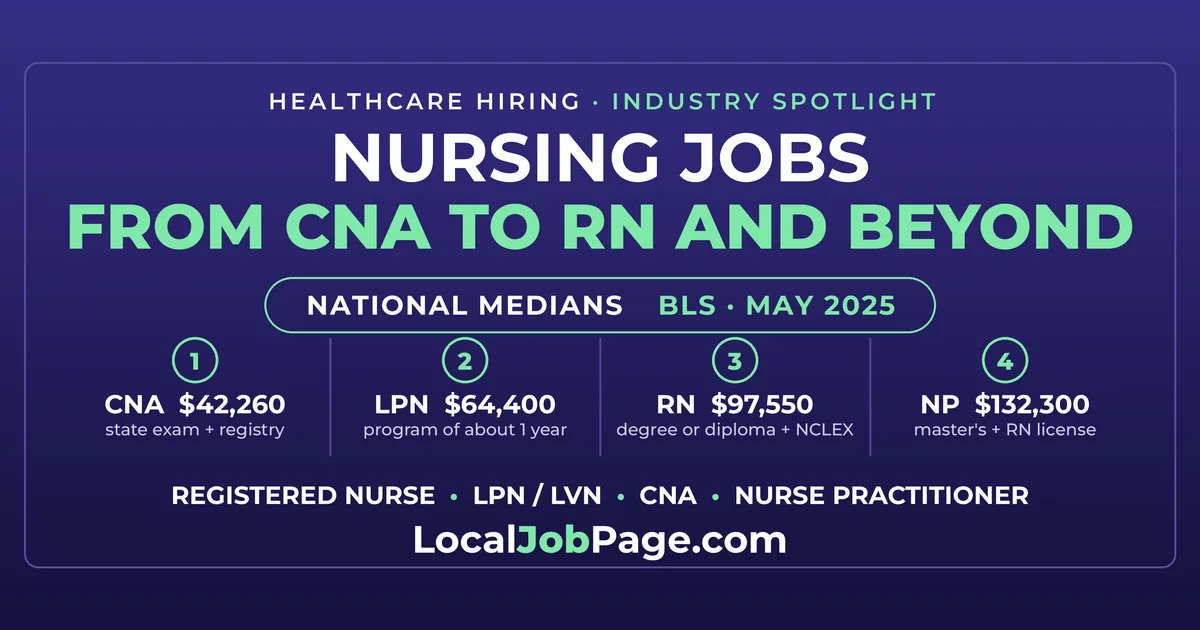
Four nursing roles, four very different entry points: nursing assistant, licensed practical nurse, registered nurse and nurse practitioner, with national median pay running from about $42,000 to more than $130,000.
Need work now? Skip straight to the job links and begin searching now →
💼 The Jobs: Four Rungs on the Nursing Ladder
Nursing assistants (CNAs). The entry rung. Nursing assistants help patients bathe, dress, eat and move, take vital signs and report changes to the nurses they work under. Nursing homes and hospitals are the main employers. The job is also the fastest way to find out whether patient care suits you before you pay for a longer program.
Licensed practical and vocational nurses (LPNs and LVNs). LPNs give basic nursing care under the direction of registered nurses and doctors: checking blood pressure, changing dressings, keeping records and, depending on the state, giving some medications. Texas and California use the title LVN for the same role. Nursing homes, home health agencies, hospitals and doctors' offices are the main employers.
Registered nurses (RNs). RNs assess patients, give medicines and treatments, set up care plans, run and monitor equipment, and teach patients and families how to manage an illness at home. RNs also supervise LPNs and nursing assistants.
Advanced practice registered nurses (APRNs). Nurse practitioners, nurse midwives and nurse anesthetists are RNs with graduate training. Nurse practitioners diagnose and treat illness and, in many states, prescribe medication. This is the top of the clinical ladder and the fastest-growing group in nursing.
💵 What Nursing Jobs Pay
The figures below are national medians from the Bureau of Labor Statistics for May 2025, the most recent occupational wage data. A median is the midpoint: half the people in the job earned more and half earned less. Pay varies by state, metro and shift.
| Job | Median pay, May 2025 | Typical entry path |
| Nursing assistant | $42,260 a year | State-approved training program and state competency exam |
| Licensed practical / vocational nurse | $64,400 a year ($30.96/hr) | State-approved program, typically about 1 year, plus a licensing exam |
| Registered nurse | $97,550 a year ($46.90/hr) | Bachelor's degree, associate's degree or diploma in nursing, plus a licensing exam |
| Nurse practitioner | $132,300 a year | Master's degree or higher, RN license, national certification, state APRN license |
| Nurse midwife | $134,040 a year | Same advanced practice path |
| Nurse anesthetist | $236,590 a year | Graduate program plus at least 1 year of critical care RN experience |
For registered nurses, the spread is wide. BLS reports the lowest-paid 10% earned less than $68,940 in May 2025 and the highest-paid 10% earned more than $137,470. The RN median was $100,220 in hospitals, $91,230 in ambulatory care such as clinics and outpatient centers, and $84,300 in nursing and residential care facilities. For LPNs the pattern flips: nursing and residential care facilities paid a median of $68,020, ahead of hospitals at $61,160.
Before you accept an offer, ask whether night, weekend or holiday shifts pay a differential on top of the base rate. On a full-time schedule it can change what a job is worth by a meaningful amount.
🎓 Training and Credentials: How Long Each Step Takes
Nursing assistant. You complete a state-approved program, offered at community colleges, technical schools, high schools, hospitals and nursing homes, then pass your state's competency exam. Passing puts you on the state registry, which BLS notes is required to work in a nursing home. Before you pay for a course, ask local nursing homes and hospitals whether they will train or reimburse new hires.
LPN or LVN. State-approved practical nursing programs typically take about a year, according to BLS, and are common at community colleges and technical schools. Graduates must pass a licensing exam, the NCLEX-PN, to be licensed.
Registered nurse. There are three routes in: a bachelor of science in nursing (BSN), an associate's degree in nursing (ADN or ASN), or a diploma from a hospital-based program. BLS says BSN programs typically take four years and diploma programs two to three. Every route ends with the same national licensing exam, the NCLEX-RN, developed by the National Council of State Boards of Nursing. You then hold a license from the state where you work. RN-to-BSN programs let associate's and diploma nurses finish a bachelor's later, which matters because BLS notes that employers, particularly hospitals, may require one.
Nurse practitioner, midwife or anesthetist. These roles require at least a master's degree in an advanced practice specialty, a registered nursing license, a national certification exam and a state APRN license. Nurse anesthetist programs also require at least a year of critical care experience as an RN.
Licenses are issued by states, not the federal government. Scope of practice, renewal rules and what an LPN or nurse practitioner may do all vary by state. Many states belong to the Nurse Licensure Compact, which lets a nurse with a multistate license practice in other member states. Check the current compact map and your own state board of nursing before you plan a move.
🔥 Who's Hiring Nurses
Hospitals are by far the largest employer of registered nurses, with 59% of RN jobs in 2025, according to BLS. Ambulatory care, which covers doctors' offices, outpatient surgery centers, clinics and home health, held 19%. Nursing and residential care facilities held 6%, and government employers held 5%, where the RN median was the highest of any setting at $110,780.
The outlook stays steady. BLS projects RN employment to grow 6% from 2025 to 2035, faster than the average for all jobs, driven by an aging population and more patients with chronic conditions. The advanced practice group is projected to grow 36% over the same decade. These are ten-year model projections, not a forecast for next year. For nursing assistants and LPNs, projected growth is slower, at 3% each, but turnover keeps openings high: BLS expects about 203,300 nursing assistant openings and 51,800 LPN openings a year.
A practical route many people take is to work as a nursing assistant at a hospital or nursing home while finishing an LPN or RN program. When you interview, ask whether the employer offers tuition assistance, flexible scheduling for students, or a new-graduate residency program for first-year RNs.
⚠️ Who Nursing Is Not For
Hospitals and nursing homes run around the clock, so new nurses and nursing assistants should expect nights, weekends and holidays. The work is physical: long hours on your feet, lifting and turning patients, and exposure to infectious disease.
Licensing boards and employers run background checks, and a criminal record can block or delay a license depending on the state and the offense. If that applies to you, contact your state board of nursing before you enroll, not after you graduate. Nursing programs can also be competitive to get into, and many require prerequisite science courses before you apply.
🔎 Search Nursing Jobs Now
- Registered nurse jobs
- Licensed practical nurse (LPN) jobs
- Licensed vocational nurse (LVN) jobs
- Certified nursing assistant (CNA) jobs
- Nurse practitioner jobs
- Home health nurse jobs
- New graduate nurse jobs
- HCA Healthcare jobs
- Kaiser Permanente jobs
🗺️ Where to Look in Your City
Every metro with a hospital hires nurses, so start with your own. These are some of the largest labor markets on the LocalJobPage network:
- Registered nurse jobs in New York
- Registered nurse jobs in Los Angeles
- Registered nurse jobs in Chicago
- Registered nurse jobs in Houston
- Registered nurse jobs in Philadelphia
- Registered nurse jobs in Boston
- Registered nurse jobs in Nashville
- Registered nurse jobs in Phoenix
- Registered nurse jobs in Atlanta
- Registered nurse jobs in Minneapolis
Not on the list? Find your city.
Frequently Asked Questions
How much do registered nurses make?
The national median for registered nurses was $97,550 a year, or $46.90 an hour, in May 2025, according to the Bureau of Labor Statistics. The lowest-paid 10% earned less than $68,940 and the highest-paid 10% more than $137,470.
What is the fastest way to start working in nursing?
Nursing assistant. You complete a state-approved training program and pass your state's competency exam. From there, an LPN program typically takes about a year.
Do I need a bachelor's degree to be a registered nurse?
No. An associate's degree or a diploma from an approved program also qualifies you to sit for the NCLEX-RN. Some employers, particularly hospitals, may require a bachelor's degree, and RN-to-BSN programs let working nurses earn one later.
What is the difference between an LPN and an RN?
LPNs give basic nursing care under the direction of RNs and doctors and train for about a year. RNs assess patients, set care plans and supervise other staff, and need a degree or diploma. The national median gap was about $33,000 a year in May 2025.
Can I use my nursing license in another state?
It depends on the states. Licenses are state-issued. If both states belong to the Nurse Licensure Compact and you hold a multistate license, you can practice in both. Otherwise you apply for a license in the new state.
Start Your Nursing Job Search Today
Whether you are looking for your first CNA job or your next RN role, create a free LocalJobPage account to start applying. You can also browse all jobs near you.
Employers: hiring nurses or nursing assistants? Post your openings on LocalJobPage and reach job seekers across 50 city sites.
Related Reading
- Healthcare Jobs Without a Bachelor's Degree: What They Pay and How Long Training Takes
- How to Negotiate a Job Offer, Even for an Hourly Job
- Common Job Interview Questions and How to Answer Them
- How to Write a Cover Letter That Gets Read
Nursing rewards people who start somewhere and keep climbing. Pick the rung you can reach this year, get licensed, and let each job pay for the next step.