Remote Jobs in 2026: Who Actually Works From Home and What They Pay
Published: September 15, 2026 | By LocalJobPage Team
NATIONWIDE — About one in five American workers did some work from home this year, and nearly three out of four of them sat in one slice of the labor market: management and professional occupations. Remote work is real. It is also narrower than the headlines suggest, and knowing where it lives saves you weeks of applying into the wrong pile.
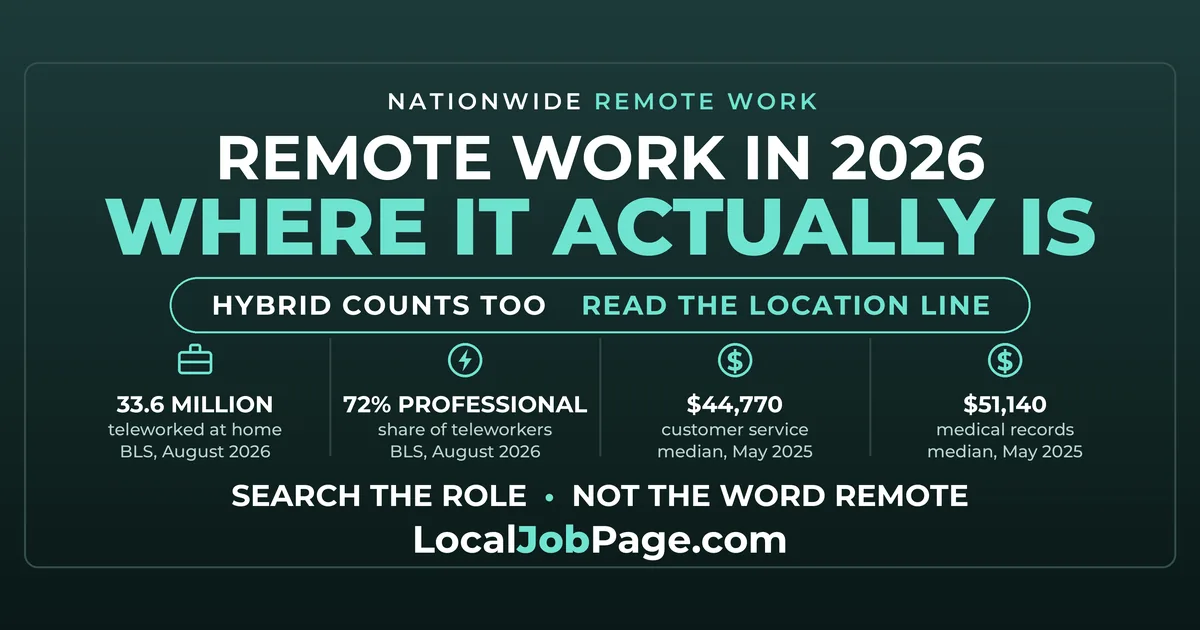
The Bureau of Labor Statistics counted 33.6 million people who teleworked or worked at home for pay in August 2026. Here is which fields they work in, what those roles pay, and the search terms that actually surface them.
Just want the openings? Skip straight to the job links and begin searching now →
📊 What the Numbers Say
The Bureau of Labor Statistics asks about telework every month through the Current Population Survey. In March 2026, 22.6 percent of employed people teleworked or worked at home for pay during the survey reference week, and BLS noted the rate had moved only between 21.5 percent and 23.0 percent over the prior year. These figures are not seasonally adjusted.
The more useful number is underneath. In August 2026, BLS Table A-46 counted 33,633,000 people who teleworked or worked at home for pay, split by occupation group. In thousands: management, professional and related, 24,351; sales and office, 6,828; service, 1,486; production, transportation and material moving, 554; natural resources, construction and maintenance, 414. Those five add to the total.
Run the arithmetic on those components and the picture is stark. Management and professional roles alone account for roughly 72 percent of everyone working from home. Add sales and office and you are at about 93 percent. Every service, production, transportation, construction and maintenance job in the country splits the remaining 7 percent.
That is the honest shape of remote work in 2026: not a general feature of the job market, but a concentration in desk work.
Which Industries Actually Telework
BLS published an industry breakdown for June 2026 in July. The spread between the top and the bottom is wider than most people expect.
| Industry | Share who teleworked, June 2026 |
| Finance and insurance | 59.0 percent |
| Financial activities, overall | 52.5 percent |
| Information | 47.2 percent |
| Professional and business services | 41.8 percent |
| Leisure and hospitality | 7.7 percent |
Source: Bureau of Labor Statistics, Current Population Survey, June 2026, not seasonally adjusted. Finance and insurance is a subsector of financial activities, which is why it sits above its own parent category.
This table is your targeting list. Insurance carriers, banks, credit unions, software and media companies, accounting firms and back-office operations of every kind are where the openings live. A restaurant group or a distribution center will not have them, however the posting is worded.
💵 What These Jobs Pay
The pay figures below come from the BLS Occupational Employment and Wage Statistics survey for May 2025, the most recent reference period published. A median means half the people in that occupation earned less than the figure shown and half earned more. For context, the median annual wage across all occupations was $50,980 in May 2025.
Roles that show up repeatedly in remote and hybrid postings, with their national medians and the education BLS lists as typical for entry:
- Customer service representatives: $44,770, high school diploma or equivalent
- Bookkeeping, accounting and auditing clerks: $50,670, some college, no degree
- Medical records specialists: $51,140, postsecondary nondegree award
- Computer support specialists: $62,890, education varies by employer
- Human resources specialists: $75,940, bachelor's degree
- Claims adjusters, appraisers, examiners and investigators: $78,020, education varies by employer
- Market research analysts: $78,760, bachelor's degree
- Software developers, quality assurance analysts and testers: $134,040, bachelor's degree
Customer service and medical records are the realistic entry points without a four-year degree. Medical records and coding work sits at $51,140, slightly above the all-occupations median, and BLS lists a postsecondary certificate rather than a degree as the typical credential.
One caution: these are medians for the occupation as a whole, on site and remote together. BLS publishes no separate wage series for remote-only postings. Treat them as a market anchor, not a quote for a work-from-home job.
⚠️ What the Data Does Not Say
Three things get lost when telework statistics turn into headlines.
Teleworking is not the same as holding a remote job. The BLS question asks whether you worked at home for pay during the reference week. A hybrid employee who took Friday at the kitchen table counts, and so does a salaried manager catching up on email at night. It measures where work happens, not how many jobs were advertised as remote.
Most remote roles are still filled locally. Many hybrid postings require you to live within commuting distance of an office even when the listing leads with the word remote. Read the location line before the job description, every time.
Remote listings attract the most job scams. A fake employer never has to produce an address or an interview room. If an offer arrives without a video interview, asks you to buy equipment through a specific vendor, or sends a check before you have started, stop. Our guide to spotting a job scam before you apply walks through the pattern.
🧭 What to Do Next
Stop searching the word remote by itself and start searching the work. Postings are written by hiring teams, not by a category system, and the ones that say telecommute, virtual, work from home, distributed or home based never surface for someone who only typed remote.
If you are coming from a low-telework field, look for the desk-side version of what you already do. Warehouse inventory experience maps to inventory control and supply chain coordination. Retail or restaurant management maps to scheduling and customer escalation roles. Front-desk or clinical healthcare experience maps to medical records, coding, prior authorization and patient scheduling. A CDL does not transfer to a laptop job, but dispatch and safety compliance are adjacent and often hybrid.
Whatever the field, expect a video interview, a background check, and an employer who wants proof you can write clearly without someone standing over your desk.
🔎 Where to Aim Right Now
These cover the terms employers actually use, plus the entry-level roles with the shortest path in. Start broad, then narrow by role rather than by the word remote.
Start here:
- Remote jobs
- Work from home jobs
- Hybrid jobs
- Remote customer service jobs
- Data entry jobs
- Medical coder jobs
- Bookkeeper jobs
- Help desk jobs
- Claims adjuster jobs
- UnitedHealth Group jobs
🗺️ Where to Look in Your City
Hybrid postings are anchored to an office, so listings cluster in the metros with the deepest finance, insurance, information and professional services employment. These are the network cities where those industries concentrate.
- Remote jobs in New York
- Remote jobs in Chicago
- Remote jobs in Charlotte
- Remote jobs in Dallas
- Remote jobs in Atlanta
- Remote jobs in Denver
- Remote jobs in Minneapolis
- Remote jobs in Austin
- Remote jobs in Seattle
- Remote jobs in San Francisco
- Remote jobs in Phoenix
- Remote jobs in Raleigh
Not on the list? Find your city.
Remote Work Questions, Answered
What percentage of American workers are remote?
In March 2026, 22.6 percent of employed people teleworked or worked at home for pay during the survey reference week, according to the Bureau of Labor Statistics. The figure is not seasonally adjusted and counts anyone who worked from home for any part of that week, not only fully remote employees.
Which industry has the most remote work?
Finance and insurance, at 59.0 percent in June 2026, according to BLS. Financial activities overall was 52.5 percent, information 47.2 percent and professional and business services 41.8 percent. Leisure and hospitality was lowest among the major industries at 7.7 percent.
Can I get a remote job without a degree?
Yes, though the list is shorter than the marketing suggests. Customer service representatives, national median $44,770 in May 2025, typically need a high school diploma. Medical records specialists, at $51,140, typically need a postsecondary certificate. Bookkeeping and accounting clerks, at $50,670, typically need some college but not a degree.
Why do so few remote jobs show up in my searches?
Partly because there are fewer than the coverage implies, and partly because employers do not all use the same word. Try telecommute, virtual, work from home, home based and distributed alongside remote, and search the job title rather than the work arrangement.
Are remote job postings more likely to be scams?
Remote listings are a favorite of fraudulent posters because there is no office to visit and no in-person interview to fake. Treat any offer that skips a live interview, requires you to pay for equipment or software, or sends you a check before your first day as fraudulent until proven otherwise.
🧭 Start Searching Today
Create a free job seeker account to save searches, set alerts on the terms above, and apply without retyping your details. Register as a job seeker or browse every open job right now.
Employers: candidates read the location line first, so say plainly whether a role is fully remote, hybrid with required office days, or on site. Create an employer account or see pricing.
Related Reading
- How to Spot a Job Scam Before You Apply
- 7.3 Million Job Openings: What July's Numbers Mean for Your Search
- Healthcare Jobs Without a Bachelor's Degree
- Warehouse and Logistics Jobs: What They Pay and How to Get Hired
Remote work is not shrinking and it is not taking over. It is sitting still, in the same fields it has held for three years. Point your search at those fields, use the words employers actually type, and read the location line first.