Restaurant Jobs: What They Pay and How to Move Up
Published: September 22, 2026 | By LocalJobPage Team
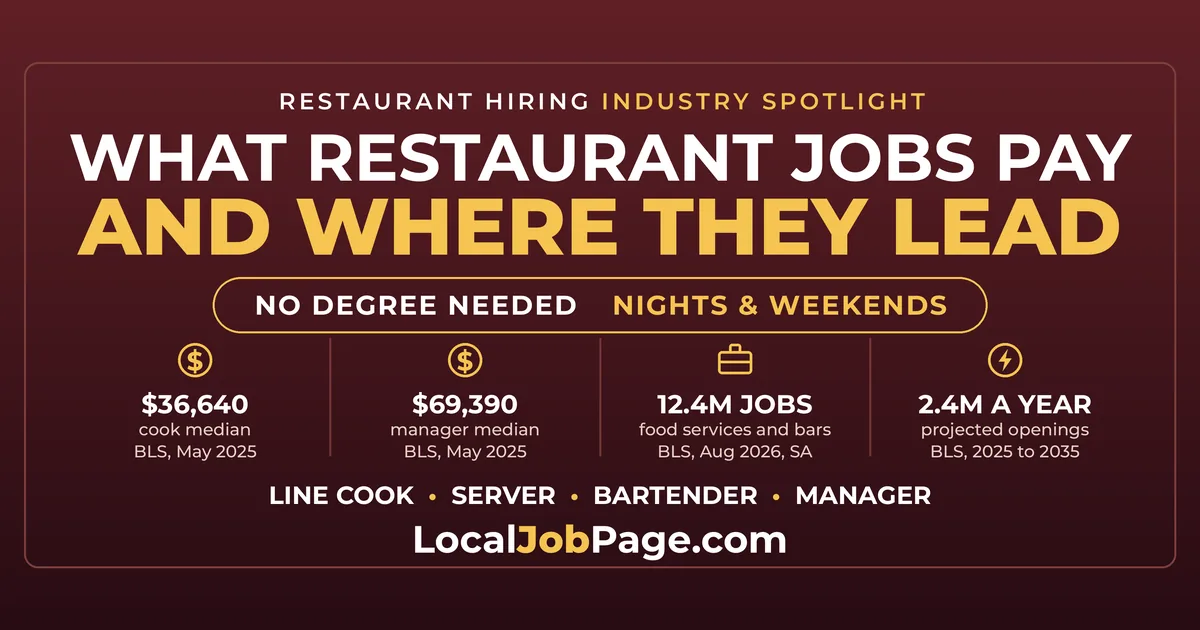
RESTAURANT HIRING — Restaurants and bars added 59,000 jobs in August 2026, well above their average monthly gain of 12,000 over the prior 12 months, according to the Bureau of Labor Statistics Employment Situation released September 4. Food services and drinking places now employ about 12.4 million people, on a seasonally adjusted, preliminary basis.
Restaurant work is some of the fastest paid work in America to get hired into and some of the hardest to read from the outside. The same industry holds a fast food kitchen with a $14.85 median hourly wage and a management job with a $69,390 median salary, and the route between them is shorter than most people think.
Just want the openings? Skip straight to the job links and start searching now →
📊 The Sector Right Now
The August 2026 gain of 59,000 was roughly five times the twelve-month average, and BLS named food services as one of the main drivers of that month's payroll growth. Both figures are seasonally adjusted and preliminary.
The longer view matters more. BLS projects roughly 2.4 million job openings a year, on average, across food preparation and serving occupations through 2035. Most are replacements rather than new positions, because turnover here is high. That is bad news for the industry and good news for anyone who needs work in the next two weeks.
💼 The Jobs, Role by Role
Below are the national median wages BLS published for May 2025, the most recent wage year available, with employment as of 2025 and the change projected through 2035. A median means half the people in that occupation earned less, so treat these as a middle marker and not a starting offer.
| Occupation | Median pay | Jobs, 2025 | Change by 2035 |
| Food and beverage serving and related workers (fast food and counter, hosts, dining room attendants) | $31,710 / $15.24 hr | 5,143,000 | +280,800 (5%) |
| Cooks | $36,640 / $17.62 hr | 2,705,800 | +183,200 (7%) |
| Waiters and waitresses | $35,230 / $16.94 hr | 2,284,400 | +46,500 (2%) |
| Food preparation workers | $35,320 / $16.98 hr | 908,500 | -27,200 (-3%) |
| Bartenders | $34,340 / $16.51 hr | 762,600 | +37,900 (5%) |
| Food service managers | $69,390 / $33.36 hr | 344,300 | +19,900 (6%) |
| Chefs and head cooks | $62,470 / $30.03 hr | 220,300 | +14,400 (7%) |
Two things stand out. Cooks and the broad serving group carry almost all the projected growth, at 183,200 and 280,800 added positions. And food preparation workers, the people who wash, peel and portion before service, are the one group BLS expects to shrink, by about 27,200 positions. If you have any choice about where to start, start on the line rather than in prep.
💵 What It Pays, and Why Tips Complicate the Number
For servers and bartenders, the BLS figures above include tips. That is why a waiter's median of $35,230 lands close to a cook's even though the posted hourly rate on a server job is often far lower. In the front of house, the number in the ad and the number you take home are two different things.
How much of that pay arrives as wages rather than tips depends on the state where the work is performed, not where you live and not where the company is headquartered. Under federal law an employer can pay a tipped worker a cash wage as low as $2.13 an hour and claim a tip credit of up to $5.12 to reach the $7.25 federal minimum, according to the Department of Labor Wage and Hour Division table revised July 1, 2026.
Seven states do not allow it. In Alaska, California, Minnesota, Montana, Nevada, Oregon and Washington, employers must pay tipped employees the full state minimum wage before tips, per that same table. Guam requires it too. Every other state permits some tip credit, and the size varies widely.
For back-of-house work, setting is what matters. BLS reported these median hourly wages for cooks in May 2025: fast food $14.85, short order $17.25, restaurant $17.98, institution and cafeteria $18.01, and private household $23.05. Institutional kitchens, meaning schools, hospitals, corporate cafeterias and senior living, pay about what restaurants pay and usually come with daytime hours and a fixed schedule. That trade is invisible from the job title and worth searching for deliberately.
🎓 Training and Credentials
Most restaurant jobs need no credential to start. BLS classifies cooks, servers, bartenders, hosts and prep workers as requiring no formal educational credential and short-term on-the-job training. That is the field's real advantage: you can be earning inside a week.
Three exceptions are worth knowing. Some states require food handler certification for cooks, set at state or county level, so check your own health department rather than assuming. Most states require alcohol servers to be at least 18, and some jurisdictions mandate a responsible-server course. Food service managers are often expected to hold a Food Protection Manager Certification.
Culinary school exists. BLS describes programs running from a few months to two years, plus apprenticeships of about a year. None of it is required, and most chefs reach the title through years on the line rather than a classroom.
How the Ladder Actually Works
Two staircases separate a restaurant job from restaurant work as a career. The kitchen staircase runs prep to line cook to chef or head cook. The median cook earns $36,640 while the median chef or head cook earns $62,470, and BLS says chefs typically have five years or more of related experience. Nobody gets there in a season, but the requirement is time on a line, not tuition.
The management staircase is shorter and widely underestimated. Food service managers earn a median of $69,390 and typically need a high school diploma plus less than five years in the industry, commonly as a cook, a server, or a supervisor of food preparation and serving workers. That is the largest pay jump this field offers someone with no degree, and the qualifying experience is the job most people are already doing. If you want a restaurant job to lead somewhere, take shift lead duties early and get the food safety certification before anyone asks.
⚠️ Who This Field Is Not For
The hours are the filter. Restaurant work concentrates on nights, weekends and holidays, and split shifts are common. Peak season is the stretch when the rest of the country is off. The physical demands are real too: long periods standing, heat, sharp equipment and repetitive lifting.
Front-of-house pay also swings week to week, which makes budgeting harder even when the annual total is respectable. If a predictable weekday schedule is non-negotiable, look at institutional food service instead. Same skills, similar cook pay, very different calendar.
🔎 Where to Aim Right Now
Restaurant listings turn over fast, so search the exact role rather than the word restaurant.
Start here:
- Line cook jobs
- Server jobs
- Bartender jobs
- Dishwasher jobs
- Host and hostess jobs
- Food prep jobs
- Barista jobs
- Restaurant manager jobs
- Chipotle jobs
🗺️ Where to Look in Your City
Restaurant hiring tracks population and tourism together, so the deepest listings sit in the largest metros and the visitor-heavy markets where bars and hotels staff up alongside dining rooms.
- Restaurant jobs in New York
- Restaurant jobs in Los Angeles
- Restaurant jobs in Chicago
- Restaurant jobs in Las Vegas
- Restaurant jobs in Miami
- Restaurant jobs in Houston
- Restaurant jobs in Atlanta
- Restaurant jobs in Nashville
- Restaurant jobs in Phoenix
- Restaurant jobs in San Diego
Not on the list? Find your city.
Frequently Asked Questions
How much do restaurant jobs pay?
BLS national medians for May 2025: $31,710 for food and beverage serving and related workers, $35,230 for waiters and waitresses, $36,640 for cooks, $34,340 for bartenders, $62,470 for chefs and head cooks, $69,390 for food service managers. Half of workers earned less. For servers and bartenders those figures include tips.
Do I need experience to get a restaurant job?
Usually not. BLS classifies cooks, servers, bartenders, hosts and food preparation workers as requiring no formal educational credential and short-term on-the-job training.
Do restaurants have to pay me minimum wage if I get tips?
Your total pay has to reach the applicable minimum wage. Under federal rules the employer may pay a cash wage as low as $2.13 an hour and count up to $5.12 of your tips toward the $7.25 federal minimum. Alaska, California, Minnesota, Montana, Nevada, Oregon and Washington do not allow a tip credit. The state where you work decides which rule applies.
What certification do I need to work in a restaurant?
Often none to start. Some states require a food handler certification for cooks, set at state or county level. Alcohol service usually requires you to be at least 18. Managers are commonly expected to hold a Food Protection Manager Certification.
Which restaurant job pays the most without a degree?
Food service manager. The median is $69,390 and BLS lists the typical entry requirement as a high school diploma plus less than five years of related experience, usually as a cook, server or supervisor.
Is restaurant work a growing field?
Yes, unevenly. BLS projects about 2.4 million openings a year through 2035 across food preparation and serving occupations, with cooks adding 183,200 positions. Food preparation workers are the exception, projected to decline by 27,200.
🧭 Start Your Restaurant Job Search
Restaurant hiring moves faster than almost any other field. A manager who needs a cook this week will interview whoever applied this morning. Set alerts for the two or three exact role titles you want rather than for the industry as a whole. Create your free account or browse every open job.
Employers: turnover means you are hiring more often than most industries. Post your openings and reach candidates in all 50 cities we cover.
Related Reading
- Retail Jobs: What They Pay and Which Ones Lead Somewhere
- Holiday Seasonal Jobs 2026: When to Apply and Where to Look
- Minimum Wage 2027: Which States Have Set Their January 1 Rate
- August 2026 Jobs Report: Where the 162,000 New Jobs Actually Are
Apply for the cook job even if the listing says experience preferred. In a field replacing millions of workers a year, the manager reading your application cares less about what you have done than about whether you will be there Friday night.