EMT and Paramedic Jobs: What They Pay and How to Get Certified
EMS HIRING — EMT and paramedic jobs are one of the few places in healthcare where a course measured in months gets you onto a payroll and into patient care. The catch is that the job is a ladder, not a single rung. An EMT card gets you on the truck. Paramedic training is what moves the pay. Here is what each level pays, how long it takes, and who is hiring.
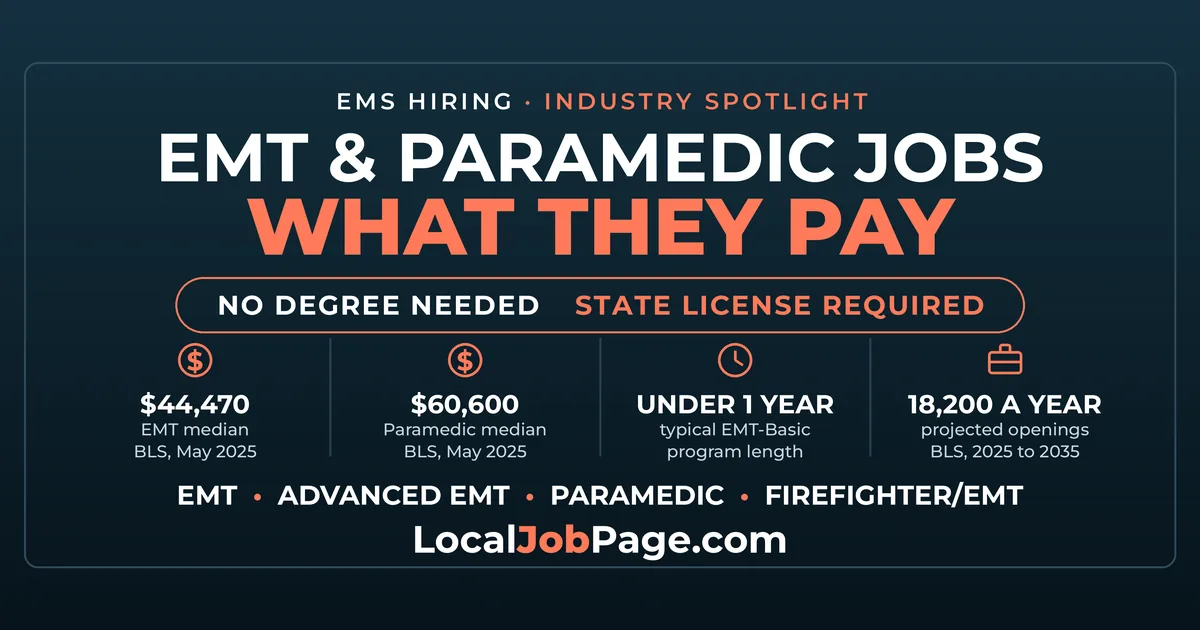
Paramedics earned a national median of $60,600 in May 2025, about $16,000 more than EMTs, and the Bureau of Labor Statistics lists no degree requirement for either.
Need work now? Skip straight to the job links and begin searching now →
Every wage here is a national May 2025 figure from the U.S. Bureau of Labor Statistics, as published in its Occupational Outlook Handbook, updated August 27, 2026. Growth figures are BLS Employment Projections for 2025 to 2035. A median means half the workers in the job earned less, and a projection is a ten-year model, not a promise about next year. Licensing is set state by state.
💼 The Jobs: Three Levels, One Ladder
BLS counted 284,100 EMT and paramedic jobs in 2025: about 181,900 EMTs and 102,200 paramedics. Volunteers are not included in those counts. Every level assesses and treats patients on scene and in transit, then hands them off with written notes. What changes as you climb is how much you are allowed to do.
EMT, sometimes called EMT-Basic. The entry level. EMTs care for patients at the scene and during transport, managing breathing, cardiac and trauma emergencies. Part of the job is also restocking the rig, cleaning equipment and, after an infectious call, decontaminating the ambulance.
Advanced EMT, also called EMT-Intermediate. The middle rung. An advanced EMT can do everything an EMT does, plus start IV fluids and give some medications.
Paramedic. The top of the field-care ladder. Paramedics give a much wider range of medications, manage advanced airways and read EKGs. Some fly with air ambulance crews.
💵 What It Pays
The gap between the two main levels is the most useful number in this guide. National annual wages, May 2025, Bureau of Labor Statistics:
| Occupation | Lowest 10% | Median | Highest 10% |
| Emergency medical technicians | under $34,130 | $44,470 | over $62,500 |
| Paramedics | under $44,230 | $60,600 | over $84,850 |
| EMTs and paramedics combined | $48,150 ($23.15/hr) |
Where you work moves the number too. Among paramedics, BLS reports a median of $61,980 in local government, $61,370 in private hospitals and $60,040 at ambulance services, so the spread by employer is narrow. EMT pay spreads wider: $67,560 in outpatient care centers, $47,160 in private hospitals, $45,780 in local government and $42,260 at ambulance services, the largest single employer of EMTs.
Long shifts and overtime are common, so ask about the shift pattern and overtime pay before comparing offers. For contrast, BLS put firefighters at a $59,280 median in May 2025.
🎓 Training and Credentials
Getting in. EMT programs usually require a high school diploma or equivalent and CPR or basic life support certification, which some programs include. BLS says EMT-Basic programs typically take less than a year, and they are run by community colleges, technical schools, universities and emergency training centers. EMT-Intermediate programs can take up to two years.
Moving up. BLS says paramedic programs require EMT-Intermediate certification to enter. Most lead to a postsecondary nondegree award or an associate's degree, and cover anatomy, EKG interpretation, airway management and supervised field experience.
The license. All states require EMTs and paramedics to be licensed in the state where they work, and the requirements vary. BLS says most states require certification or a state exam, and some add a minimum age or a background check. The National Registry of Emergency Medical Technicians certifies at four levels: Emergency Medical Responder, EMT, Advanced EMT and Paramedic. Whether your state relies on that national certification is a question for your state EMS office, not a training school's brochure.
The other cards. Employers typically require a driver's license, and some prefer an ambulance driver certification. BLS also notes that volunteering as an EMT can help you build experience.
The long game. Paramedic-to-RN bridge programs are an accelerated route into registered nursing, one of the higher-paying clinical jobs that EMS experience feeds directly.
🔥 Who's Hiring
The employer mix is different for each level, and it shapes your schedule and your benefits.
For EMTs, BLS reports 46 percent worked for ambulance services in 2025, 24 percent for local government, 16 percent for private hospitals, 3 percent for local hospitals and 2 percent in outpatient care centers. For paramedics, local government and ambulance services each employed 38 percent, private hospitals 13 percent and local hospitals 4 percent.
Read that as three doors: private ambulance companies, which employ the most EMTs; city and county EMS and fire departments, which may hire in classes with testing dates and a public job announcement; and hospitals, which use EMTs and paramedics on transport teams and in emergency departments.
BLS projects employment to grow 6 percent from 2025 to 2035, faster than the 3 percent average for all occupations, with about 18,200 openings a year on average. Most of those come from people moving into other jobs or retiring, not new positions. BLS ties the growth to emergencies of every kind and to more age-related calls such as falls, heart attacks and strokes as the population ages.
⚠️ Who This Field Is Not For
Anyone who needs regular hours. Most EMTs and paramedics work full time, some more than 40 hours a week, often nights, weekends and holidays. Some work 12-, 18- or 24-hour shifts.
Anyone who can't lift. BLS lists EMTs and paramedics among the occupations with the highest rates of injury and illness. The work means kneeling, bending and lifting patients, often outdoors, plus exposure to infectious disease.
Anyone who hasn't checked the background rules. Some states run background checks for licensure. Ask your state EMS office what it disqualifies before you pay tuition.
Anyone planning to move soon. The license belongs to the state where you work. A move can mean more paperwork, and sometimes more testing, before you can run calls again.
🔎 Where to Aim
Search the exact title. Postings are written in credential language, and the level you hold decides which ones you can apply to. With no card yet, read the EMT postings anyway: if an employer offers paid training or tuition help, the posting is where it will say so.
🔎 Search EMT and Paramedic Jobs Now
- EMT jobs
- Emergency medical technician jobs
- Paramedic jobs
- Advanced EMT jobs
- Firefighter/EMT jobs
- Ambulance jobs
- Emergency room technician jobs
- 911 dispatcher jobs
- American Medical Response jobs
Want to see every opening, not just EMS? Browse all jobs.
🗺️ Where to Look in Your City
EMS employers hire across the country, but these large metros on our network have both city or county fire-based EMS systems and private ambulance services that hire EMTs and paramedics.
- EMT jobs in New York
- EMT jobs in Los Angeles
- EMT jobs in Chicago
- EMT jobs in Houston
- EMT jobs in Phoenix
- EMT jobs in Philadelphia
- EMT jobs in Dallas
- EMT jobs in Atlanta
- EMT jobs in Denver
- EMT jobs in Seattle
Not on the list? Find your city.
Frequently Asked Questions
How much do EMTs make?
The national median annual wage for emergency medical technicians was $44,470 in May 2025, according to BLS. The lowest-paid 10 percent earned under $34,130 and the highest-paid 10 percent earned over $62,500.
How much more do paramedics make than EMTs?
Paramedics had a national median of $60,600 in May 2025, about $16,130 more than the EMT median. The extra training is the clearest pay raise in the field.
How long does it take to become an EMT?
BLS says EMT-Basic programs typically take less than a year. You will then need to meet your state's licensing requirements, which in most states means certification or a state exam.
Do I need a college degree?
No. BLS lists a postsecondary nondegree award as the typical entry-level education. Many paramedic programs lead to a certificate, though some lead to an associate's or bachelor's degree.
Can I work as an EMT in another state?
Not automatically. All states require EMTs and paramedics to be licensed in the state where they work, and requirements vary. Contact the state EMS office where you plan to work before you move.
Is EMS a good way into nursing or firefighting?
Often, yes. Paramedic-to-RN bridge programs offer an accelerated route into nursing, and BLS notes firefighters may need EMT or paramedic certification, depending on the state or locality.
🧭 Your Next Step This Week
Look up your state EMS office, find the approved EMT programs near you, and search the EMT postings in your area to see which employers mention paid training or tuition help.
Create a free LocalJobPage account to save searches and catch new EMS postings as they go up, or browse every open job on the board.
Employers: ambulance services, fire districts and hospitals can post EMT and paramedic openings as an employer. See pricing.
Related Reading
- Police, Firefighter and Corrections Jobs: What They Pay and How to Get Hired
- Nursing Jobs: What They Pay and How to Become a Registered Nurse
- Healthcare Jobs Without a Bachelor's Degree: What They Pay and How Long Training Takes
- Workplace Injuries in 2025: Which Industries Run Highest and What to Ask Before You're Hired
An EMT card is the fastest way into emergency care, and the paramedic level is where the pay moves. Get the first one, run calls, then decide how far up the ladder you want to go.