Workplace Injuries in 2025: Which Industries Run Highest and What to Ask Before You're Hired
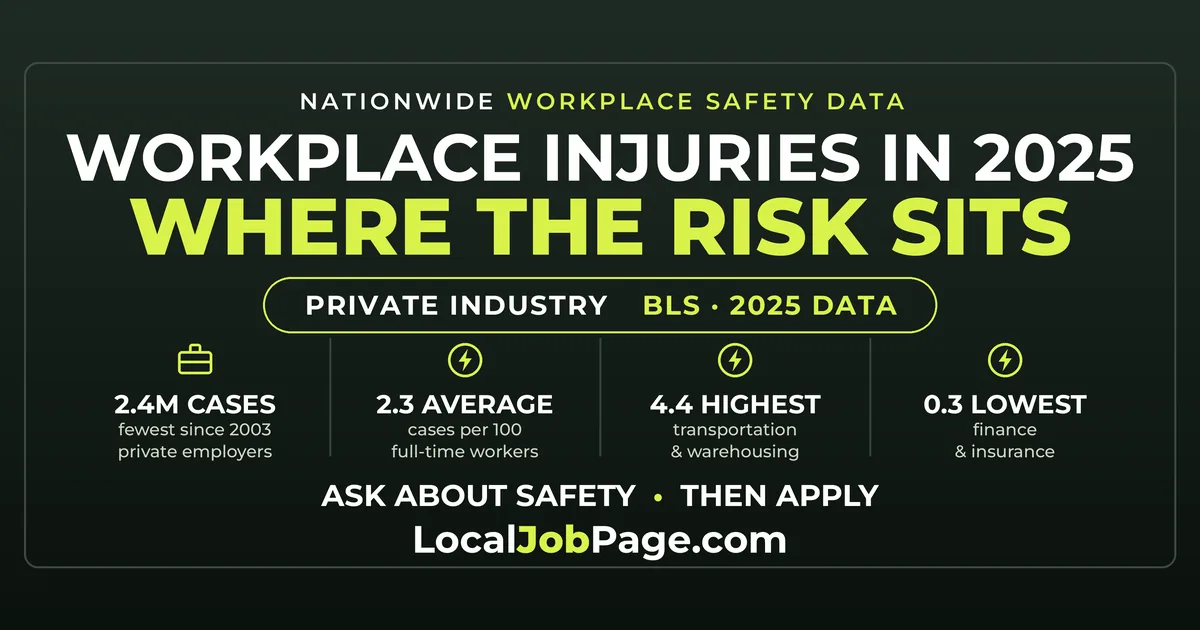
NATIONWIDE — Private employers reported 2.4 million nonfatal workplace injuries and illnesses in 2025, the fewest in a data series that goes back to 2003, the Bureau of Labor Statistics said on November 18. The overall rate held at 2.3 cases for every 100 full-time workers. That average hides a wide spread, though: transportation and warehousing reported 4.4 cases per 100 full-time workers, while finance and insurance reported 0.3.
Transportation and warehousing, agriculture, and arts and entertainment had the highest workplace injury and illness rates of any private-industry sector in 2025, and knowing where the risk sits can change the questions you ask before you take a job.
Ready to go? Skip straight to the job links and begin searching now →
📊 What the Numbers Say
The figures come from the BLS Survey of Occupational Injuries and Illnesses, which counts the cases private employers recorded during calendar year 2025. Government workers are not part of these numbers, and self-reported injuries that never made it onto an employer's log are not either.
- Total cases: 2.4 million, down 3.0 percent from 2024.
- Injuries: 2.3 million, down 1.5 percent.
- Illnesses: 109,400, down 26.1 percent, led by a drop in respiratory illness. The respiratory illness rate fell to 1.6 cases per 10,000 full-time workers, from 5.1 in 2024.
- Serious cases: 842,500 cases involved days away from work, a rate of 0.8 per 100 full-time workers. Another 558,300 involved a job transfer or restricted duty, a rate of 0.5.
Two notes on reading these. Rates are per 100 full-time-equivalent workers, so they adjust for industries full of part-timers. And BLS moved the 2025 industry data to a newer industry coding system, so it cautions against stacking these industry figures against older ones too closely.
Which Industries Run Highest in 2025
Total recordable cases per 100 full-time workers, private industry, from the BLS release tables. The top seven sectors and the lowest three are shown.
| Sector | 2025 rate | 2024 rate |
| Transportation and warehousing | 4.4 | 4.4 |
| Agriculture, forestry, fishing and hunting | 3.9 | 3.9 |
| Arts, entertainment and recreation | 3.7 | 3.9 |
| Health care and social assistance | 3.2 | 3.4 |
| Retail trade | 2.8 | 3.0 |
| Accommodation and food services | 2.7 | 2.6 |
| Manufacturing | 2.5 | 2.7 |
| All private industry | 2.3 | 2.3 |
| Professional, scientific and technical services | 0.7 | 0.7 |
| Management of companies | 0.5 | 0.5 |
| Finance and insurance | 0.3 | 0.3 |
Transportation and warehousing held at the top. Inside it, the injury rate at warehousing and storage employers eased to 4.4 from 4.6, while total cases at couriers and messengers rose 11.4 percent. At 4.4, the warehousing injury rate alone is double the private-industry injury rate of 2.2.
Health care and social assistance still logged more cases than any other sector, 535,500, even as its rate fell to 3.2 from 3.4. Nursing and residential care facilities saw their illness rate drop to 37.0 cases per 10,000 full-time workers, from 95.7, as respiratory cases fell.
Retail and manufacturing both moved the right way: retail cases fell 5.9 percent to 319,600, and manufacturing cases fell 8.5 percent to 304,200. Two sectors went the other way. Cases in educational services rose 13.5 percent to 42,000, and the rate in real estate and rental and leasing climbed to 2.0 from 1.6.
🔎 What This Means for Your Search
A high industry rate is not a reason to skip a field. Warehousing, delivery, patient care and retail are also where much of the entry-level hiring is, and an industry average says nothing about a single employer, which can be far better or far worse. What the data does is tell you where to ask harder questions.
In the interview, ask:
- What safety training do new hires get in the first week, and is it paid time?
- Who provides protective gear like gloves, boots or back support, and who pays for it?
- Will you train and certify me on equipment such as forklifts or patient lifts before I use it?
- How do I report a hazard or an injury, and who do I report it to?
- How many people usually work this shift, and is help available for heavy lifts?
Once you are hired, federal recordkeeping rules give you more to look at. Employers that keep injury records must post their annual summary, OSHA Form 300A, in a visible spot at each workplace from February 1 to April 30. Under 29 CFR 1904.35, employees and former employees can ask for the full injury log for their workplace, and the employer must provide it by the end of the next business day, with the first copy free. That right covers workers, not applicants, which is why the interview questions matter.
Before you apply, there is one more place to look. Larger workplaces, those with 250 or more employees and some with 20 to 249 in designated industries, must file their 300A summaries electronically with OSHA, and the agency distributes that establishment-level data publicly.
🦺 Safety Is a Career, Too
Every industry at the top of that table employs people whose job is to bring the number down: safety coordinators, environmental health and safety specialists, site safety managers and safety trainers. Plenty of them started on the floor or on a route and moved over once they knew the work. If you already have a year or two in a warehouse, on a construction crew or in a plant, a safety role is a realistic next step, and the search terms below are a good place to start.
🔎 Search Jobs Now
- Safety coordinator jobs
- Environmental health and safety jobs
- Safety manager jobs
- Safety trainer jobs
- Forklift operator jobs
- Warehouse associate jobs
- Delivery driver jobs
- Patient care technician jobs
- UPS jobs
Prefer to browse everything near you? See all jobs.
🗺️ Where to Look in Your City
These markets lean heavily on the sectors with the highest rates, from distribution hubs to farm country to a hospitality and entertainment capital.
- Warehouse jobs in Memphis
- Warehouse jobs in Louisville
- Warehouse jobs in Indianapolis
- Warehouse jobs in Columbus
- Warehouse jobs in Dallas
- Warehouse jobs in Kansas City
- Safety jobs in Atlanta
- Agriculture jobs in Fresno
- Agriculture jobs in Bakersfield
- Entertainment jobs in Las Vegas
Not on the list? Find your city.
Frequently Asked Questions
Which industry had the highest workplace injury rate in 2025?
Transportation and warehousing, at 4.4 recordable cases per 100 full-time workers, according to the BLS. Agriculture, forestry, fishing and hunting was next at 3.9, followed by arts, entertainment and recreation at 3.7.
What counts as a recordable workplace injury?
Under federal recordkeeping rules, a work-related injury or illness is recordable if it leads to death, days away from work, restricted work or a job transfer, medical treatment beyond first aid, or loss of consciousness. A significant injury or illness diagnosed by a licensed health care professional is also considered.
Should I avoid jobs in high-injury industries?
Not necessarily. Industry rates are averages across thousands of employers. Ask about training, equipment and staffing in the interview, and judge the specific employer rather than the sector.
Can I see a company's injury records before I apply?
The right to request the full injury log belongs to current and former employees. Before you apply, your best options are OSHA's public establishment-level data for larger workplaces and direct questions in the interview.
Do these numbers include government jobs?
No. The 2025 figures in this release cover private-industry employers only.
Find Work That Fits, Then Ask the Right Questions
Create a free LocalJobPage account to save searches and get new openings in your field as they post.
Employers: A strong safety program is a hiring advantage. Say so in your listing and post your jobs on LocalJobPage.
Related Reading
- Warehouse and Logistics Jobs: What They Pay and How to Get Hired
- Truck Driving and Delivery Jobs: What They Pay and How to Get a CDL
- Healthcare Jobs Without a Bachelor's Degree
- Construction Jobs: What They Pay and How to Get Hired
- Common Job Interview Questions and How to Answer Them
Workplaces got safer again in 2025, but the risk is not spread evenly. Pick your field for the pay and the path, then let the interview tell you whether the employer takes safety as seriously as you do.