Construction Jobs: What They Pay and How to Get Hired
CONSTRUCTION HIRING — Construction is one of the few fields where you can start this month with no degree, no license and no experience, and still have a clear path to $60,000 or more. The catch is knowing which door to walk through: a laborer job, a helper spot, or an apprenticeship.
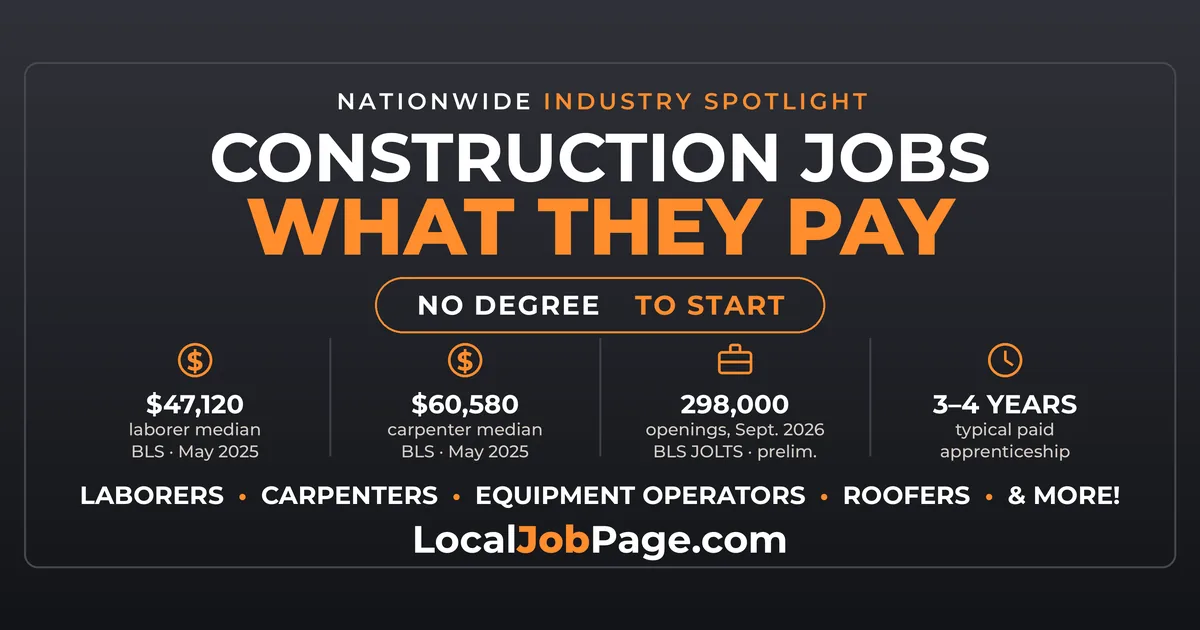
Construction employers had 298,000 open jobs in September 2026, and most entry-level construction jobs need no more than a high school diploma.
Ready to go? Skip straight to the job links and begin searching now →
📊 Construction Jobs Right Now
The Bureau of Labor Statistics reported 298,000 job openings in construction in September 2026, seasonally adjusted, in its Job Openings and Labor Turnover Survey released November 3. That figure is preliminary and will be revised. A year earlier, in September 2025, the same series stood at 206,000.
The longer view is steadier. BLS projects employment of construction laborers and helpers to grow 6% between 2025 and 2035, faster than the 3% average for all occupations, with about 137,000 openings a year on average. Most of those openings come from replacing people who retire or move into other work, not from new positions. Projections are a model of the decade, not a forecast of next spring.
Construction is also local by nature. Crews are hired where the projects are, and in colder states outdoor work can slow in winter, so the best time to line up a spot is often before the spring building season starts.
💼 The Jobs, From First Day to Running the Site
Construction laborers and helpers are the front door. They load and unload materials, set up and break down scaffolding, clean the site, dig, and hand tools to the tradespeople. BLS says no formal credential is typically required and training is short-term, on the job.
Carpenters frame houses, set forms for concrete, hang doors and build out interiors. BLS lists apprenticeship, which mixes classroom hours with paid work each year, as the typical way in.
Construction equipment operators run excavators, loaders, bulldozers and graders on road, utility and site-prep crews. BLS lists moderate-term on-the-job training as typical; others go through a three- or four-year apprenticeship.
Roofers, drywall installers, painters and flooring installers are the finish trades. BLS lists no formal educational credential as the typical entry requirement for drywall, painting, flooring and roofing work, which makes them a common next step for helpers who want a skilled title.
Ironworkers set the structural and reinforcing steel inside buildings, bridges and roads. BLS lists apprenticeship as the typical training.
Construction and building inspectors and construction managers are where many careers end up. BLS says inspectors typically need five or more years of related experience. Managers typically hold a bachelor's degree, but BLS notes that people without one can qualify through many years of construction experience, and that an associate's degree plus experience may be enough for smaller projects.
💵 What Construction Pays
The figures below are national medians from the Bureau of Labor Statistics for May 2025, the most recent available. A median is the middle: half the workers in each job earned less, half earned more. Actual pay varies by region, employer and experience.
| Job | Median pay, May 2025 |
| Helpers, construction trades | $43,260 a year |
| Construction laborers | $47,120 a year |
| Painters, construction and maintenance | $49,400 a year |
| Flooring installers and tile and stone setters | $54,390 a year |
| Roofers | $55,440 a year ($26.65 an hour) |
| Masonry workers | $58,270 a year |
| Construction equipment operators | $59,600 a year ($28.66 an hour) |
| Drywall installers, ceiling tile installers and tapers | $59,780 a year |
| Carpenters | $60,580 a year ($29.12 an hour) |
| Ironworkers | $61,910 a year ($29.77 an hour) |
| Construction and building inspectors | $74,690 a year ($35.91 an hour) |
| Construction managers | $114,990 a year ($55.28 an hour) |
The spread inside a single job is wide. For construction laborers and helpers combined, the lowest-paid 10% earned less than $34,820 in May 2025 and the highest-paid 10% earned more than $76,400. For carpenters the same range ran from under $40,410 to over $99,910. Skills, a trade card and years on the job are what move you up that range.
🎓 Training and Credentials
No credential needed to start. Laborer and helper jobs are learned on the job. BLS notes that employers often require OSHA-compliant safety certification, either before or after you are hired, and some want a valid driver's license to get to the jobsite. Optional rigging or scaffolding certifications can open more complex work.
Apprenticeships are paid training. BLS notes they are often sponsored by local unions or trade associations. For ironworkers, BLS describes a typical program as three or four years, with at least 144 hours of technical instruction and 2,000 hours of paid on-the-job training each year. Equipment operator apprenticeships run on a similar three- or four-year structure. Apprentices earn less than fully trained workers, and pay rises as they progress.
Licensing is state-by-state. A commercial driver's license is often needed to haul equipment between sites, and a few states license backhoe, loader and bulldozer operators. Some states and cities require crane licenses for certain operators. BLS says most states and localities require building inspectors to be licensed or certified. Check your own state's licensing board rather than assuming a rule from another state applies.
If your goal is a licensed trade such as electrician or plumber, construction laborer work is a common first step. Our skilled trades guide covers those paths.
🔥 Who's Hiring
Construction employers fall into a few groups, and each hires differently:
- Homebuilders, from national builders such as Lennar and D.R. Horton to small local outfits, along with the framing, roofing and drywall subcontractors they use.
- Specialty contractors in concrete, roofing, drywall, painting, flooring and steel, where many helpers and laborers start.
- Heavy and civil contractors building roads, bridges, pipelines and utility lines, which run crews of equipment operators.
- Commercial general contractors running offices, hospitals, warehouses and data centers, which hire superintendents and project managers.
- Staffing agencies that place day laborers and short-term crews, a fast way in, though not always a stable one.
⚠️ Who This Field Is Not For
Construction is physical. BLS describes roofing as climbing, bending, kneeling and heavy lifting outdoors in extreme temperatures, and most of the field is some version of that. Days often start early, work can stop for weather, and pay can stop with it if you are hourly. Many jobs need reliable transportation to sites that change from project to project. If you need a steady indoor schedule or cannot lift and climb, look at the office side of construction, such as estimating or scheduling, instead.
🔎 Search Construction Jobs Now
- Construction laborer jobs
- Construction helper jobs
- Carpenter jobs
- Heavy equipment operator jobs
- Roofer jobs
- Drywall jobs
- Ironworker jobs
- Construction superintendent jobs
- Lennar jobs
Prefer to browse? See all open jobs.
🗺️ Where to Look in Your City
Construction crews are hired where the projects are, so search the market you can commute from. These cities on our network span the South, Mountain West, Midwest and both coasts.
- Construction jobs in Houston
- Construction jobs in Dallas
- Construction jobs in Phoenix
- Construction jobs in Atlanta
- Construction jobs in Charlotte
- Construction jobs in Nashville
- Construction jobs in Tampa
- Construction jobs in Denver
- Construction jobs in Chicago
- Construction jobs in Seattle
Not on the list? Find your city.
Frequently Asked Questions
Can I get a construction job with no experience?
Yes. Construction laborer and helper jobs typically require no formal credential and are learned on the job, according to BLS. Expect to need safety training, either before you start or soon after.
What is the highest-paying construction job without a degree?
Among the jobs in this guide, construction and building inspectors had the highest national median at $74,690 in May 2025, but they typically need five or more years of experience first. Ironworkers ($61,910) and carpenters ($60,580), also May 2025 medians, are well-paid trades you can enter through an apprenticeship.
How long is a construction apprenticeship?
Commonly three to four years. BLS describes ironworker programs as at least 144 hours of technical instruction and 2,000 hours of paid on-the-job training per year. You are paid while you train.
Do I need a license to work in construction?
Not for most entry-level jobs. Licensing applies to certain roles, such as some equipment and crane operators and building inspectors, and the rules vary by state. Check with your state's licensing board.
Is construction work steady year-round?
It depends on where you live and what you do. Outdoor work can slow in winter in colder states and stop for bad weather anywhere, and hourly pay stops when the work does.
Start Your Construction Job Search
Set up your job seeker profile and start applying to construction openings near you. Sign up as a job seeker or browse all open jobs.
Employers: Hiring laborers, helpers or skilled trades? Post your construction jobs on LocalJobPage.
Related Reading
- Skilled Trades Jobs: What They Pay and How to Get In Without a Degree
- Truck Driving and Delivery Jobs: What They Pay and How to Get a CDL
- Manufacturing Jobs: What They Pay and How to Get In
- Utility and Energy Jobs: What They Pay and How to Get In
Start as a laborer or helper, get your safety training, and ask every crew lead about apprenticeships. In construction, the first job is the hardest one to get, and every skill you add after it moves your pay.