Cleaning, Landscaping and Pest Control Jobs: What They Pay and How to Get Hired
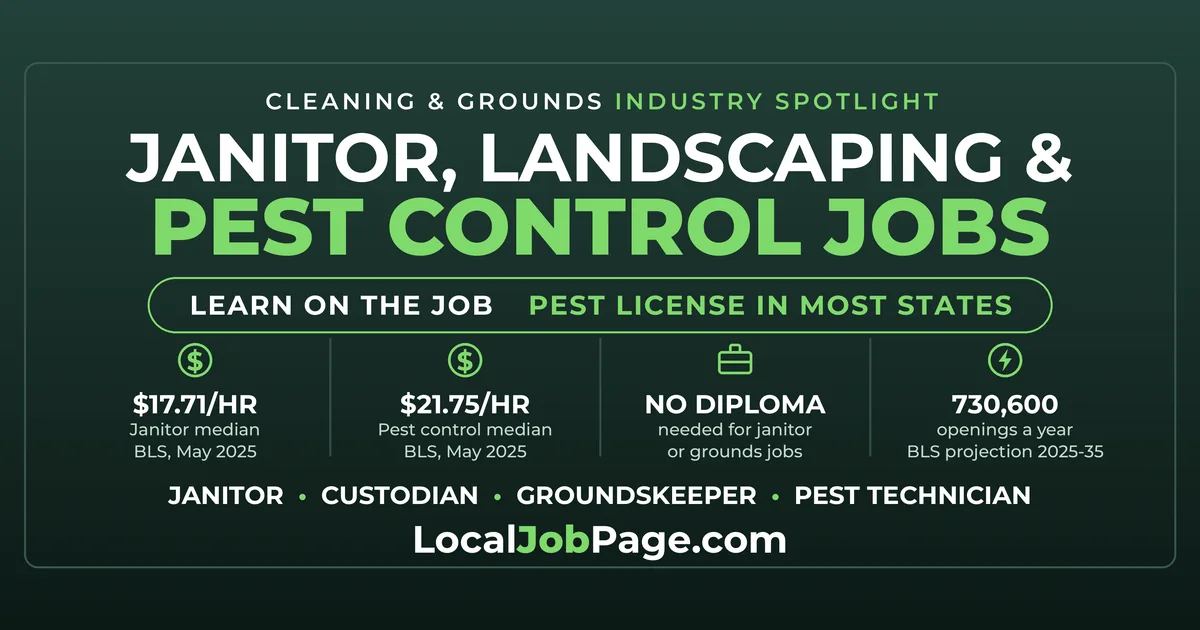
CLEANING & GROUNDS JOBS — Every office tower, school, hospital and apartment complex in the country gets cleaned, mowed and treated for pests on a schedule, whether the economy is hot or cold. That is why cleaning, landscaping and pest control jobs are among the easiest doors to walk through in 2026: most need no diploma, training happens on the job, and the Bureau of Labor Statistics expects about 730,600 openings in this group every year through 2035.
Janitors, grounds crews and pest control technicians can start with little or no formal training, and the pay climbs from about $17.71 to $21.75 an hour at the national median depending on which of the three you pick.
Just want the openings? Skip straight to the job links and begin searching now →
💼 The Jobs: Cleaning, Landscaping and Pest Control
BLS groups these three fields together as building and grounds cleaning occupations. They share an entry bar that is about as low as it gets, but the day-to-day work is very different.
Janitors and building cleaners. You keep a building clean, sanitary and in working order: floors, restrooms, trash, supplies, and often small repairs like a leaking faucet or a dead light fixture. BLS counted 2,432,600 of these jobs in 2025, making it by far the largest of the three. About a third of janitors work for contract cleaning companies that service other people's buildings. Schools employ another 17 percent, healthcare 7 percent and government 5 percent.
Grounds maintenance workers. You mow, plant, prune, water and keep outdoor spaces safe and tidy for businesses, campuses, parks, golf courses and homes. There were 1,299,200 of these jobs in 2025. Nearly half work for landscaping and building-services companies, and a fifth are self-employed.
Pest control workers. You inspect homes and businesses, find where insects or rodents are getting in, and treat or seal the problem. It is a smaller field, 108,700 jobs in 2025, and almost nine in ten work for exterminating companies. It is also the best paid of the three and the only one that typically asks for a high school diploma.
One note on scope: hotel housekeepers and home cleaners, which BLS calls maids and housekeeping cleaners, are counted separately and are not in the figures here.
💵 What Cleaning and Grounds Jobs Pay
These figures are national medians from the BLS Occupational Employment and Wage Statistics survey for May 2025, as published in the Occupational Outlook Handbook. A median is the midpoint: half the workers in the job earned more, and half earned less.
| Job | Median pay, May 2025 |
| Janitors and building cleaners | $17.71/hr ($36,840/yr) |
| Landscaping and groundskeeping workers | $18.82/hr |
| Grounds maintenance workers, all | $19.27/hr ($40,080/yr) |
| Pesticide applicators, vegetation | $22.28/hr |
| Tree trimmers and pruners | $24.50/hr |
| Pest control workers | $21.75/hr ($45,250/yr) |
For context, BLS put the median for the whole group at $37,680 a year in May 2025, against $50,980 for all occupations.
Who you work for changes the janitor paycheck. BLS reports the median janitor in government buildings earned $20.76 an hour, in schools and colleges $18.63, and in healthcare $18.35, compared with $17.21 at contract cleaning companies. If you can choose, compare a school district or hospital posting against a contract cleaning one.
Specializing pays on the grounds side. A general landscaping worker's median was $18.82 an hour. Tree trimmers came in at $24.50 and vegetation pesticide applicators at $22.28. Tree work and a pesticide license both carry higher medians than general crew work.
The top end is real. The highest-paid 10 percent of janitors made more than $24.17 an hour, of grounds maintenance workers more than $28.10, and of pest control workers more than $61,890 a year. Your own floor depends on where you work: state and local minimum wages apply to the address where the work is done.
🎓 Training and Credentials
Janitor: BLS lists no formal educational credential and short-term on-the-job training. Some employers prefer a high school diploma. You usually learn by working beside an experienced custodian, including how to run floor machines and handle minor electrical and plumbing fixes. No license is required. Industry certifications exist and can help, but they are optional.
Grounds maintenance: also no formal credential, with training typically lasting a month or less. The exception is chemicals. BLS says most states require a license to apply pesticides, and fertilizer rules vary by state. Under federal rules in 40 CFR Part 171, restricted-use pesticides may only be applied by a certified applicator or by someone working under that person's direct supervision, and certified commercial applicators must be at least 18. Your state's agriculture or pesticide regulator runs the exam.
Pest control: a high school diploma or equivalent and moderate-term on-the-job training. BLS says most states require pest control workers to be licensed, usually by completing training and passing an exam, and requirements differ from state to state. Many companies also require a driver's license and a clean driving record, because you will drive a company truck between jobs. Because BLS lists on-the-job training for this role, ask in the interview whether the company trains new hires for the state exam and covers the fees.
🔥 Who's Hiring
The biggest employers are contract services companies. ABM Industries describes itself as having more than 100,000 specialists providing cleaning and facility services to clients that include more than half of the U.S. Fortune 500. Rollins, the parent of Orkin, runs more than 60 pest control brands through more than 800 company-owned and franchised locations.
Beyond them, look at school districts and universities, hospital systems, city and county facilities and parks departments, property management companies, hotels, golf courses and local landscaping firms. Public employers are worth the extra paperwork: among the industries BLS lists, government janitors earned the highest median.
⚠️ Who This Work Is Not For
- Night shifts. Offices are cleaned when they are empty, so many janitor jobs run evenings. Hospitals and other 24-hour buildings schedule nights, weekends and holidays.
- Your body. BLS notes sprains and strains from lifting and pain from repetitive motion among cleaners. Grounds work is physically demanding and outdoors in all weather.
- Real danger on grounds crews. BLS says fatalities are uncommon, but grounds maintenance workers have one of the highest fatality rates of any occupation, from mowers, chain saws, chemicals and work at height.
- Seasonality. Grounds work can be seasonal, mainly spring through fall, so ask about winter hours before you sign on.
- Licensing and driving. Pest control and pesticide work need a state license, and a poor driving record can rule you out of pest control routes.
📊 The Outlook Through 2035
BLS projects employment in this group to grow about as fast as the average for all occupations from 2025 to 2035. Pest control is projected to grow 6 percent and grounds maintenance 5 percent, both faster than average, while janitorial jobs grow 2 percent. Those are model projections, not promises. The bigger number for a job seeker is turnover: most of the roughly 730,600 openings projected each year come from replacing people who move on, which is why these postings never really stop.
🔎 Where to Aim Right Now
Search by job title first, then by the big employers by name. Try "custodian" as well as "janitor," because schools and public employers often use the older title.
Start here:
- Janitor jobs
- Custodian jobs
- Cleaner jobs
- Housekeeper jobs
- Landscaping jobs
- Groundskeeper jobs
- Pest control technician jobs
- ABM jobs
- Orkin jobs
🗺️ Where to Look in Your City
Cleaning work follows big building stocks, so start with large metros full of offices, hospitals and campuses, then the Sun Belt markets where outdoor crews and pest control routes stay busy for more of the year.
- Janitor jobs in New York
- Janitor jobs in Chicago
- Janitor jobs in Los Angeles
- Custodian jobs in Washington
- Pest control jobs in Houston
- Pest control jobs in Atlanta
- Pest control jobs in Tampa
- Landscaping jobs in Phoenix
- Landscaping jobs in Dallas
- Landscaping jobs in Las Vegas
- Landscaping jobs in Miami
- Landscaping jobs in Charlotte
Not on the list? Find your city.
Frequently Asked Questions
Do you need a diploma to be a janitor?
No. BLS lists no formal educational credential for janitors and building cleaners, though some employers prefer a high school diploma. Training happens on the job.
How much do janitors make?
The national median was $17.71 an hour, or $36,840 a year, in May 2025, according to BLS. Janitors in government buildings had a higher median, $20.76 an hour.
Do you need a license to do pest control?
In most states, yes. BLS says requirements vary but usually include training and an exam. Check your state regulator for the exact rules, and ask employers whether they train new hires for the exam.
Which of these jobs pays best?
Pest control, at a $45,250 national median in May 2025. On the grounds side, tree trimmers had the highest median, $24.50 an hour.
Start Working This Week
Most of these jobs ask for little paperwork to get started. Create a free LocalJobPage account to save searches and get alerts for new cleaning, landscaping and pest control postings, or browse all jobs near you.
Employers: need custodians, grounds crew or technicians? Post your openings on LocalJobPage and reach job seekers in 50 cities.
Related Reading
- Security Guard Jobs: What They Pay and How to Get Licensed
- Warehouse and Logistics Jobs: What They Pay and How to Get Hired
- Skilled Trades Jobs: What They Pay and How to Get In Without a Degree
- How to Write a Resume With No Work Experience
If you want to start this week, apply for a custodian job with a school district or hospital. If you want a bigger paycheck down the road, look for an employer that trains you for a pest control or pesticide license.