Air Traffic Controller Jobs: What They Pay and How to Get Hired
AIR TRAFFIC CONTROL — Air traffic controller jobs are some of the best-paid roles in the country that do not require a four-year degree, and the Federal Aviation Administration is hiring trainees at a record pace. The FAA says it hired 2,235 controller trainees in fiscal year 2026, the most in its history, and its workforce plan calls for at least 2,300 more in fiscal 2027.
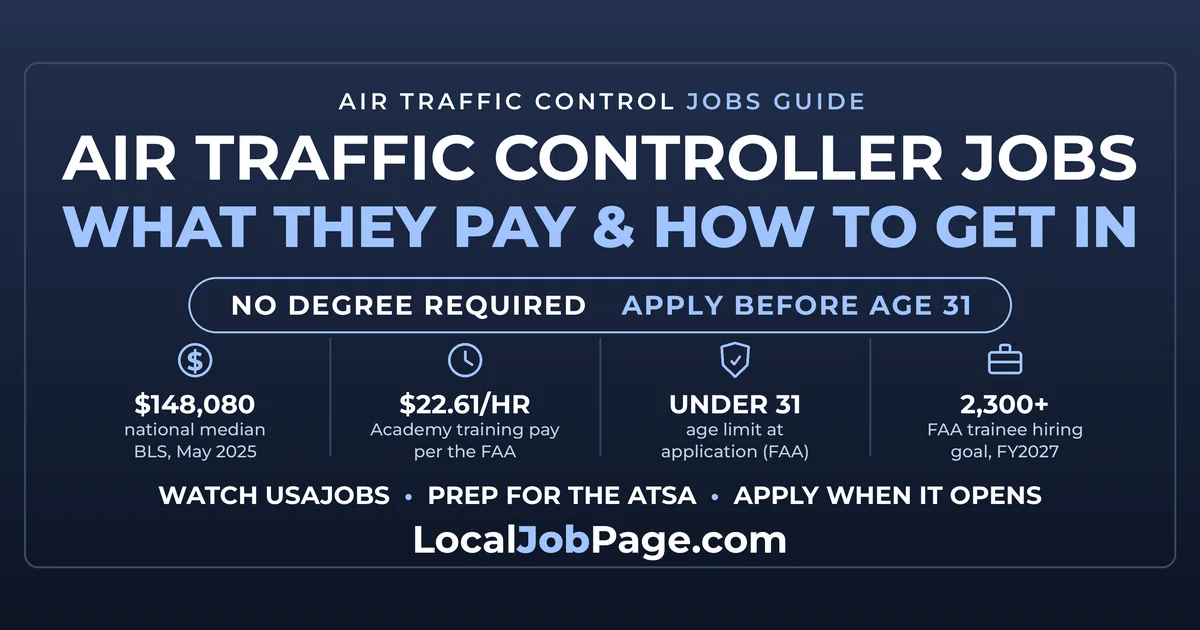
The national median for air traffic controllers was $148,080 in May 2025, but there is a hard catch: the FAA's own hiring page says you must be under 31 when you apply.
Need work now? Skip straight to the job links and begin searching now →
| Hiring agency | Federal Aviation Administration (FAA) |
| National median pay | $148,080 a year, May 2025 (BLS) |
| Pay during FAA Academy training | $22.61 an hour, per the FAA |
| Age limit | Under 31 at application (FAA) |
| Degree required | No. One year of work experience, a bachelor's degree, or a mix of school and work totaling one year |
| FAA hiring goal | At least 2,300 trainees in FY2027 and 2,400 in FY2028 (FAA workforce plan) |
| How to apply | USAJOBS, during an open FAA announcement |
🔥 Why the FAA Is Hiring Now
On October 1, 2026, the FAA announced that it had beaten its fiscal 2026 goal by hiring 2,235 air traffic controller trainees. The agency said more than 1,300 trainees had already graduated from the FAA Academy during the year, and that June brought the most Academy students in its history.
The push is not a one-year event. The FAA's 2026–2028 Air Traffic Controller Workforce Plan, cited in the same release, calls for hiring at least 2,300 trainees in fiscal 2027 and 2,400 in fiscal 2028. Those are hiring targets, not guaranteed openings, but they tell you the door will keep opening for the next two years.
The longer view from the Bureau of Labor Statistics is steadier. BLS counts about 24,000 air traffic controller jobs in 2025 and projects only 2% growth from 2025 to 2035. Even so, it expects about 2,100 openings a year over the decade, mostly to replace controllers who retire or leave. Controllers face a mandatory retirement age of 56, according to BLS, which keeps that replacement need steady.
💼 The Job: What Controllers Actually Do
Controllers keep aircraft safely separated, on the ground and in the air. The work splits into a few settings. Tower controllers handle takeoffs, landings and taxiing at an airport. Approach and departure controllers work radar rooms near busy airports and manage traffic climbing out or descending in. En route controllers sit in large regional centers and guide planes at cruising altitude between airports.
All of it is shift work. Airports and radar centers run around the clock, so expect nights, weekends and holidays, especially early on. The job demands fast decisions, steady concentration and clear speech over the radio. The FAA requires annual medical exams for working controllers, and BLS notes twice-yearly performance checks and periodic drug testing after you are hired.
💵 What It Pays
The Bureau of Labor Statistics reports a median annual wage of $148,080 for air traffic controllers in May 2025, or $71.19 an hour. A median is the midpoint: half of controllers earned less. The lowest 10% earned less than $78,420, and the top 10% earned more than $215,610.
Pay starts much lower while you train. The FAA says trainees earn $22.61 an hour at the Academy. After that, pay rises as you certify on positions at your assigned facility. The FAA says average earnings for certified controllers exceed $155,000 a year within three years of Academy graduation. That is the agency's own average, not a starting salary, and pay varies by facility.
🎓 How to Get Hired: Requirements and Training
The FAA's qualifications page lists the basics. You must be a U.S. citizen, be under 31 when you apply, pass a medical exam and a security investigation, and speak English clearly enough to be understood over radio equipment. You also need one of these: one year of progressively responsible work experience, a bachelor's degree, or a combination of college and work that adds up to one year.
The FAA lays out a five-step path:
- Apply on USAJOBS when an announcement is open, with a resume of two pages or less, plus transcripts or a college training program letter if you have them, and a DD-214 if you are claiming veterans' preference.
- Pass the Air Traffic Skills Assessment (ATSA), a 3.5-hour computer-based aptitude test taken in person at a Pearson VUE center.
- Clear medical and security screening, including fingerprints, background checks, a drug test and a psychological evaluation.
- Train at the FAA Academy in Oklahoma City for several months, paid.
- Train on the job at your facility until you become a Certified Professional Controller. The FAA's pages put this at one to three years.
The FAA says fewer than 10% of applicants meet the requirements and are accepted into training. Plan for a long, selective process, not a quick hire.
About application windows: the FAA hires through announcements that open and close. When this article was written, the FAA's hiring page showed its most recent announcement as closed, and that announcement was set to close once 8,000 applications arrived. Windows can fill fast, so have your resume and documents ready before the next one opens.
⚠️ Who This Job Is Not For
The age cutoff rules out most career changers. If you are 31 or older, the standard FAA route is closed. BLS notes one exception: controllers with military air traffic experience can be hired even if they are past the cutoff. If you are under 31 and weighing the military, controller is a role the services train for.
The medical standards are strict. The FAA's list covers vision, hearing, heart, neurological and psychiatric health and substance dependency. For example, it calls for distance and near vision of 20/20 or better in each eye separately, and limits on hearing loss. Read the full list before you invest in the process.
And the job never closes. If you need a fixed daytime schedule, this is a hard fit, at least for the first several years.
🔎 Search Aviation Jobs Now
- Air traffic controller jobs
- FAA jobs
- Air traffic control specialist jobs
- Airport operations jobs
- Flight dispatcher jobs
- Aviation jobs
- Airport jobs
- Ramp agent jobs
Not ready for the controller path, or past the age cutoff? Airport operations and dispatch roles keep you close to the work.
🗺️ Where to Look in Your City
These markets are home to some of the country's busiest airports, plus Oklahoma City, home of the FAA Academy where new trainees start.
- Aviation jobs in Oklahoma City
- Aviation jobs in Atlanta
- Aviation jobs in Dallas
- Aviation jobs in Denver
- Aviation jobs in Chicago
- Aviation jobs in Los Angeles
- Aviation jobs in New York
- Aviation jobs in Washington, D.C.
- Aviation jobs in Houston
- Aviation jobs in Memphis
Not on the list? Find your city.
Frequently Asked Questions
Do you need a degree to become an air traffic controller?
No. The FAA accepts one year of progressively responsible work experience, a bachelor's degree, or a combination of college and work that totals one year. BLS lists an associate's degree as the typical entry-level education, reflecting candidates who come through college aviation programs.
What is the age limit for air traffic controllers?
The FAA says you must be under 31 at the time you apply. BLS notes that controllers with military air traffic experience can be hired past that cutoff.
How much do air traffic controllers make?
The national median was $148,080 a year in May 2025, according to BLS. Trainees earn $22.61 an hour at the FAA Academy, and the FAA says certified controllers average more than $155,000 a year within three years of graduating.
Where is air traffic controller training?
Most new FAA hires train at the FAA Academy in Oklahoma City for several months, then finish training on the job at their assigned facility.
What is the ATSA test?
The Air Traffic Skills Assessment is the FAA's aptitude exam. It is a 3.5-hour computer-based test of cognitive skills, taken in person at a Pearson VUE testing center.
When can I apply?
Only while an FAA announcement is open on USAJOBS. The FAA's hiring page showed its latest announcement as closed when this article was written, so check the FAA's hiring page often.
🧭 Get Ready Before the Next Window Opens
The FAA's application windows can close quickly once enough people apply. Create a free LocalJobPage account to keep your resume ready and track aviation openings while you wait, and browse all jobs in the meantime.
Employers: hiring for airport, aviation or operations roles? Post your openings on LocalJobPage.
Related Reading
- Airline and Airport Jobs: What They Pay and How to Get Hired
- Veterans Job Search: How to Turn Military Experience Into a Civilian Job
- Police, Firefighter and Corrections Jobs: What They Pay and How to Get Hired
- Railroad Jobs: What They Pay and How to Get Hired
If you are under 31, can pass the medical and want a six-figure career without a four-year degree, get your documents ready now and watch for the FAA's next window. If you are past the cutoff, airport operations and dispatch are other ways into aviation.