Veterans Job Search: How to Turn Military Experience Into a Civilian Job
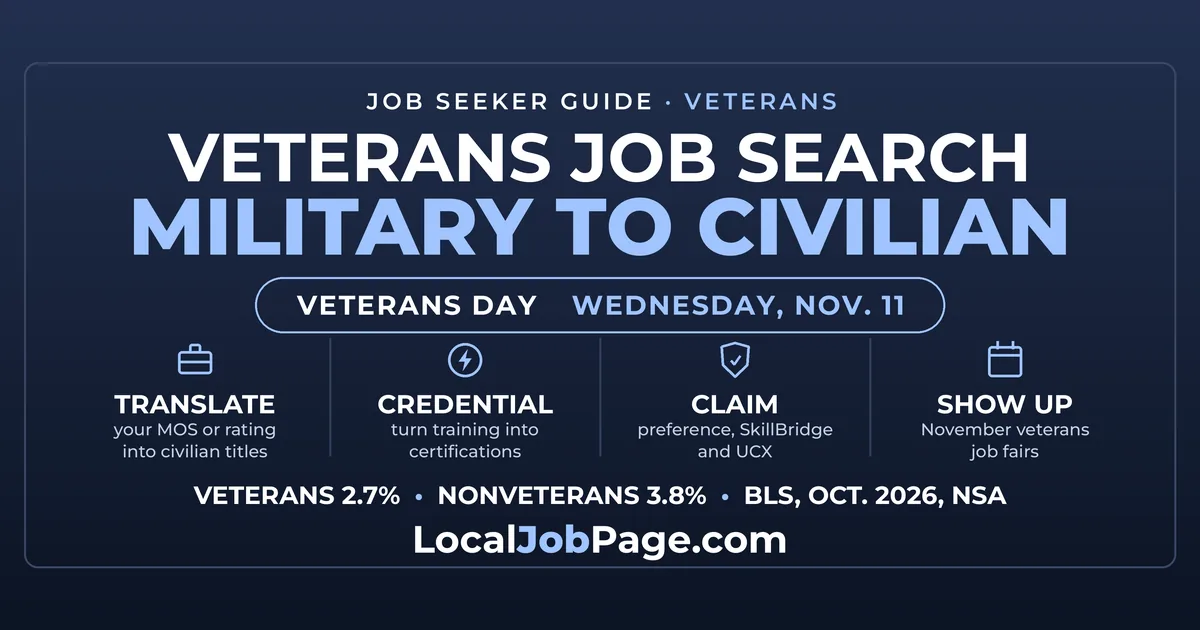
Veterans Day falls on Wednesday, November 11, and the weeks around it are full of veterans hiring events. The hard part of a veterans job search is rarely a lack of skills. It is getting a civilian recruiter to see those skills in a resume written in military language.
Veterans are unemployed at a lower rate than nonveterans, and these five steps can turn a DD-214 into a civilian offer faster.
Need work now? Skip straight to the job links and begin searching now →
📊 Where Veterans Stand in the Job Market
The Bureau of Labor Statistics reported that the unemployment rate for veterans 18 and older was 2.7% in October 2026, against 3.8% for nonveterans. Both figures come from the same table of the Employment Situation release and are not seasonally adjusted. Veterans who served after September 2001, the group BLS calls Gulf War-era II, ran a little higher at 3.4%.
The annual picture points the same way. In its 2025 annual averages, released April 28, 2026, BLS put the veteran unemployment rate at 3.5%, up from 3.0% in 2024, with nonveterans at 4.2%. Those 2025 averages cover 11 months, because the October 2025 survey was not collected during the federal government shutdown. The same release found that 24.4% of employed veterans worked in government, against 13.0% of nonveterans. Public-sector jobs are a natural landing spot, but most veterans work in the private sector.
Step 1: Translate Your Military Job Into Civilian Titles
Civilian applicant systems search for job titles and keywords. Nobody's software is searching for "88M" or "Boatswain's Mate." Start with My Next Move for Veterans, a free Department of Labor-sponsored tool. Pick your branch, enter your MOS, rating, AFSC or SFSC, and it returns civilian occupations that match, with pay and outlook for each.
Then rewrite every resume bullet in civilian terms. "Squad leader" becomes "supervised and trained a team of nine." "Motor transport operator" becomes "commercial vehicle driver with a clean safety record." Keep the numbers: people led, equipment value, miles driven, inventory accounted for. Those are what hiring managers remember.
Step 2: Turn Training Into Credentials
Much military training lines up with civilian certifications, but an employer can only credit what is on paper. Each branch runs a Credentialing Opportunities On-Line (COOL) program that maps your job to related licenses and certifications. Check your branch's COOL site for what it can help pay for. Common wins include CDL licenses for drivers, CompTIA certifications for IT and signals roles, and EMT credentials for medics. Licensing for trades and healthcare is set state by state, so check the board in the state where you plan to work.
Step 3: Use the Help You've Earned
- Priority of service. Under the Jobs for Veterans Act, veterans and eligible spouses must be served first in Department of Labor-funded job training programs, including those run through local American Job Centers. Walk in, say you're a veteran, and ask whether a veterans' employment representative is available.
- SkillBridge. Still in uniform? DoD SkillBridge lets service members train, intern or apprentice with civilian employers during their last 180 days of service, with unit commander approval.
- Unemployment benefits. If the job hunt runs longer than planned, the UCX program pays unemployment benefits to former service members separated under honorable conditions. States run it, so contact your state workforce agency soon after discharge and have your DD-214 ready.
Step 4: Know How Veterans' Preference Really Works
For federal jobs, veterans' preference gives eligible veterans an edge over many other applicants on new appointments. The Office of Personnel Management describes 5-point preference for qualifying service periods or campaigns, and 10-point preference for veterans with a service-connected disability or a Purple Heart. You need a discharge under honorable conditions, your DD-214, and an SF-15 if you claim 10 points. Two cautions from OPM itself: preference does not guarantee a job, and it does not apply to promotions or transfers once you are inside. Many state and city governments run their own preference rules for police, fire and civil service jobs, so read each posting.
Step 5: Show Up Where Employers Are Recruiting Veterans
November is packed with veterans job fairs. Many are open to everyone, and some reserve the first hour for veterans. Bring printed resumes in civilian language, a 30-second answer to "what did you do in the military," and questions about how each employer credits military experience in starting pay. Our city sites cover these events as they're announced. See Related Reading below for some of this month's.
🔎 Search Veteran-Friendly Jobs Now
- Veteran jobs
- Jobs that need a security clearance
- Logistics jobs
- Police officer jobs
- Aircraft mechanic jobs
- Cybersecurity jobs
- Truck driver jobs
- Project manager jobs
- Lockheed Martin jobs
Search by the civilian titles My Next Move gave you, not by your military job code.
🗺️ Where to Look in Your City
These network cities sit near major military installations, where employers are used to reading military resumes.
- Veteran jobs in San Antonio
- Veteran jobs in Virginia Beach
- Veteran jobs in San Diego
- Veteran jobs in Colorado Springs
- Veteran jobs in Jacksonville
- Veteran jobs in Tampa
- Veteran jobs in Washington, DC
- Veteran jobs in Tucson
- Veteran jobs in Fort Worth
- Veteran jobs in Albuquerque
Not on the list? Find your city.
Veterans Job Search FAQ
Do I have to say I'm a veteran on a job application?
No, but it usually helps. Many employers track veteran hiring, and federal and many state jobs require you to claim preference to receive it.
Is the veteran unemployment rate lower than average?
Yes. BLS put it at 2.7% in October 2026, not seasonally adjusted, against 3.8% for nonveterans in the same table.
Does veterans' preference guarantee me a federal job?
No. OPM says plainly that it gives an advantage in hiring but does not guarantee a job, and it does not apply to promotions.
Can I start a civilian job before I leave the military?
Through DoD SkillBridge, service members can train or intern with a civilian employer during their last 180 days of service, with commander approval.
Can I collect unemployment after I separate?
Possibly. The UCX program covers former service members separated under honorable conditions. File with your state workforce agency, which applies its own benefit rules.
What jobs do veterans do best in?
Any role that rewards leadership, logistics, technical training or working under pressure. BLS found that 44.7% of employed veterans worked in management, professional and related occupations in 2025.
Put Your Service to Work
Create a free LocalJobPage account to save searches and get new veteran-friendly openings as they post, or browse all jobs.
Employers: Hiring veterans? Post your openings on LocalJobPage and reach job seekers in 50 cities.
Related Reading
- Police, Firefighter and Corrections Jobs: What They Pay and How to Get Hired
- Common Job Interview Questions and How to Answer Them
- Tampa Paychecks for Patriots Job Fair, November 12
- Kentuckiana Veteran & Community Job Fair, November 17
- DAV RecruitMilitary Veterans Job Fair at AT&T Stadium, November 19
Your service already proved you can learn fast and deliver under pressure. Put it in civilian words, claim the help you've earned, and get in front of employers this month.