Laid Off? What to Do in the First Week, Step by Step
You just found out your job is ending. Before you touch your resume, know that several deadlines started running the day you got the news, and missing one can cost you weeks of benefits or months of health coverage.
Here is what to do in your first week after a layoff, in the order that protects your money and your coverage, with the real deadlines from the Department of Labor, HealthCare.gov and the IRS.
Need work now? Skip straight to the job links and begin searching now →
1. Get Everything in Writing Before You Leave
Ask HR for written answers on your official last day, your final paycheck date and amount, whether unused vacation is paid out, the date your health insurance ends, and what any severance offer includes.
You usually do not have to sign a severance agreement in the room. Ask how long you have to review it, read what you give up in exchange, and ask whether the terms are negotiable.
On the final paycheck itself, the Department of Labor says federal law does not require an employer to hand it over immediately, but some states do. If your regular payday comes and goes with nothing, your state labor agency or the federal Wage and Hour Division can help.
2. File for Unemployment Right Away
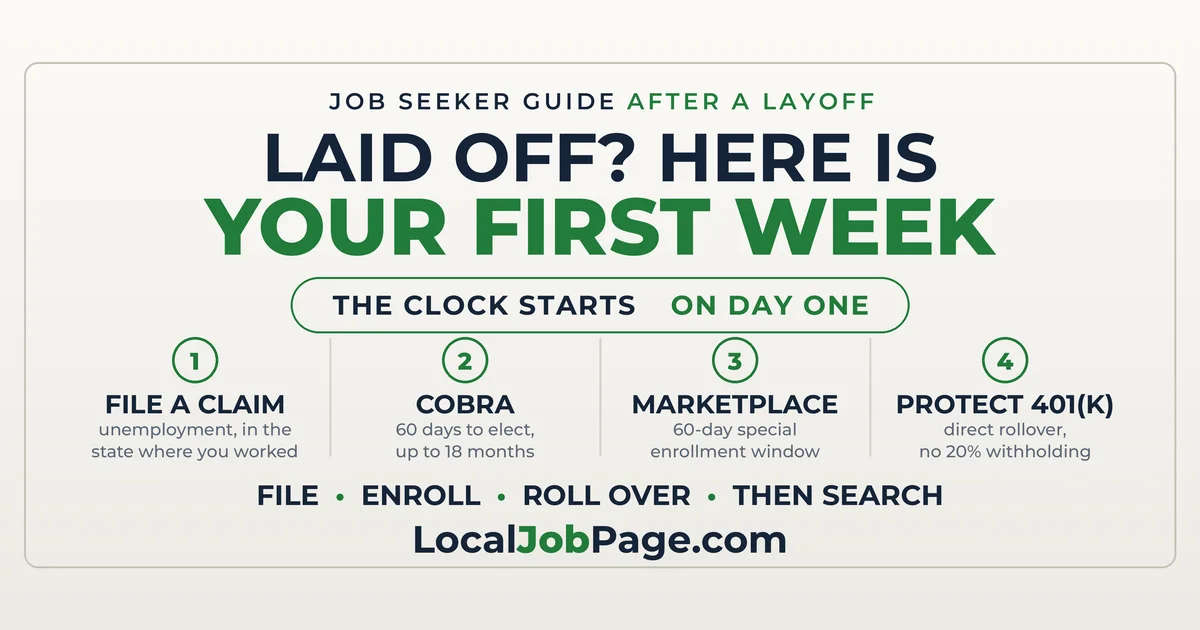
Do not wait until severance runs out. The Department of Labor's guidance is to file as soon as possible after becoming unemployed, and it says the first payment typically arrives two to three weeks after you file.
- Where to file: generally with the state where you worked, not necessarily the state where you live. If you worked in more than one state, your current state's agency can explain how to file.
- Who qualifies: people out of work through no fault of their own, who also pass their state's earnings test over a "base period," usually the first four of the last five completed calendar quarters.
- Taxes: the IRS counts unemployment compensation as taxable income. You can ask for federal tax to be withheld with Form W-4V so April is not a surprise.
CareerOneStop, a Department of Labor site, keeps a finder for every state's unemployment office.
3. Decide on Health Coverage: COBRA or the Marketplace
You have two main paths, and you do not have to choose on day one.
COBRA lets you keep your employer's plan. According to the Department of Labor's COBRA FAQ for workers, it generally applies to employers with 20 or more employees, lasts up to 18 months after a layoff, and gives you 60 days to elect it, counted from the later of when your coverage ends or when your election notice arrives. You then have 45 days to make the first payment. The catch is cost: you can be charged the full premium plus up to 2%, or 102% of the plan's cost.
The Marketplace can cost less for someone whose income just dropped, because savings are based on expected income. Losing job-based coverage opens a Special Enrollment Period: you qualify if you lost coverage in the past 60 days or expect to lose it in the next 60. Timing helps right now, too. Open Enrollment runs November 1 through January 15, and you must enroll by December 15 for coverage that starts January 1.
One trap: HealthCare.gov says dropping COBRA on purpose by not paying does not open a new Special Enrollment Period. Compare both first.
4. Leave Your 401(k) Alone Until You Have a Plan
Cashing out a retirement account usually costs more than people expect. Under the IRS rollover rules, a check made out to you comes with mandatory 20% withholding, and money you do not roll over within 60 days can be taxed and hit with a 10% additional tax on early distributions unless an exception applies.
To move the money, ask for a direct rollover to an IRA or a new employer's plan, which avoids withholding. Leaving it where it is for now is also fine.
5. Start the Search With Free Help
Once the deadlines are handled, put the search on a schedule. The Department of Labor counts about 2,300 American Job Centers nationwide, offering job search help, referrals and reemployment services for people on unemployment. Some services carry eligibility rules.
Then, while the details are fresh, write down what you accomplished, line up two or three references before coworkers scatter, and update your resume with numbers.
🔎 Search Jobs Now
- Customer service jobs
- Administrative assistant jobs
- Warehouse jobs
- Delivery driver jobs
- Remote jobs
- Project manager jobs
- Medical assistant jobs
- Amazon jobs
Seasonal roles can bridge a gap while you look for something permanent.
🗺️ Where to Look in Your City
These are some of the largest metros on the LocalJobPage network, each with its own local job board.
- Full-time jobs in New York
- Full-time jobs in Los Angeles
- Full-time jobs in Chicago
- Full-time jobs in Houston
- Full-time jobs in Dallas
- Full-time jobs in Phoenix
- Full-time jobs in Philadelphia
- Full-time jobs in Atlanta
- Full-time jobs in Seattle
Not on the list? Find your city.
Frequently Asked Questions
How soon after a layoff should I file for unemployment?
As soon as possible. The Department of Labor says to file right after you become unemployed and to expect the first payment about two to three weeks after filing.
Can I get unemployment if I received severance?
It depends on your state, since states treat severance and vacation payouts differently. File anyway, report the payments, and let the state agency decide.
How long do I have to sign up for COBRA?
Generally 60 days, counted from the later of the day your coverage ends or the day your election notice is sent. The first premium is due within 45 days after you elect.
Is COBRA or a Marketplace plan cheaper?
It varies. COBRA can cost up to 102% of the plan's full premium because your employer no longer chips in, while Marketplace savings are based on your expected income, which often drops after a layoff. Price both.
Did my employer have to warn me before the layoff?
Sometimes. The federal WARN Act, under 20 CFR Part 639, generally requires employers with 100 or more employees to give at least 60 days' notice before a qualifying plant closing or mass layoff. Smaller layoffs often fall below its thresholds, and some states have their own notice laws.
Get Back to Work Faster
Create a free LocalJobPage account, or browse all open jobs now.
Employers: hiring experienced people who were just laid off? Post your openings on LocalJobPage.
Related Reading
- How to Write a Cover Letter That Gets Read
- Common Job Interview Questions and How to Answer Them
- How to Negotiate a Job Offer, Even for an Hourly Job
- How to Spot a Job Scam Before You Apply
File the claim, lock in your health coverage and leave the retirement money where it is. Everything else, including the search, goes better once those three are done.