Pharmacy Jobs: What They Pay and How to Get Hired
HEALTHCARE HIRING — Pharmacy jobs are one of the few corners of healthcare where you can start with a high school diploma and a few months of training, then climb as far as a doctoral-level career if you want to. The counter at your neighborhood drugstore is only the most visible part of it. Hospitals, grocery chains, big-box stores and clinics all run pharmacies, and every one of them needs technicians to keep prescriptions moving.
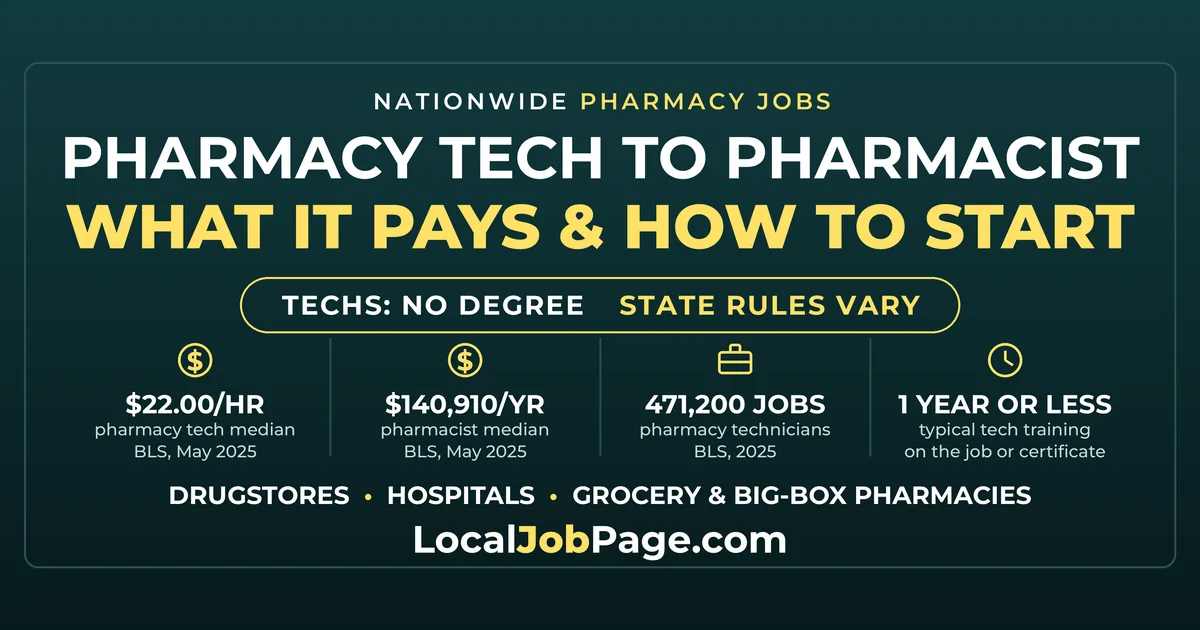
Pharmacy technicians earned a national median of $22.00 an hour in May 2025 and usually need no college degree, while pharmacists earned a median of $140,910 a year after a four-year Pharm.D.
Ready to go? Skip straight to the pharmacy job links and start searching →
💼 The Jobs Behind the Counter
Most pharmacy teams are built around three roles. The titles are similar from employer to employer, but the work and the entry bar are very different.
Pharmacy technician. Technicians do most of the hands-on prescription work: taking prescription requests, counting and measuring medication, labeling, running insurance claims, handling inventory and answering customer questions that do not need a pharmacist's judgment. In hospitals the job leans toward preparing medications for patients on the floors, which can include sterile compounding of IV products. The Bureau of Labor Statistics counted 471,200 pharmacy technician jobs in 2025.
Pharmacy aide. Aides handle the clerical and stocking side: the register, phones, restocking shelves and keeping the work area organized. It is a common first step for someone who wants to see the work before paying for technician training. Aides generally do not fill prescriptions.
Pharmacist. Pharmacists check every prescription before it goes out, counsel patients on how to take their medication, watch for dangerous drug interactions and, in most states, give vaccinations. BLS counted 325,200 pharmacist jobs in 2025. This is a licensed, doctoral-level profession, and the path in is long.
💵 What Pharmacy Jobs Pay
The figures below are national medians from the Bureau of Labor Statistics Occupational Outlook Handbook, based on May 2025 wage data. A median is the midpoint: half of workers in the job earned more and half earned less.
| Role | Median pay, May 2025 | Lowest 10% earned under | Highest 10% earned over |
| Pharmacy technician | $45,750 a year ($22.00/hr) | $36,020 | $61,040 |
| Pharmacist | $140,910 a year ($67.75/hr) | $99,290 | $174,230 |
Where you work moves the number more than most people expect. BLS puts the median for pharmacy technicians in hospitals at $50,760, against $39,240 at pharmacies and drug retailers. That is a gap of more than $11,000 a year for a job with the same title. Technicians at general merchandise retailers earned a median of $48,150 and those at grocery stores $41,430.
Pharmacists show the same pattern at a higher level. The hospital median was $157,290, compared with $132,940 at pharmacies and drug retailers. If you are choosing between offers, the setting is worth asking about as much as the hourly rate.
🎓 Training and Credentials: How to Get In
Pharmacy aide: no formal credential in most places. Employers train on the job.
Pharmacy technician: BLS lists a high school diploma or equivalent as the typical entry-level education, with moderate-term on-the-job training. There are two common routes:
- Train on the job. Many retail chains hire trainees and teach them in the store. BLS says that training typically lasts less than a year.
- Take a program first. Community colleges and vocational schools offer certificate programs, and BLS notes many award a certificate after a year or less. Some run longer and lead to an associate's degree, which can help for hospital roles.
The part most guides gloss over is that the rules are set state by state. According to BLS, most states regulate pharmacy technicians, and the requirements can include some or all of the following: a high school diploma, a formal training program, an exam, fees, continuing education, a criminal background check and a minimum age. Some states and employers also require national certification. The two best-known certifications come from the Pharmacy Technician Certification Board and the National Healthcareer Association. BLS notes that some employers will pay for the certification exam, so ask before you pay out of pocket.
Before you enroll anywhere, look up your own state board of pharmacy and read its technician requirements. That one step tells you whether you need to register, get certified or finish a program before your first day.
Pharmacist: a Doctor of Pharmacy (Pharm.D.) degree. BLS says programs usually take four years after at least two years of prerequisite college coursework, though some offer a three-year option and others admit students straight from high school into a six-year program. Every state requires pharmacists to be licensed, which typically means passing two exams and completing a set number of internship hours. Pharmacists who want to work in clinical hospital roles often add a one- to two-year residency.
🔥 Who's Hiring Pharmacy Workers
BLS breaks down where these jobs are. For pharmacy technicians in 2025:
- Pharmacies and drug retailers: 51%
- Hospitals (state, local and private): 18%
- General merchandise retailers: 9%
- Grocery and specialty food retailers: 8%
- Ambulatory healthcare services: 5%
For pharmacists, pharmacies and drug retailers employed 37% and hospitals 32%.
The practical takeaway: drugstore chains such as CVS and Walgreens are the biggest door in, and grocery and big-box pharmacies are close behind. Hospitals hire fewer technicians but pay them more, and they are the natural next step once you have a year or two of retail experience and a certification.
The outlook is steady rather than spectacular. BLS projects pharmacy technician employment to grow 6% from 2025 to 2035, adding about 30,100 jobs, and pharmacist employment to grow 5%. Both are faster than the average for all occupations. Those are ten-year projections, not a forecast for next year, but they point to a field that keeps needing people.
⚠️ Who Pharmacy Work Is Not For
- Anyone who cannot pass a background check. Many states check technicians before registering them, and employers handling controlled substances screen carefully.
- Anyone who needs a weekday-only schedule. BLS notes pharmacies may be open at all hours, so technicians may work nights or weekends. Hospital pharmacists can work nights, weekends and holidays too.
- Anyone who dislikes detail work under time pressure. A busy pharmacy fills a lot of prescriptions a day, and one wrong digit matters.
- Anyone who wants to skip the state rules. A technician job in one state does not automatically transfer to another. Moving means checking the new state's board.
🔎 Search Pharmacy Jobs Now
- Pharmacy technician jobs
- Pharmacy technician trainee jobs
- Certified pharmacy technician jobs
- Hospital pharmacy technician jobs
- Pharmacy aide jobs
- Pharmacist jobs
- CVS pharmacy jobs
- Walgreens jobs
New to the field? Start with the trainee search. Those listings are the ones that train you on the job.
🗺️ Where to Look in Your City
These markets have large hospital systems, and several have seen new pharmacy operations reported on LocalJobPage city sites this year, including Louisville, Albuquerque and Mesa.
- Pharmacy technician jobs in Louisville
- Pharmacy technician jobs in Albuquerque
- Pharmacy technician jobs in Mesa
- Pharmacy technician jobs in Houston
- Pharmacy technician jobs in Philadelphia
- Pharmacy technician jobs in Boston
- Pharmacy technician jobs in Nashville
- Pharmacy technician jobs in Chicago
- Pharmacy technician jobs in Dallas
- Pharmacy technician jobs in Tucson
Not on the list? Find your city.
Frequently Asked Questions
Do you need a degree to be a pharmacy technician?
No. BLS lists a high school diploma or equivalent as the typical entry-level education. Many employers train new technicians on the job, though some states require a formal program, an exam or certification.
How much do pharmacy technicians make?
The national median was $22.00 an hour, or $45,750 a year, in May 2025, according to BLS. Hospital technicians earned more, with a median of $50,760.
How long does it take to become a pharmacy technician?
On-the-job training typically lasts less than a year, and many certificate programs take a year or less. Your state's registration or certification rules can add steps, so check your state board of pharmacy first.
Is pharmacy technician certification required?
It depends on the state and the employer. Some require it and others do not, but BLS notes certification can help you get hired even where it is optional, and some employers pay for the exam.
How long does it take to become a pharmacist?
Usually at least six years of college: two or more years of prerequisite courses and a four-year Pharm.D. program, followed by two licensing exams. Some programs are shorter, and hospital-bound pharmacists often add a one- to two-year residency.
Can a pharmacy technician become a pharmacist?
Yes, and technician experience is a common starting point. Working as a technician while finishing prerequisite coursework is a practical way to confirm you like the field before committing to a Pharm.D.
Start Your Pharmacy Career Today
Create a free LocalJobPage account to save searches and get new pharmacy listings as they post, or browse all jobs to see what's open near you.
Employers: hiring pharmacy technicians or pharmacists? Post your openings on LocalJobPage and reach job seekers across our 50-city network.
Related Reading
- Nursing Jobs: What They Pay and How to Become a Registered Nurse
- EMT and Paramedic Jobs: What They Pay and How to Get Certified
- Retail Jobs: What They Pay and Which Ones Lead Somewhere
- Medvantx Opens Expanded Louisville Pharmacy: 122 New Jobs Coming
- Eden Pharmacy's $2.7 Million Albuquerque Expansion: 45-Plus Pharmacy Jobs Planned
The fastest way into pharmacy is a trainee technician job at a drugstore or grocery pharmacy. Check your state's rules first, then apply, and let the experience decide how far up the ladder you want to go.