Childcare Jobs: What They Pay and How to Get Hired
CHILDCARE HIRING — Childcare is a field where you can be hired without a degree and build toward a credential while you get paid. The pay is also low, and anyone weighing it deserves to see both halves before applying.
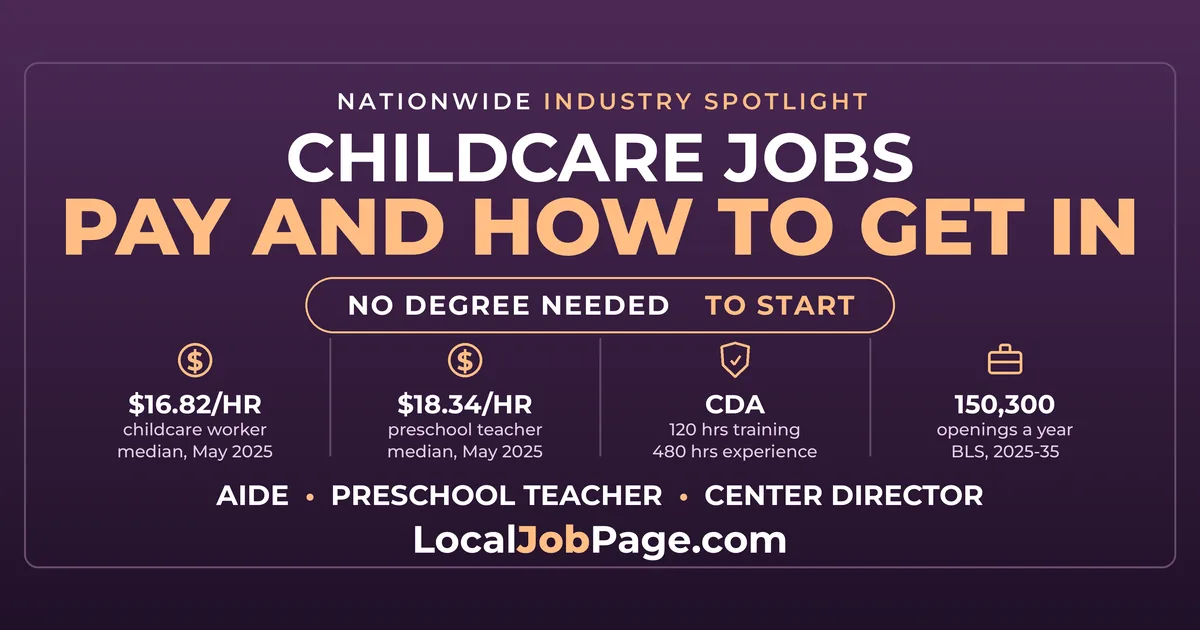
Childcare jobs pay a national median of $16.82 an hour, and the Bureau of Labor Statistics projects about 150,300 openings a year through 2035 even as total employment edges down.
Need work now? Skip straight to the job links and begin searching now →
💼 The Jobs: Three Rungs on One Ladder
Childcare work in the U.S. sorts into three main occupations, and most people climb them in order.
Childcare worker. This is the entry rung and the biggest one, at about 1,010,300 jobs in 2025 according to the BLS Occupational Outlook Handbook. The day is supervision, meals and snacks, diapers and hygiene, routines and play, and noticing when a child is not hitting a milestone. Titles on job posts vary: assistant teacher, infant room aide, toddler teacher, before-and-after-school staff, nanny. Nannies working in private homes are counted here too.
Preschool teacher. About 583,200 jobs in 2025. Preschool teachers plan lessons for children around ages 3 to 5, track development and prepare kids for kindergarten. The step up from childcare worker is mostly a credential, which is covered below.
Center director. About 91,900 jobs. Directors run the building: staffing, budgets, state licensing compliance, parents and enrollment. It usually takes a few years of classroom experience to get there.
Part-time schedules and split shifts are common across all three, because centers staff up for drop-off and pickup.
💵 What Childcare Jobs Pay
These are national medians for May 2025 from the Bureau of Labor Statistics, the most recent occupational wage data. A median is the midpoint: half of workers in each job earned less and half earned more.
| Job | Median pay, May 2025 |
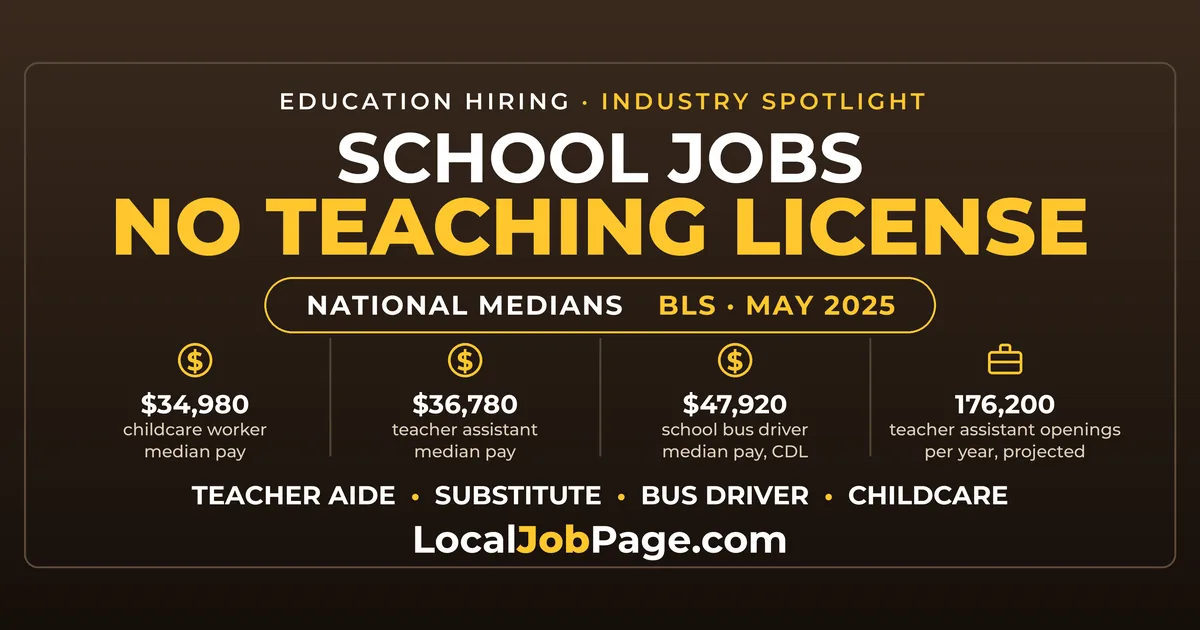
| Childcare worker | $16.82/hr ($34,980/yr) |
| Preschool teacher | $18.34/hr ($38,140/yr) |
| Preschool and childcare center director | $28.51/hr ($59,300/yr) |
The spread inside each job matters more than the median. BLS reports that the lowest-paid 10 percent of childcare workers earned less than $11.66 an hour and the top 10 percent earned more than $22.12. For preschool teachers the range ran from under $28,990 a year to more than $61,390.
Where you work moves the number. Childcare workers employed by local school districts had a median of $18.15 an hour, compared with $16.43 at daycare centers. Preschool teachers in educational services, which includes public school pre-K programs, had a median of $52,800 a year, compared with $36,850 at daycare centers. Public pre-K pays best, and it also asks for the most schooling.
🎓 Training and Credentials: What Opens Each Door
This is where childcare differs from most entry-level fields: the rules are set state by state, and they apply to the center as much as to you.
To start as a childcare worker. BLS says some states require a high school diploma or equivalent and others set no education requirement at all, though employers often prefer a diploma. Licensed centers commonly require a background check, immunization records, and training before you start, and many states require annual training hours after that. Some states also require CPR and first aid certification.
The Child Development Associate (CDA). This is the national credential most states name when they require one, and it is a common way to move from aide to lead teacher. The Council for Professional Recognition, which issues it, lists the requirements as a high school diploma or GED, 120 hours of early childhood education, and 480 hours of work experience in the age group you choose, followed by an exam and an observed Verification Visit. Its current flyer lists a $525 assessment fee. The credential is renewed every three years. Because the 480 hours can be earned on the job, many workers complete it while employed. Ask in the interview whether the employer helps pay for it.
To teach preschool. BLS says preschool teachers typically need at least an associate's degree. In Head Start centers, teachers need at least an associate's degree, and half of Head Start preschool teachers nationwide must hold a bachelor's. Public school pre-K generally requires a bachelor's degree and a state teaching license covering early childhood.
To direct a center. Most states require a bachelor's degree, according to BLS, plus several years of experience in early childhood education.
The childcare.gov state resources page, run by the federal Office of Child Care, points you to your own state's child care offices. That is the place to confirm what your state actually requires before you pay for any course.
📊 Is Childcare Growing or Shrinking?
The honest answer is both. BLS projects childcare worker employment to decline 2 percent from 2025 to 2035, citing slowing birth rates and rising childcare costs. Center director jobs are projected to decline 3 percent. Preschool teacher jobs are projected to grow 4 percent, about as fast as the average for all occupations.
For a job seeker, the openings figure matters more than the growth rate. BLS projects about 150,300 childcare worker openings each year on average over the decade, all of them from people leaving the job or the workforce. High turnover is the reason. Centers are hiring constantly, which means getting in is rarely the hard part. Staying, and moving up, is.
🔥 Who's Hiring
BLS counts child daycare services as the biggest employer of childcare workers, at 29 percent of jobs, followed by self-employed providers at 24 percent and private households at 17 percent. Local schools and religious and civic organizations account for most of the rest.
In practice that means national center chains such as KinderCare and Bright Horizons, franchise preschools, Head Start and Early Head Start programs, school district pre-K and after-school programs, YMCAs and church-run centers, and families hiring nannies directly.
⚠️ Who This Field Is Not For
Childcare requires a background check for licensed settings, and a disqualifying record can rule a candidate out. The work is physical: lifting toddlers, kneeling, and being on your feet most of the day. Illness goes around a classroom fast. And at a national median under $17 an hour, it is hard to support a household on a childcare worker's wage alone in many metros without moving into a lead teacher or director role.
If you are looking at private nanny work, be careful with listings that pay before you start or ask you to deposit a check. That pattern is a common scam, and our job scam guide below walks through the warning signs.
🔎 Where to Start Searching
Search under several titles. Centers rarely agree on what to call the same job, and an assistant teacher posting in one city is a childcare aide in the next.
Start here:
- Childcare jobs
- Daycare jobs
- Preschool teacher jobs
- Assistant teacher jobs
- Infant and toddler teacher jobs
- Before and after school program jobs
- Nanny jobs
- Childcare center director jobs
- KinderCare jobs
- Bright Horizons jobs
🗺️ Where to Look in Your City
Childcare hiring follows population and working families, so these large metros on our network are good places to start.
- Childcare jobs in Houston
- Childcare jobs in Dallas
- Childcare jobs in Phoenix
- Childcare jobs in Atlanta
- Childcare jobs in Charlotte
- Childcare jobs in Nashville
- Childcare jobs in Denver
- Childcare jobs in Chicago
- Childcare jobs in Columbus
- Childcare jobs in San Antonio
- Childcare jobs in Los Angeles
- Childcare jobs in New York
Not on the list? Find your city.
Frequently Asked Questions
Do I need a degree to work in childcare?
Not for an entry-level childcare worker job. Requirements are set by each state, and some require only a high school diploma or none at all. Preschool teachers typically need at least an associate's degree, and public pre-K usually requires a bachelor's.
How much do childcare workers make?
The national median was $16.82 an hour in May 2025, according to the Bureau of Labor Statistics. Pay ranged from under $11.66 to more than $22.12 an hour, and school district jobs paid more than daycare centers.
What is a CDA and do I need one?
The Child Development Associate is a national early childhood credential. It requires 120 hours of education and 480 hours of experience, then an exam and an observation. Some states and employers require it for lead teacher roles.
Can I earn a CDA while working?
Yes. The 480 experience hours are earned working with children in the age group you choose, so many people complete it on the job. Ask employers whether they help pay the fee.
Is childcare a good job for a student or parent?
Often, because part-time and split-shift schedules are common. Centers staff heavily at morning drop-off and afternoon pickup.
Will I need a background check?
Almost certainly, for any licensed center or school program. Licensed centers often also require immunization records and pre-service training before you start.
Start Your Childcare Search Today
Create a free LocalJobPage account to save searches and get new childcare openings near you. Sign up here, or browse all jobs.
Employers: Hiring teachers, aides or a center director? Post your openings on LocalJobPage and reach job seekers in your city.
Related Reading
- School Jobs: What They Pay and How to Get Hired Without a Teaching License
- How to Spot a Job Scam Before You Apply
- How to Write a Resume With No Work Experience
- Common Job Interview Questions and How to Answer Them
Getting hired in childcare is the easy part. The CDA is what turns an aide's job into a teacher's, so ask about it on your first interview.