Accounting, Bookkeeping and Tax Preparer Jobs: What They Pay and How to Get In
ACCOUNTING & TAX JOBS — Every business that pays bills, runs payroll or files taxes needs someone to keep the numbers straight. Accounting, bookkeeping and tax preparer jobs range from no-degree clerk work to licensed CPA careers, and tax offices staff up ahead of each filing season.
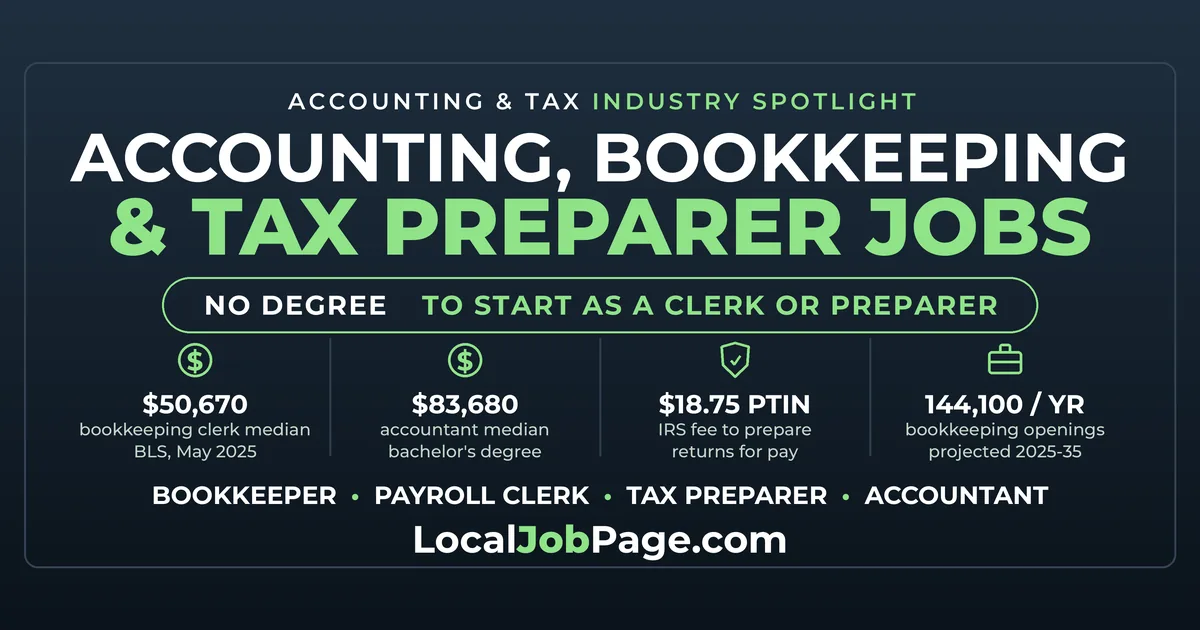
Bookkeeping clerks earned a national median of $50,670 in May 2025 and usually need no degree, while accountants earned $83,680 with a bachelor's, and the federal entry fee for a paid tax preparer is $18.75.
Need work now? Skip straight to the job links and begin searching now →
| Field | Accounting, bookkeeping, payroll and tax preparation |
| Entry jobs | Bookkeeping clerk, accounts payable or receivable clerk, payroll clerk, billing clerk, seasonal tax preparer |
| Median pay (BLS, May 2025) | Bookkeeping clerks $50,670 · Payroll clerks $58,260 · Billing clerks $48,500 · Accountants $83,680 |
| Degree needed? | Not for clerk and tax preparer roles. Accountants usually need a bachelor's; CPAs need 150 college credit hours. |
| Federal requirement to prepare returns for pay | An IRS Preparer Tax Identification Number (PTIN), $18.75 |
💼 The Jobs: From Clerk to Accountant
Bookkeeping, accounting and auditing clerks are the largest group. The Bureau of Labor Statistics counts about 1.53 million of these jobs in 2025. A full-charge bookkeeper keeps a small company's entire set of books: the general ledger, financial statements, and often payroll, invoicing and chasing overdue accounts. At bigger companies the work is split up, so you might handle only accounts payable or only receivables. Auditing clerks check figures for mistakes, fix the small ones and send the big ones to an accountant.
Payroll and timekeeping clerks make sure hours are recorded and paychecks come out right. Billing and posting clerks prepare invoices and post payments. Both are close cousins of bookkeeping and share the same skills.
Tax preparers fill out returns for individuals and small businesses.
Accountants and auditors sit higher up. They prepare and examine financial records. BLS counts about 1.6 million of these jobs, and the largest single employer group is the accounting, tax preparation, bookkeeping and payroll services industry, at 21 percent.
💵 What Accounting and Bookkeeping Jobs Pay
These are national medians from the BLS Occupational Outlook Handbook, based on May 2025 wage data. A median means half the people in the job earned less and half earned more.
| Job | Median annual pay | Typical entry education |
| Billing and posting clerks | $48,500 | High school diploma |
| Bookkeeping, accounting and auditing clerks | $50,670 | Some college, no degree |
| Payroll and timekeeping clerks | $58,260 | High school diploma (financial clerks group) |
| Accountants and auditors | $83,680 | Bachelor's degree |
The spread inside each job is wide. For bookkeeping clerks, the lowest-paid 10 percent earned under $36,000 and the top 10 percent earned more than $74,550. For accountants, the range ran from under $56,020 to more than $144,090.
We could not reach the BLS wage page for tax preparers for this article, so we are not printing a median for that job. Seasonal tax preparer pay is set office by office, so read the range on the posting.
🎓 Training and Credentials
Bookkeeping and clerk jobs. BLS lists the typical entry level as some college, no degree, and some employers hire with only a high school diploma. Most of the learning happens on the job, often next to an experienced clerk, plus training in the company's accounting software. Certification is optional; BLS says some clerks choose to earn one to show what they know.
Tax preparer jobs. The federal bar is low. Anyone who prepares or helps prepare federal returns for pay must hold a valid Preparer Tax Identification Number, or PTIN, from the IRS. The fee is $18.75, and the IRS issues PTINs by filing season, so the current ones are 2027 PTINs. Beyond that, the IRS runs a voluntary Annual Filing Season Program: 18 hours of continuing education, including a six-hour federal tax law refresher with a test. It is not required, but it gets you listed in the IRS public directory of preparers and gives you limited rights to represent your own clients.
Some states add their own rules. Two examples:
- California: Paid preparers who are not CPAs, enrolled agents or attorneys must register with the California Tax Education Council. That means a 60-hour qualifying course from an approved provider, a $5,000 surety bond, a PTIN, a background check and 20 hours of continuing education every year. New preparer registration opens November 1, according to CTEC.
- New York: Commercial preparers must register with the state Department of Taxation and Finance every year and pay a $100 fee. First-time registrants complete a free 16-hour state course. CPAs, attorneys, public accountants and enrolled agents are excluded.
Other states have their own rules, so check with your state's tax agency first.
Enrolled agent. This is the highest credential the IRS awards. You pass all three parts of the Special Enrollment Examination within three years, pass a tax compliance and background check, and apply. The IRS does not list a degree requirement. Enrolled agents, CPAs and attorneys are the only tax professionals with unlimited rights to represent taxpayers before the IRS.
Accountant and CPA. Accountants typically need a bachelor's degree. To become a CPA, every state requires 150 semester hours of college, which is 30 more than a typical bachelor's, plus a national exam and licensure through the state board of accountancy. BLS notes a few states let years of public accounting experience stand in for part of the degree.
🔥 Who's Hiring
Clerks work almost everywhere. BLS says the largest employers of bookkeeping clerks are professional and technical services firms (14 percent), construction (8 percent), retail (7 percent), wholesale (7 percent) and healthcare (6 percent).
Tax preparers work for national tax-prep chains, independent tax offices, and accounting firms. They staff up ahead of the filing season, so fall and early winter are the time to look. Accountants work for accounting firms, corporate finance teams, banks and insurers, and government.
If you want practice before you get paid for it, the IRS's free tax help programs, VITA and TCE, train volunteers online or in a classroom to prepare returns for low- and moderate-income families. That is real experience for a resume.
⚠️ Who This Field Is Not For
Be honest with yourself about the outlook. BLS projects bookkeeping clerk jobs to shrink 6 percent from 2025 to 2035, mainly because accounting software now handles a lot of routine data entry. There will still be about 144,100 openings a year as people retire or switch careers, but the jobs that remain lean toward reviewing books and advising, not typing in numbers. Financial clerk jobs overall are projected to fall 4 percent. Accountants, by contrast, are projected to grow 5 percent over the same decade.
Much tax preparer work is seasonal and built around the filing deadline, so ask whether a role continues after spring. The enrolled agent and California preparer routes both include a background check. If you dislike detail work and fixed deadlines, this is a hard fit.
🔎 Where to Aim Right Now
Start with the no-degree clerk and seasonal tax titles.
Start here:
- Bookkeeper jobs
- Accounting clerk jobs
- Accounts payable jobs
- Payroll clerk jobs
- Billing clerk jobs
- Tax preparer jobs
- Seasonal tax jobs
- Staff accountant jobs
- Jackson Hewitt jobs
- H&R Block jobs
🗺️ Where to Look in Your City
Bookkeepers and tax preparers are hired in every market, so these are large business centers in every region, including the two states with the preparer rules above.
- Bookkeeper jobs in New York
- Tax preparer jobs in Los Angeles
- Accounting jobs in Chicago
- Bookkeeper jobs in Dallas
- Tax preparer jobs in Houston
- Accounting jobs in Atlanta
- Accounting jobs in Charlotte
- Accounting jobs in Washington, D.C.
- Tax preparer jobs in Phoenix
- Bookkeeper jobs in Denver
- Accounting jobs in Minneapolis
- Accounting jobs in Boston
Not on the list? Find your city.
Frequently Asked Questions
Do I need a degree to be a bookkeeper?
Usually not. BLS lists the typical entry level for bookkeeping clerks as some college, no degree, and some employers hire with a high school diploma.
What do I need to prepare taxes for pay?
At the federal level, a Preparer Tax Identification Number from the IRS, which costs $18.75. Some states add more. California requires CTEC registration with a 60-hour course and a $5,000 bond, and New York requires annual registration for commercial preparers.
Is bookkeeping a dying job?
It is shrinking, not disappearing. BLS projects a 6 percent decline from 2025 to 2035, but still about 144,100 openings a year from people leaving the job. Bookkeepers who can review books and advise, not just enter data, are in a stronger spot.
When do tax preparer jobs start hiring?
Tax offices staff up ahead of the filing season, so fall and early winter are a good time to apply. In California, new preparer registration with CTEC opens November 1.
What is the difference between an enrolled agent and a CPA?
An enrolled agent is licensed by the IRS after passing a three-part exam and focuses on taxes. A CPA is licensed by a state board, needs 150 college credit hours and covers all of accounting. Both can represent taxpayers before the IRS without limits.
Get Started in Accounting and Tax Work
Create a free LocalJobPage account to save searches and get new bookkeeping and tax openings as they post. Sign up here, then browse all jobs.
Employers: Hiring a bookkeeper or seasonal tax staff? Post your openings on LocalJobPage and reach job seekers in 50 cities.
Related Reading
- Banking Jobs: What They Pay and How to Get In Without a Degree
- Customer Service and Office Jobs: What They Pay and How to Get Hired
- How to Write a Resume With No Work Experience
- How to Negotiate a Job Offer, Even for an Hourly Job
If you are good with numbers and want in without a degree, a bookkeeping clerk job or a PTIN and a seasonal tax desk this winter is a quick first step onto this ladder.