Animal Care and Veterinary Jobs: What They Pay and How to Get Hired
ANIMAL CARE HIRING — If you would rather spend your shift with dogs and cats than with spreadsheets, veterinary and animal care jobs are one of the few fields where you can start with a high school diploma and still have a clear ladder to climb. Clinics, emergency hospitals, kennels, shelters and grooming salons hire year round, and demand for boarding and pet sitting tends to climb when owners travel for the holidays.
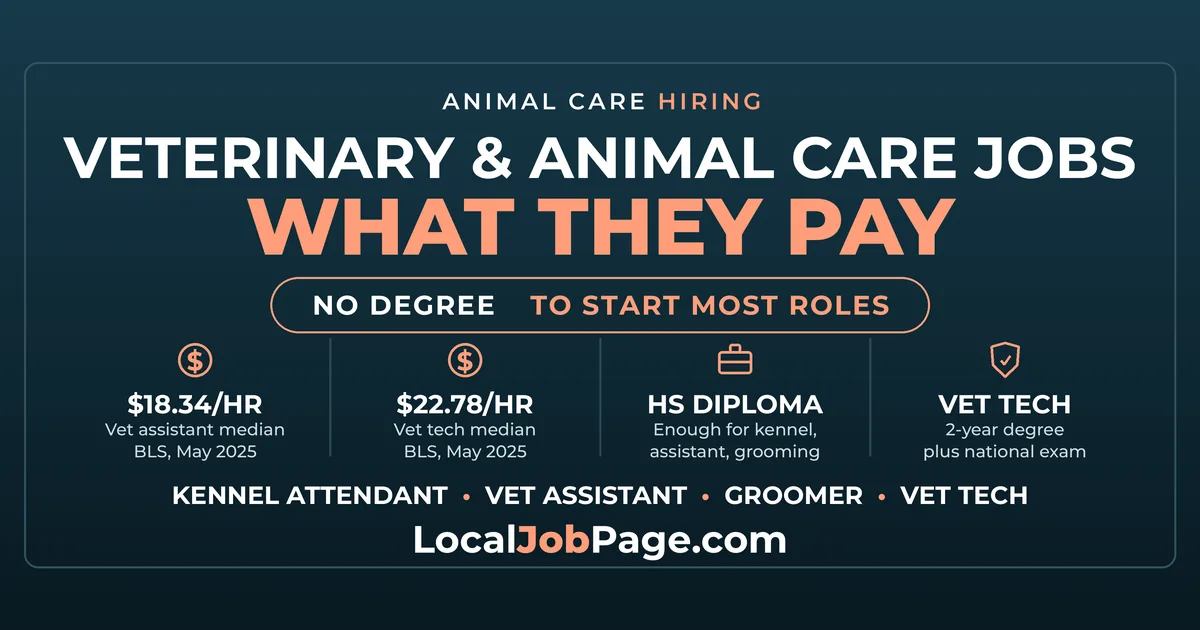
Animal care jobs below the veterinarian level pay national medians of about $17 to $23 an hour, and three of the four main paths need no college degree to start.
Want to see the openings first? Skip straight to the job links and begin searching now →
💼 The Animal Care and Veterinary Jobs
The field splits into four main jobs, and they differ a lot in what you do all day and what it takes to get in.
Animal caretakers. This is the biggest group by far, and it covers kennel attendants, boarding and daycare staff, shelter attendants, pet sitters and groomers. The day is feeding, walking, cleaning runs and cages, bathing, and watching for an animal that is off its food or limping. The Bureau of Labor Statistics counts about 365,300 caretaker jobs. A quarter of them are self-employed.
Veterinary assistants. Assistants are the extra set of hands in a clinic. They restrain animals during exams, clean and sterilize instruments, prepare kennels, collect samples, give medication a vet has prescribed and keep an eye on animals coming out of surgery. Laboratory animal caretakers do similar work in research facilities and universities. BLS counts 132,100 jobs across the two.
Veterinary technicians. Technicians do the medical work that most people assume the vet does personally: drawing blood, running lab tests, taking X-rays, administering anesthesia, preparing patients for surgery and giving nursing care. They work under a licensed veterinarian and often explain treatment to owners. BLS counts 131,400 technologist and technician jobs, and 89 percent of them are in veterinary practices.
Animal trainers. About 47,800 jobs, from dog obedience to horse work. It is a small group, and nearly 4 in 10 trainers work for themselves.
At the top of the ladder are veterinarians, who need a four-year Doctor of Veterinary Medicine degree after college and a license. That is a different career decision, but it is where some assistants and technicians eventually aim.
💵 What Animal Care Jobs Pay
The figures below are national medians from the Bureau of Labor Statistics for May 2025, the most recent wage year it has published. A median is the midpoint, so half the people in each job earned less. Local pay runs higher or lower with the cost of living and your state's minimum wage.
| Job | Median pay, May 2025 | Lowest 10% / highest 10% (annual) |
| Animal caretaker | $35,360 a year | under $27,250 / over $50,060 |
| Veterinary assistant or lab animal caretaker | $38,150 a year ($18.34/hr) | under $30,120 / over $49,150 |
| Animal trainer | $39,990 a year | under $29,600 / over $75,490 |
| Veterinary technologist or technician | $47,380 a year ($22.78/hr) | under $35,710 / over $63,180 |
| Veterinarian | $130,100 a year | Requires a DVM and a state license |
The jump that matters most is from assistant to technician. On the BLS medians, that step is worth roughly $9,000 a year, and it is the step that takes a credential. Where you work moves pay too. Assistants in research and development earned a median of $49,230, well above the $37,930 median in veterinary clinics, and technicians in colleges and universities out-earned those in clinics.
BLS projects all four groups to grow much faster than average from 2025 to 2035: 9 percent for assistants and for technicians, and 11 percent for animal care and service workers, which works out to about 46,100 added caretaker and trainer jobs. Those are ten-year projections, not a forecast for this year.
🎓 Training and Credentials
This is where the four paths separate, and it is the part worth reading twice.
No credential needed to start: animal caretakers, kennel and daycare staff, shelter attendants and veterinary assistants. BLS lists a high school diploma or equivalent and short on-the-job training. Groomers usually learn under an experienced groomer, and large pet retailers such as PetSmart post bather and groomer trainee jobs. Optional certifications exist for assistants and trainers. They help a resume, but BLS does not list them as required. If you set up as a self-employed pet sitter or groomer, many states require a business license.
Credential required: veterinary technicians. The usual route is a two-year associate degree in veterinary technology, then the Veterinary Technician National Examination. The exam is owned by the American Association of Veterinary State Boards, runs three hours and is offered in four testing windows a year. The application fee is $375. BLS says most states require technicians to pass an exam and become registered, licensed or certified, and the rules and title differ by state, so check your state veterinary board before you enroll.
Pick a program accredited by the American Veterinary Medical Association. The AAVSB says graduates of AVMA-accredited programs qualify for the exam in every jurisdiction. Other routes are narrow. Its candidate handbook lists an on-the-job-trained pathway that is accepted only in Alaska, Montana, Utah and Wisconsin, and it limits where you can later transfer your credential.
The smart sequence for most people: get hired as a kennel attendant or veterinary assistant, learn whether you can handle the work, and then enroll in a vet tech program while you keep earning. Ask in the interview whether the employer offers any tuition help.
🔥 Who's Hiring
- General and emergency veterinary hospitals. Independent clinics and corporate groups such as Banfield Pet Hospital, VCA Animal Hospitals and BluePearl, the specialty and emergency chain. Emergency hospitals run around the clock and staff nights and weekends.
- Pet retailers. Grooming salons, in-store clinics and pet care counters at chains like PetSmart and Petco.
- Boarding, daycare and kennels. Independent kennels and dog daycares, where weekends and holidays are often the busiest shifts.
- Shelters and humane societies. City and county animal services, plus nonprofit rescues.
- Research and universities. Laboratory animal caretaker and technologist roles, where BLS medians run above clinic pay.
⚠️ Who This Field Is Not For
Be honest with yourself on three points before you apply.
It is physically hard and it carries real injury risk. BLS says veterinary technicians and assistants have one of the highest injury and illness rates of any occupation, often from bites, scratches and kicks. Expect lifting, moving cages and long stretches on your feet.
It is emotionally hard. You will see sick, injured and neglected animals, and in clinics and shelters you may help with euthanasia. People who love animals sometimes find that part harder than they expected.
Animals need care every day. Evenings, weekends and holidays come with the job, especially in boarding, emergency medicine and shelters.
🔎 Where to Aim Right Now
If you have no experience, start with kennel attendant, animal caretaker and veterinary assistant searches. If you already hold a technician credential, search the technician title and the large hospital groups directly.
Start here:
- Veterinary assistant jobs
- Veterinary technician jobs
- Kennel attendant jobs
- Animal caretaker jobs
- Dog groomer jobs
- Veterinary receptionist jobs
- Dog trainer jobs
- Banfield Pet Hospital jobs
- PetSmart jobs
🗺️ Where to Look in Your City
Clinics, kennels and groomers operate wherever people keep pets, so these links cover large metros in every region the network serves.
- Veterinary jobs in Seattle
- Veterinary jobs in Portland
- Veterinary jobs in Denver
- Veterinary jobs in Phoenix
- Veterinary jobs in Austin
- Veterinary jobs in Chicago
- Veterinary jobs in Nashville
- Veterinary jobs in Atlanta
- Veterinary jobs in Charlotte
- Veterinary jobs in Tampa
Not on the list? Find your city.
Frequently Asked Questions
Can I work with animals without a degree?
Yes. Animal caretakers, kennel attendants, groomers and veterinary assistants typically need a high school diploma or equivalent and learn on the job, according to the Bureau of Labor Statistics. Veterinary technicians usually need a two-year degree.
How much do veterinary assistants make?
The national median was $18.34 an hour, or $38,150 a year, in May 2025, according to BLS. Assistants in research settings earned more than those in clinics.
What is the difference between a vet tech and a vet assistant?
A technician does medical work such as anesthesia, X-rays and lab tests, and usually needs a two-year degree plus a passing score on a national exam. An assistant handles restraint, cleaning, feeding and support tasks and learns on the job. The national median gap was about $9,000 a year in May 2025.
How long does it take to become a vet tech?
Most people complete a two-year associate program, then sit for the Veterinary Technician National Examination, which is offered in four windows a year. Your state may add its own registration or licensing step.
Is animal care a good holiday job?
It can be. Boarding kennels, daycares and pet sitters tend to get busier when owners travel at Thanksgiving and in December, and part-time kennel roles are common. Ask whether the role continues after New Year's.
Start Your Animal Care Job Search
Create a free LocalJobPage account to save these searches and get new veterinary and animal care postings near you, or browse all jobs.
Employers: hiring kennel staff, assistants or technicians? Post your openings on LocalJobPage and reach job seekers in 50 cities.
Related Reading
- Healthcare Jobs Without a Bachelor's Degree: What They Pay and How Long Training Takes
- How to Write a Resume With No Work Experience
- Common Job Interview Questions and How to Answer Them
- How to Negotiate a Job Offer, Even for an Hourly Job
Start as a kennel attendant or assistant this fall, find out whether the work suits you, and let the paycheck carry you toward the technician credential that raises your pay.