California's New AI Workplace Laws: What Changes for Workers in 2027
CALIFORNIA — If you work in California, a computer program will soon be barred from firing you on its own. Governor Gavin Newsom signed a package of AI workplace laws on September 30, 2026, and the ones aimed at employees change how bosses can use automated tools to discipline, lay off and monitor workers. Most take effect January 1, 2027. The biggest one waits until July 1, 2027.
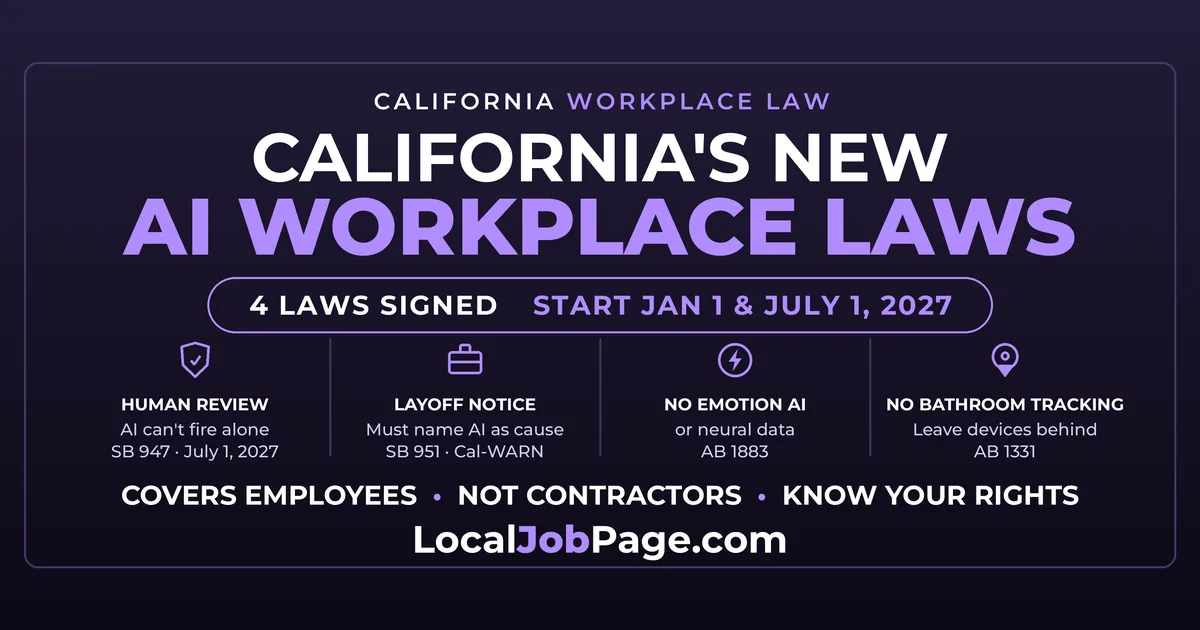
Four new California AI workplace laws give employees a human review before AI-driven firing or discipline, an AI disclosure on mass-layoff notices, and new limits on workplace surveillance.
Just want the openings? Skip straight to the job links and begin searching now →
| What changed | Four AI and surveillance laws for California workplaces: SB 947, SB 951, AB 1331 and AB 1883 |
| Signed | Wednesday, September 30, 2026 |
| Who it covers | Employees of California employers, including public employers and labor contractors. SB 951 applies to employers covered by the state's WARN Act. |
| Effective date | SB 947: Thursday, July 1, 2027. The other three: Friday, January 1, 2027, California's standard start date for new laws. |
| Exceptions | Independent contractors are not covered by SB 947. Surveillance rules have national security and federal-law carve-outs. |
| Where to read the rule | Governor's signing announcement |
🏛️ What Changed: California's Four New AI Workplace Laws
SB 947, the No Robo Bosses Act. Employers may not rely solely on an automated decision system to discipline or fire an employee. If an AI tool drives the decision, a person has to review it and back it up with other information, such as supervisor evaluations, personnel files, work product or witness interviews. When the employer tells you about the decision, it must also tell you in writing that it relied mainly on an automated system and that a human reviewed it. You can ask for a description of your own data the system used. Retaliating against you for using these rights is illegal. The law starts July 1, 2027, applies to employers of any size, and the Labor Commissioner can enforce it with penalties of up to $500 per violation. Senator Jerry McNerney, who wrote the bill, calls it the first law of its kind in the nation.
SB 951, AI on layoff notices. California's WARN Act already requires 60 days' notice before a mass layoff, relocation or closure at a covered site, generally one with 75 or more employees. Starting January 1, 2027, if those job cuts are substantially due to AI or other automation, the notice must say so at the top. It must also list the affected jobs and locations, the duties being automated and the type of technology replacing them. The law also directs the state's Employment Development Department to report on AI's effect on hiring by January 1, 2028.
AB 1331, no surveillance in workplace bathrooms. Employers may not monitor employees in a workplace bathroom unless a court orders it. You have the right to leave a work-issued tracking device, such as a scanner or wearable, outside when you go in. Employers may still log a single entry and exit.
AB 1883, no emotion reading or brain data. Employers may not use workplace surveillance tools to read or predict your emotional state, or to collect neural data, meaning information measured from your nervous system. Both AB 1331 and AB 1883 carry civil penalties of up to $500 per violation.
What These California Laws Mean If You Work There
These laws matter most in jobs where software already scores the work: warehouse and fulfillment roles with productivity rates, call centers with monitored calls, delivery routes tracked by app and many retail and office jobs. If you are disciplined or let go, look for the written notice. If it says an automated system was used, you can ask for the data behind it. If you have no notice and suspect a tool made the call, ask. Keep copies of every write-up.
Pay is changing on January 1 too. California's minimum wage rises to $17.40 an hour, according to the state Department of Industrial Relations, and some cities set a higher local floor on top. The address where you do the work decides which rate applies.
⚠️ What These Laws Do Not Cover
SB 947 covers discipline and firing, not hiring, and it covers employees, not independent contractors. A gig driver classified as a contractor is outside it. SB 951 applies only to layoffs large enough to trigger the state WARN Act. None of these laws apply outside California, so a remote worker for a California company who lives and works in another state should not assume they are covered. This is a summary for job seekers, not legal advice. If a dispute is in front of you, talk to the Labor Commissioner's office or an employment lawyer.
🔎 Where to Aim Your California Job Search
These are the job types where automated tracking and scoring are most common, plus the HR and compliance roles employers will be adding to run the new reviews.
Start here:
- Warehouse associate jobs
- Delivery driver jobs
- Customer service representative jobs
- Call center jobs
- Retail sales associate jobs
- Human resources jobs
- Compliance jobs
- Amazon jobs
🗺️ Where to Look in Your City
These laws apply statewide, and these are the nine California cities on the LocalJobPage network.
- Jobs in Los Angeles
- Jobs in San Diego
- Jobs in San Jose
- Jobs in San Francisco
- Jobs in Fresno
- Jobs in Sacramento
- Jobs in Long Beach
- Jobs in Oakland
- Jobs in Bakersfield
Not on the list? Find your city.
Frequently Asked Questions
Can AI fire me in California?
Starting July 1, 2027, not on its own. Under SB 947, an employer that uses an automated system to fire or discipline you must have a person review the decision, back it up with other information, and tell you in writing that the system was used.
When do California's new AI workplace laws take effect?
SB 951, AB 1331 and AB 1883 take effect January 1, 2027. SB 947 takes effect July 1, 2027.
Does the No Robo Bosses Act cover hiring?
No. SB 947 covers discipline and termination decisions. It does not cover hiring, and it does not cover independent contractors.
Will a layoff notice tell me if AI replaced my job?
If the layoff is big enough to require a California WARN notice, yes. From January 1, 2027, the notice must say when cuts are substantially due to AI or automation and name the type of technology.
Can my employer track me in the bathroom?
Under AB 1331, no, unless a court orders it. You can leave a work tracking device outside when you go in.
Know Your Rights, Then Find Your Next Job
Whether you are looking for a new role or protecting the one you have, create a free LocalJobPage account to save searches and get new postings first, or browse all jobs near you.
Employers: hiring in California? Post your openings on LocalJobPage and reach job seekers across the state.
Related Reading
- New Workplace Laws in October 2026: What Changes for Workers
- Minimum Wage 2027: Which States Have Set Their January 1 Rate
- September 2026 Job Cuts Hit Lowest Level Since 2022: What It Means for Your Search
- Los Angeles Minimum Wage 2027: What California's January 1 Raise Means for Your Paycheck
Mark two dates: January 1, 2027 for layoff notices and surveillance limits, and July 1, 2027 for a human review before an AI-driven firing. If a write-up ever arrives with a machine behind it, you now have the right to ask how it was made.