New Workplace Laws in October 2026: What Changes for Workers
Published: September 27, 2026 | By LocalJobPage Team
5 STATES + D.C. — A handful of new workplace laws switch on over the next two weeks, and several of them change what happens before you ever clock in: how a teenager gets a work permit, how late a 14-year-old can work, whether a gig or contract job counts as employment, and what a job post has to tell you about pay.
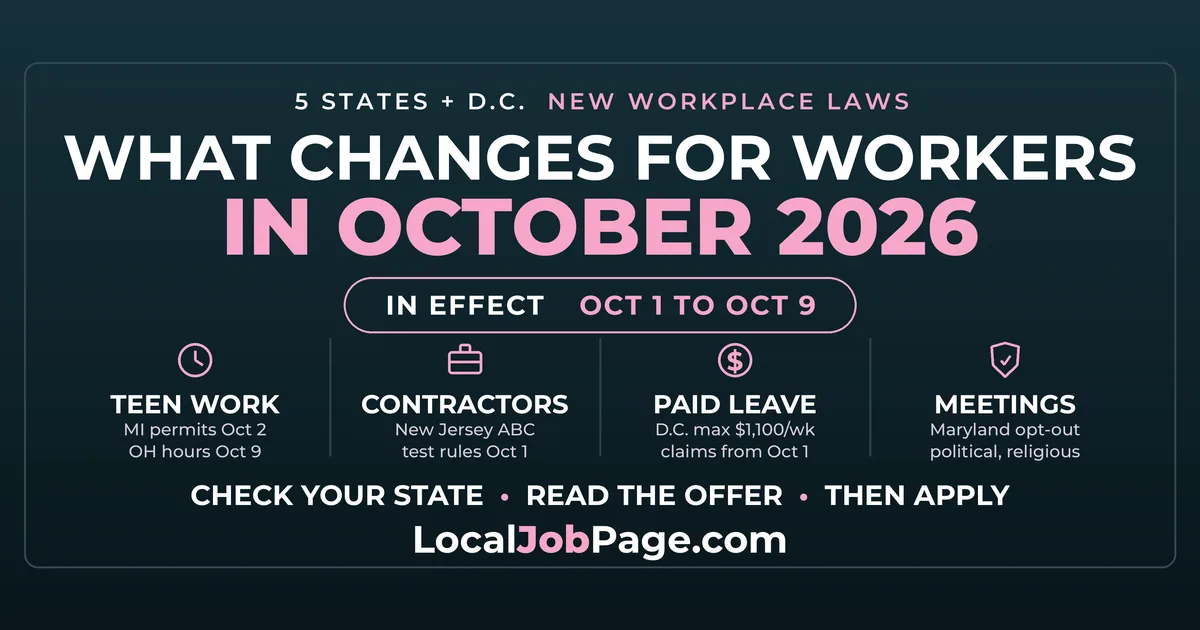
Between October 1 and October 9, 2026, new workplace rules take effect in Connecticut, Maryland, Michigan, New Jersey, Ohio and the District of Columbia, and each one applies only to work performed in that jurisdiction.
Need work now? Skip straight to the job links and begin searching now →
| What changed | Teen work permits, teen evening hours, contractor classification, paid leave benefits, mandatory meetings, pay in job posts |
| Who it covers | Workers and employers in the six jurisdictions below, with different thresholds for each rule |
| Effective dates | October 1, 2026 (Thursday) for Connecticut, Maryland, New Jersey and D.C.; October 2 (Friday) for Michigan; October 9 (Friday) for Ohio |
| Jurisdictions | Connecticut, Maryland, Michigan, New Jersey, Ohio, District of Columbia |
| Where to read the rule | Each state agency or legislature, linked in its section below |
📅 New Workplace Laws in October 2026, at a Glance
Most new employment laws land on January 1 or July 1. October is a smaller wave, but it arrives every year, partly because Maryland and Connecticut routinely start new laws on October 1. This year's batch leans practical rather than sweeping, and the table below is the short version.
| Jurisdiction | What changes | Effective |
| Michigan | All youth work permits move to one state-run online system instead of schools | Oct 2, 2026 |
| Ohio | 14- and 15-year-olds may work 7 to 9 p.m. on nights before a non-school day, with parental approval | Oct 9, 2026 |
| New Jersey | Final state rules spelling out the ABC test for employee vs. independent contractor | Oct 1, 2026 |
| District of Columbia | Paid leave maximum weekly benefit becomes $1,100; medical and family leave durations change | Oct 1, 2026 |
| Maryland | Workers can't be punished for skipping employer meetings about political or religious matters | Oct 1, 2026 |
| Connecticut | Job posts must show a wage range and describe benefits | Oct 1, 2026 |
One rule governs all of it: the location where the work is performed decides which law applies, not where you live and not where the company is headquartered. A Pennsylvania resident working a shift in Camden is covered by New Jersey's rules.
🎓 Teen Jobs: Michigan Permits and Ohio Hours
Two Midwest changes land in the middle of the fall and holiday hiring season, when stores, grocers and restaurants lean hardest on teenage workers.
Michigan: work permits go online, and only online
Until now, Michigan minors got their work permits from their school. Starting October 2, 2026, the Michigan Department of Labor and Economic Opportunity says every youth work permit must be obtained through the state's centralized system, run by its Wage and Hour Division. The platform is called the Youth Employment Permit Portal (YEPP), and employers have to register there to take part.
What it means in practice: a teen who lands a job in October should expect the permit step to happen online, with the employer involved, rather than at the school office. The agency's notice describes a change in how permits are issued, not in the hours or ages the law allows. If you are hiring teens in Michigan and haven't registered on YEPP, that is the step that will hold up a start date.
Ohio: two more evening hours, on the right nights
Ohio House Bill 455, signed July 10, 2026, takes effect October 9. According to the Ohio Legislative Service Commission's analysis, it lets 14- and 15-year-olds work between 7 and 9 p.m. on any night before a day school is not in session, as long as a parent or guardian approves. Summer hours, June 1 through September 1, were already 7 a.m. to 9 p.m. and don't change.
There is a catch, and the commission flagged it itself. Federal child labor rules generally cap 14- and 15-year-olds at 7 p.m. outside the summer window, and when state and federal law differ, the rule more protective of the minor prevails. Many employers are covered by the federal rule, so plenty of Ohio teens will see no change on Friday nights. Ask the manager before assuming the new window applies to your job.
🏛️ New Jersey's ABC Test Rules for Contractors
New Jersey has used the three-part ABC test to decide who counts as an employee for years. What's new is that the New Jersey Department of Labor and Workforce Development adopted final regulations, at N.J.A.C. 12:11, that spell out how the test works under the state's unemployment compensation, wage and hour, and wage payment laws. The department's announcement sets the effective date at October 1, 2026.
Under the test, someone paid for services is presumed to be an employee unless the business proves all three of these:
- A: the worker is free from the company's control or direction in doing the work.
- B: the work is outside the usual course of the business, or done outside all its places of business.
- C: the worker is customarily engaged in an independently established trade or business.
The burden sits on the business. For a job seeker, the practical point is this: if an offer in New Jersey is labeled "1099" or "contract" but looks like a regular job, with a set schedule, a supervisor and work that is the company's core business, you are entitled to ask how it clears the test. Employee status is what brings unemployment insurance, minimum wage and overtime protections under state law.
💵 D.C. Paid Leave Benefits Shrink
The District of Columbia is moving in the opposite direction from most paid leave programs. The D.C. Department of Employment Services' Office of Paid Family Leave says that starting October 1, 2026, the maximum weekly benefit for every claim type will be $1,100, and that maximum leave durations are changing for medical and family leave claims.
If you work in D.C. and are planning leave for your own health condition or to care for a relative, check the office's current duration limits before you file, because a claim filed after the switch may be shorter than one filed today. Parental leave is not among the categories the office lists as changing.
Maryland Protects Workers Who Skip Political or Religious Meetings
Maryland's Senate Bill 417, enacted as Chapter 221 of 2026, takes effect October 1. It bars employers from firing, disciplining, penalizing or threatening a worker who declines to attend an employer-sponsored meeting where the employer shares its opinion on religious or political matters. Employers also cannot refuse to hire an applicant for declining to attend.
The law defines political matters to include elections, political parties, proposed changes to laws, regulations or public policy, and the decision to join or support a political party or civic organization. It carries no employer-size threshold. It exempts religious organizations covered by the federal Title VII exemption, political organizations on their own tenets, schools covering such subjects in coursework, training that employers must provide to comply with federal or state law, and new-employee orientations at government agencies. The state labor commissioner can assess civil penalties of up to $10,000 for a first violation and $25,000 for later ones.
📢 Connecticut Job Posts Must Show Pay
Connecticut's biggest October change for job seekers is the one we covered in detail on September 25: job postings must now include a wage range and a description of benefits. If you are applying to Connecticut jobs this month, a posting with no pay range after October 1 is worth a second look. Our full Connecticut explainer, linked below, has the details.
🔎 Where to Aim Right Now
October is also the heart of seasonal hiring, which is exactly when teen workers, contract roles and new postings pile up. These searches cover the roles most touched by this month's changes, from first jobs to delivery and contract work.
Start here:
- Part-time jobs
- Entry-level jobs
- Cashier jobs
- Grocery store jobs
- Seasonal jobs
- Delivery driver jobs
- Kroger jobs
- Meijer jobs
🗺️ Where to Look in Your City
These are the network cities inside the states that changed, plus the two big metros whose job markets reach deep into New Jersey.
- Part-time jobs in Detroit
- Part-time jobs in Columbus
- All jobs in Baltimore
- All jobs in Washington, D.C.
- All jobs in New York
- All jobs in Philadelphia
Not on the list? Find your city.
Frequently Asked Questions
Do these laws apply if I live in another state?
What matters is where you do the work. A job performed in New Jersey, Maryland, Michigan, Ohio, Connecticut or D.C. follows that jurisdiction's rules, wherever you live.
Can a 14-year-old in Ohio now work until 9 p.m. on Fridays?
Under Ohio law starting October 9, yes, with a parent's approval and only before a non-school day. But federal rules still cap 14- and 15-year-olds at 7 p.m. outside summer at employers they cover, and the stricter rule wins. Many jobs won't change.
How does a teen get a work permit in Michigan now?
From October 2, 2026, through the state's Youth Employment Permit Portal rather than through a school. The employer registers on the same system and keeps the permit on file.
Does New Jersey's rule ban independent contractor work?
No. It spells out when someone genuinely qualifies as a contractor under state wage, wage payment and unemployment laws. The business must show all three parts of the ABC test.
What is the D.C. paid leave maximum after October 1?
$1,100 a week for every claim type, according to the District's Office of Paid Family Leave. Medical and family leave durations are also changing, so check the office's current limits before you file.
Is this legal advice?
No. It is a plain-language summary of each agency's or legislature's own description. For a specific situation, contact that state's labor department.
Ready for Your Next Job?
Whatever state you work in, the first step is the same: find the openings. Create a free LocalJobPage account to save searches and apply faster, or browse all jobs now.
Employers: Hiring in one of these states this fall? Post your openings on LocalJobPage and reach local candidates across the network.
Related Reading
- Connecticut Job Posts Must Show Pay and Benefits Starting October 1, 2026
- What Your Job Post Must Include: Pay Transparency Rules by State
- Minimum Wage 2027: Which States Have Set Their January 1 Rate
- How to Write a Resume With No Work Experience
New rules don't change the job hunt so much as the fine print around it. Know which state your shift is in, read the offer closely, and ask the question before you sign.