New Workplace Laws in January 2027: What Changes for Workers
CONNECTICUT, WASHINGTON, MARYLAND & CALIFORNIA — A handful of new workplace laws take effect on Friday, January 1, 2027, and they reach further down the ladder than most: into the smallest employers, the first paycheck of the year and the job post itself. This is not a nationwide change. It lands in four states and one Ohio city, and if you work in one of them, it changes what you can expect from an employer starting the first week of the year.
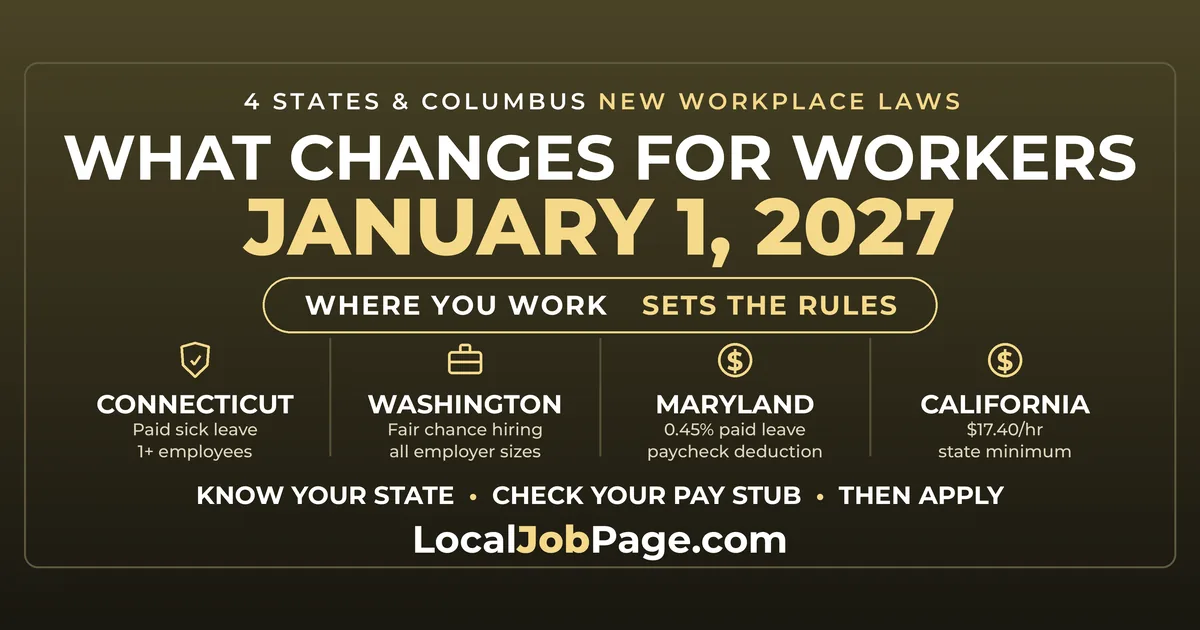
New workplace laws in January 2027 bring paid sick leave to nearly every Connecticut employer, fair chance hiring and pregnancy accommodations to every Washington employer, a new paid leave deduction to Maryland paychecks, a $17.40 minimum in California, and salary-range enforcement in Columbus.
Need work now? Skip straight to the job links and begin searching now →
📍 At a Glance: What Changes January 1, 2027
| Connecticut | Paid sick leave expands to employers with 1 or more employees in the state |
| Washington | Fair Chance Act reaches employers with fewer than 15 employees; Paid Leave job protection drops to employers with 15 or more; pregnancy accommodation law covers all employers; minimum wage rises to $17.73 |
| Maryland | FAMLI paid leave contributions begin: 0.9% of wages, split 0.45% employee and 0.45% employer |
| California | Statewide minimum wage rises to $17.40; exempt salary floor rises to $72,384 |
| Columbus, Ohio | Enforcement of the salary-range rule for job postings, reported to begin January 1, 2027 |
🏛️ Connecticut: Paid Sick Leave Reaches Almost Every Employer
Connecticut has been phasing in a broad paid sick leave law for three years. On January 1, 2026, it covered employers with 11 or more employees in the state. On January 1, 2027, the last step arrives: according to the Connecticut Department of Labor, the law covers employers with one or more employees in Connecticut. Employer size is counted from payroll for the week that contains January 1.
The mechanics are simple. You earn one hour of paid sick leave for every 30 hours you actually work, up to 40 hours a year. Part-time workers earn it the same way, based on hours worked. You can start using it 120 calendar days after you were hired, unless your employer lets you use it sooner. Up to 40 unused hours carry over, though use is still capped at 40 hours a year unless the employer offers more.
The reasons are broader than a cold. The state lists your own or a family member's illness or injury, preventive care, a mental health wellness day, a public health closure of your workplace or a family member's school, and time needed after family violence or sexual assault.
Two groups are left out: seasonal workers who work 120 days or fewer in a year, and certain union construction workers covered by multiemployer health plans. The law sits at Connecticut General Statutes sections 31-57r through 31-57w.
Washington: Three Worker Protections Widen on One Day
Washington stacks several changes on January 1, and two of them reach the state's smallest businesses.
Fair chance hiring for small employers. The amended Fair Chance Act already applies to employers with 15 or more employees as of July 1, 2026. On January 1, 2027, it extends to employers with fewer than 15, according to the Washington Attorney General's Office. Under the law, a job ad cannot say "no felons" or anything like it. An employer cannot ask about a criminal record, or run a background check, until it has decided you are otherwise qualified and made a conditional offer. Before rejecting you over a record, it must tell you which record it is relying on, hold the job open at least two business days so you can explain or correct it, and give you a written decision. Some roles are exempt, including jobs with unsupervised access to children or vulnerable adults and law enforcement positions.
Job protection while on Paid Leave. Washington's Paid Family and Medical Leave program pays benefits to most workers, but the right to return to your job has depended on employer size. The Employment Security Department lists the threshold falling from 25 employees in 2026 to 15 in 2027, then 8 in 2028. Since 2026, you qualify after 180 calendar days with the employer, with no minimum hours.
Pregnancy accommodations at every employer. Washington's pregnancy accommodation law, the Healthy Starts Act, has applied to employers with 15 or more employees. A notice in the Washington State Register says that under E2SSB 5217 the law will apply to all employers in the state starting January 1, 2027, with enforcement moving to the Department of Labor and Industries.
A higher wage floor. The Department of Labor and Industries announced on September 30, 2026 that the statewide minimum wage rises to $17.73 an hour on January 1, up 60 cents. Seattle and several nearby cities set higher local rates.
Maryland: A New Paid Leave Deduction on Your Paycheck
Maryland's Family and Medical Leave Insurance program, known as FAMLI, starts collecting money before it pays any out. According to Maryland Labor, contributions apply to wages paid from January 1, 2027, at an initial rate of 0.9% of wages up to the Social Security wage cap. That is split evenly: 0.45% comes out of your pay and 0.45% is paid by your employer. At employers with fewer than 15 total employees, the employer share is waived, but the employee share still applies.
So most Maryland workers will see a new line on their first 2027 pay stub. The payoff comes later: the state's FAMLI FAQ says benefits begin in January 2028, with up to 12 weeks of leave in a 12-month period at 90% of wages, capped at $1,000 a week.
California: $17.40 an Hour and a Higher Salary Floor
The California Department of Industrial Relations announced in August that the statewide minimum wage rises to $17.40 an hour on January 1, 2027. That also lifts the minimum salary for most overtime-exempt jobs to $72,384 a year. Some industries and many cities and counties set higher floors. California's new workplace technology rules are a separate story, covered in our guide to the state's 2027 AI workplace laws linked below.
Columbus, Ohio: Salary Ranges in Job Posts Get Teeth
Columbus requires employers with 15 or more employees in the city to include "a reasonable salary range or scale" in job postings, under Chapter 2335 of the city code. The ordinance also bars asking about your pay history. Law firms tracking the 2025 amendments report that the posting rule took effect in December 2025, with enforcement by the city's Community Relations Commission deferred until January 1, 2027. If a Columbus listing has no pay range after that date, that is worth noticing.
⚠️ Read This Before You Count On It
- The address where you work decides which rules apply, not where you live or where the company is headquartered.
- Employer size matters. Several of these laws turn on headcount, and each state counts it its own way.
- Other states raise wages January 1 too. Our state-by-state minimum wage tracker has the full list.
- This is general information, not legal advice. The state agencies linked above have the authoritative rules and complaint processes.
🔎 Search Jobs Now
- Part-time jobs
- Retail jobs
- Warehouse jobs
- Customer service jobs
- Caregiver jobs
- Restaurant jobs
- Administrative assistant jobs
- Amazon jobs
Comparing offers? Pay, sick leave and paycheck deductions all count toward what a job is really worth.
🗺️ Where to Look in Your City
These are the LocalJobPage cities in the states and city where the January 1 changes land. Connecticut has no city site yet, so readers there can start from the national search above.
- Jobs in Seattle
- Jobs in Baltimore
- Jobs in Columbus
- Jobs in Los Angeles
- Jobs in San Francisco
- Jobs in San Diego
- Jobs in San Jose
- Jobs in Sacramento
Not on the list? Find your city.
Frequently Asked Questions
Do I get paid sick leave in Connecticut if I work for a very small business?
Starting January 1, 2027, yes, in most cases. The law covers employers with one or more employees in Connecticut. Seasonal workers who work 120 days or fewer a year and certain union construction workers are excluded.
When can I start using Connecticut sick leave at a new job?
120 calendar days after your hire date, unless your employer allows it sooner. You earn one hour for every 30 hours worked, up to 40 hours a year.
Can a small Washington employer ask about my criminal record on the application?
Not after January 1, 2027. Employers of every size must wait until they have found you otherwise qualified and made a conditional offer. Some roles, such as jobs with unsupervised access to children, are exempt.
How much will Maryland's FAMLI deduction take from my pay?
The employee share is 0.45% of wages up to the Social Security wage cap, starting with wages paid January 1, 2027. On $1,000 of pay, that works out to $4.50.
What is California's minimum wage in 2027?
$17.40 an hour statewide, starting January 1, 2027. Some cities, counties and industries require more.
Are these laws nationwide?
No. Each change applies only in the state or city named. Where the work is performed decides which rules apply.
Start the New Year in a Job That Fits
Create a free profile and get matched with openings near you. Sign up on LocalJobPage or browse all jobs.
Employers: Hiring in 2027? Post a job with a clear pay range and reach local candidates. Create an employer account.
Related Reading
- Minimum Wage 2027: Which States Have Set Their January 1 Rate
- California's New AI Workplace Laws: What Changes for Workers in 2027
- What Your Job Post Must Include: Pay Transparency Rules by State
- New Workplace Laws in October 2026: What Changes for Workers
If you work in one of these places, check your first pay stub of 2027 and your employer's leave policy. The rules changed, and knowing them makes it easier to spot an employer that follows them.