Connecticut Job Posts Must Show Pay and Benefits Starting October 1, 2026
Published: September 25, 2026 | By LocalJobPage Team
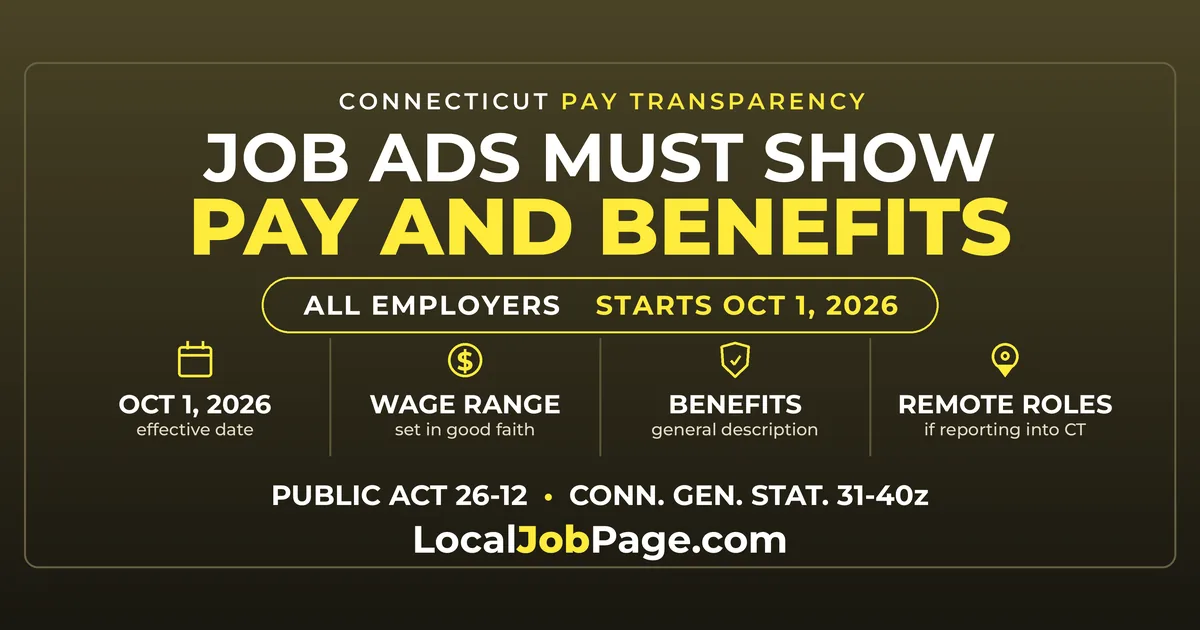
CONNECTICUT — Starting Thursday, October 1, 2026, a Connecticut job ad has to tell you what the job pays before you apply. Public Act 26-12 rewrites the state's pay transparency law so that every internal or public job advertisement carries the wage or wage range plus a general description of benefits. Until now, Connecticut applicants generally got the range only if they asked, or once pay came up in the hiring process.
From October 1, every Connecticut employer, of any size, must put the pay range and a benefits summary in the job ad itself, and the rule reaches remote jobs that report into the state.
Ready to go? Skip straight to the job links and begin searching now →
| What changed | Job ads must show the wage or wage range and a general description of benefits |
| Who it covers | Any employer with one or more employees, including the state and its towns and cities |
| Effective date | Thursday, October 1, 2026 |
| Jurisdiction | Connecticut, plus out-of-state roles that report to a supervisor, office or worksite in Connecticut |
| Where to read the rule | Public Act 26-12, amending Conn. Gen. Stat. 31-40z |
🏛️ What Changed in Connecticut's Pay Transparency Law
Connecticut already had a pay range law on the books, section 31-40z of the General Statutes. Under it, an employer had to hand an applicant the range on request, or before any discussion of compensation or an offer, whichever came first. That part stays. What Public Act 26-12 adds is the step most job seekers actually care about: the number now has to be in the ad.
The act, passed as Substitute House Bill 5003, requires an employer to disclose in an internal or public job advertisement the wages or wage range for the position, and a general description of the benefits. Benefits are defined broadly: health insurance, retirement, fringe benefits, paid leave and any other non-wage compensation offered with the job.
A wage range is the range the employer sets in good faith for the position. The law lets the employer build it from an existing pay scale, a range it set earlier, what current employees in comparable jobs earn, or the budget for the role. Current employees keep their right to the range for their own job when they are hired, when their position changes, and the first time they ask.
The act allows a legal action over a violation of the range-disclosure rules to be brought within two years. This is a summary, not legal advice.
Who It Covers, Including Remote Jobs
There is no small-business exemption. The law's definition of employer reaches any business, nonprofit or association using the services of one or more employees for pay, and it includes the state and its political subdivisions. A two-person shop is covered like a hospital system.
The part with the widest reach is remote work. The rule covers any position performed in Connecticut, and any position performed outside the state that reports directly to a supervisor, office or other worksite in Connecticut. An Ohio resident applying for a remote role that reports to a Hartford office is covered too.
Where Connecticut Fits Nationally
Connecticut is not the first state to do this. LocalJobPage's September 13 rundown, checked against each state's own statute or labor agency, counted 12 states plus Washington, D.C., that already require pay in the posting itself: California, Colorado, Hawaii, Illinois, Maryland, Massachusetts, Minnesota, New Jersey, New York, Vermont, Virginia and Washington. Connecticut makes it 13 states.
The details still differ. Several of those states apply the rule only above an employee threshold, such as 15 employees in California, Illinois and Washington. Connecticut, like Colorado, Maryland and Virginia, covers every employer. The rule that decides which law applies is where the work is performed or, in Connecticut's case, where a remote role reports.
🧭 How to Use a Posted Range
A range in the ad changes how you search, not just how you negotiate.
- Filter early. If the top of a range sits below what you need, skip the application and spend the time on one that fits.
- Read the benefits line. Two jobs posting the same hourly range can land far apart once health coverage, retirement matching and paid leave are counted.
- Aim inside the range. Experience and certifications are your case for the upper half.
- Ask when it is missing. If a Connecticut ad posted after October 1 has no range, you can still ask for it. The law already required employers to give one on request.
- Keep the floor in view. Connecticut's minimum wage is $16.94 an hour in 2026 and rises to $17.48 on January 1, 2027, the Connecticut Department of Labor announced in August. A posted range should never start below it.
🔎 Where to Aim Right Now
These searches cover common roles across the country, including remote jobs, which must now carry a range when they report into Connecticut.
Start here:
- Remote jobs
- Customer service jobs
- Registered nurse jobs
- Medical assistant jobs
- Insurance jobs
- Accounting jobs
- Manufacturing jobs
- Warehouse jobs
- Aetna jobs
🗺️ Where to Look in Your City
LocalJobPage has no city site in Connecticut yet, so these are the network cities in states that already require pay in job posts, starting with New York and Boston next door.
- Jobs in New York
- Jobs in Boston
- Jobs in Washington, D.C.
- Jobs in Baltimore
- Jobs in Virginia Beach
- Jobs in Chicago
- Jobs in Minneapolis
- Jobs in Denver
- Jobs in Colorado Springs
- Jobs in Seattle
- Jobs in Los Angeles
- Jobs in San Francisco
Not on the list? Find your city.
📢 Employers: What to Change Before You Post
If you hire in Connecticut, or hire remote staff who report to a Connecticut office, check every open ad and template before October 1. Each one needs the wage or wage range you have set in good faith for that role and a plain description of the benefits that come with it. Internal ads count as well as public ones. Build ranges from your real pay data, since the act names pay scales, prior ranges, current pay for comparable roles and the position's budget as the basis.
Frequently Asked Questions
When does Connecticut's job posting pay law take effect?
Thursday, October 1, 2026, under Public Act 26-12.
Does it apply to small businesses?
Yes. It covers any employer with one or more employees, including the state and local governments.
What has to be in the job ad?
The wage or wage range for the position and a general description of benefits such as health insurance, retirement, paid leave and other non-wage compensation.
Does it cover remote jobs?
It covers roles performed outside Connecticut when the employee reports directly to a supervisor, office or worksite in Connecticut.
What if a Connecticut job ad has no pay range?
Ask for it. Employers must give the range on request, or before discussing pay or making an offer. The act allows an action over a violation to be brought within two years.
Which other states require pay in job posts?
California, Colorado, Hawaii, Illinois, Maryland, Massachusetts, Minnesota, New Jersey, New York, Vermont, Virginia and Washington, plus Washington, D.C. Thresholds vary by state.
Search With the Number Up Front
Looking for work? Create a free LocalJobPage account, or browse every open job.
Employers: Post your openings on LocalJobPage and put the range in the ad from day one.
Related Reading
- What Your Job Post Must Include: Pay Transparency Rules by State
- Minimum Wage 2027: Which States Have Set Their January 1 Rate
- Remote Jobs in 2026: Who Actually Works From Home and What They Pay
- 7.3 Million Job Openings: What July's Numbers Mean for Your Search
In Connecticut, the pay range now comes before the application. Use it to decide where your time goes.