Teaching Jobs: What They Pay and How to Get Certified
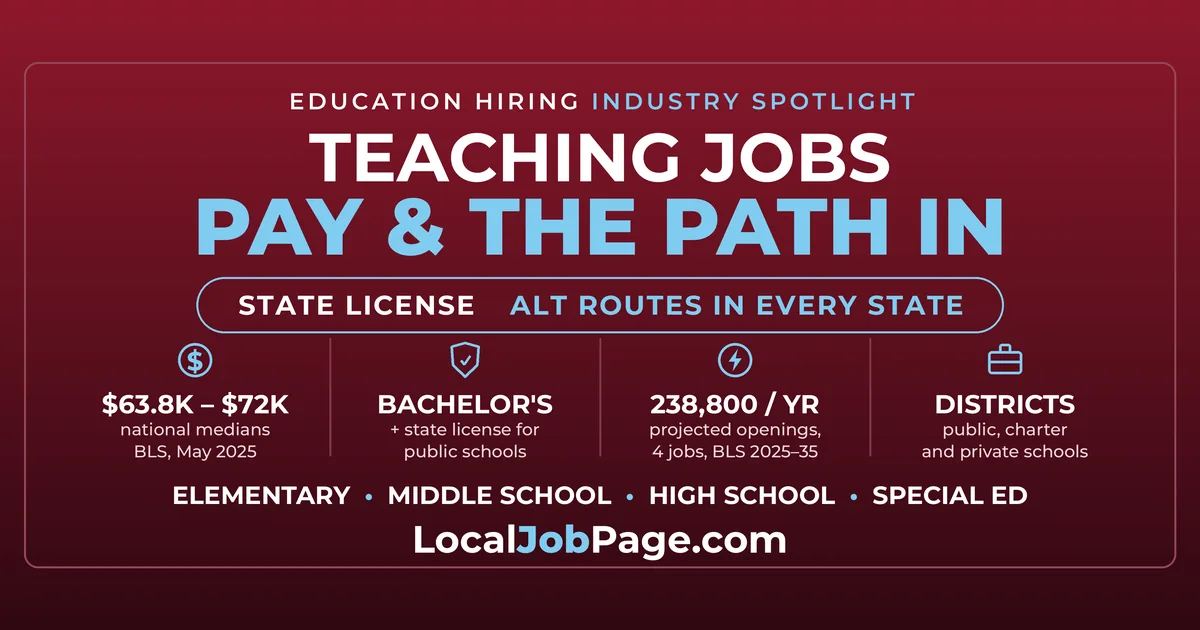
EDUCATION HIRING — Teaching jobs pay a national median of $63,820 to $72,040 a year depending on grade level, and every state requires a license to teach in a public school. The good news for career changers: every state also offers an alternative route for people who already hold a bachelor's degree in something other than education.
Four teaching occupations, about 238,800 projected openings a year combined, and one license standing between most applicants and a public classroom.
Ready to go? Skip straight to the job links and begin searching now →
💼 The Jobs
Teaching is not one job. The Bureau of Labor Statistics splits it by grade level, and the differences matter for pay, training and what your day looks like.
Kindergarten and elementary school teachers cover every subject with one class for most of the day: reading, math, science and social studies, plus the classroom management that comes with young kids. This is the biggest group, with about 1.53 million jobs in 2025, according to BLS.
Middle school teachers usually specialize in one or two subjects and teach several class periods of students in grades 6 through 8. BLS counted about 630,100 of these jobs in 2025.
High school teachers teach a single subject, such as math, chemistry, English or history, to several sections of students. Most hold a secondary certification that BLS describes as typically covering grades 7 through 12. There were about 1.09 million of these jobs in 2025.
Special education teachers work with students who have learning, emotional or physical disabilities, adapting lessons and writing the individualized plans each student follows. They work at every grade level, and BLS counted about 584,100 jobs in 2025.
Two related roles round out a school's teaching staff. Career and technical education teachers cover fields like auto repair, culinary arts and health science. Adult basic education and ESL teachers work with adults finishing a high school equivalency or learning English.
💵 What Teaching Pays
The figures below are national medians from the BLS Occupational Outlook Handbook, for May 2025. A median is the midpoint: half the teachers in each occupation earned more, and half earned less.
| Occupation | Median pay, May 2025 |
| Kindergarten and elementary school teachers | $63,820 |
| Middle school teachers | $64,370 |
| High school teachers | $72,040 |
| Special education teachers | $67,170 |
| Career and technical education teachers | $65,150 |
| Adult basic and secondary education and ESL teachers | $61,540 |
| Teacher assistants | $36,780 |
The spread inside each job is wide, and it mostly tracks experience and the district's pay scale. For high school teachers, BLS reports the lowest-paid 10 percent earned under $48,780 in May 2025, while the top 10 percent earned over $107,600. Elementary teachers ranged from under $47,960 to over $104,340.
Where you teach changes the number too. Public schools generally pay more than private ones. High school teachers in local public schools had a median of $74,190 in May 2025, against $61,810 in private schools, according to BLS. The gap for elementary teachers was $65,260 public against $58,140 private.
Many public districts pay on a published salary schedule, with steps for years of service and lanes for extra education such as a master's degree. Before you accept an offer, ask to see the schedule and where you will land on it. Many teachers work a 10-month year with summers off, and some earn extra by teaching summer school.
🎓 Training and Credentials
This is where most would-be teachers get stuck, so here is how it works.
You need a bachelor's degree. BLS lists a bachelor's as the typical entry-level education for all four core teaching jobs. Elementary teachers usually major in elementary education. Middle and high school teachers often major in the subject they want to teach, depending on the state.
Public schools require a state license. BLS says all states require public school teachers to be licensed or certified for the grade level they teach. The usual requirements are a bachelor's degree with a minimum GPA, a student-teaching placement under a mentor teacher, a background check, and passing a general teaching test plus a subject test. The details, the tests and the fees are set state by state, so check your state's education department or teacher licensing board before you enroll in anything.
Already have a degree in something else? Look at alternative certification. BLS reports that every state offers an alternative route to a license for people who hold a bachelor's degree but did not take education courses. Some programs put you in a classroom right away under supervision while you finish coursework. Others require education classes first. This is the main path for career changers, from engineers who want to teach math to veterans moving into the classroom.
Special education may ask for more. Some states require a special education degree, while others accept an education or content major with a special education minor. BLS notes some states require a master's degree after you are hired to become fully certified.
Private schools are different. BLS says private school teachers typically do not need a state license, though many private schools still expect a bachelor's degree.
Not ready to commit to a license? Substitute teaching and teacher assistant jobs are a common way to test the work first. Substitute requirements vary widely by state and district, so check with the district directly.
🔥 Who's Hiring
Teachers are hired by local public school districts, charter schools, private and religious schools, and some state-run schools. Districts can post openings at any point in the year as positions come open, not only during the spring hiring season.
Employment in these four jobs is not projected to grow over the decade. BLS projects little or no change in each from 2025 to 2035. The openings come from turnover: teachers retiring or moving to other work. BLS projects about 99,400 openings a year for elementary teachers, 63,500 for high school teachers, 38,800 for middle school teachers and 37,100 for special education teachers. Those four add up to about 238,800 openings a year, our sum of the BLS figures.
Demand is local. Which subjects a district struggles to fill varies from place to place, so search by the subject you are certified in, and check the district's own job board as well as ours.
⚠️ Who Teaching Is Not For
- Anyone without a bachelor's degree who wants a public classroom of their own. Teacher assistant and substitute jobs are the realistic entry point while you finish a degree.
- Anyone who can't pass a background check. BLS lists a background check among the usual licensing requirements, and districts typically run their own before hiring.
- Anyone hoping to move states easily. Licenses are issued state by state. Check the new state's rules before you move, and expect paperwork and possibly more testing.
- Anyone expecting a 9-to-5. Grading, planning and parent communication spill into evenings and weekends, especially in the first few years.
🔎 Search Teaching Jobs Now
- Teacher jobs
- Elementary teacher jobs
- High school teacher jobs
- Special education teacher jobs
- Math teacher jobs
- ESL teacher jobs
- Substitute teacher jobs
- Teacher assistant jobs
- KIPP charter school jobs
Hiring is done district by district, so the city ladder below is the fastest way to see what is open near you.
🗺️ Where to Look in Your City
These markets are home to some of the largest school districts in the country, which means the most teaching openings at any given time.
- Teacher jobs in New York
- Teacher jobs in Los Angeles
- Teacher jobs in Chicago
- Teacher jobs in Miami
- Teacher jobs in Houston
- Teacher jobs in Las Vegas
- Teacher jobs in Philadelphia
- Teacher jobs in Jacksonville
- Teacher jobs in Dallas
- Teacher jobs in Denver
Not on the list? Find your city.
Teaching Jobs FAQ
How much do teachers make?
National median pay ranged from $63,820 for kindergarten and elementary teachers to $72,040 for high school teachers in May 2025, according to BLS. Pay depends heavily on the district's salary schedule, your experience and your education.
Can I become a teacher without an education degree?
Yes. BLS reports every state offers an alternative route to a license for people who already have a bachelor's degree in another field. Requirements differ by state, so start with your state's education department.
Do private school teachers need a license?
Typically not, according to BLS. Many private schools still expect a bachelor's degree, and pay is generally lower than in public schools.
Is special education a separate license?
Usually it carries its own requirements. BLS says some states require a degree in special education, while others accept an education or subject major with a special education minor, and some require a master's degree after hiring for full certification.
Can I teach while I get my license?
Some alternative certification programs let you teach under supervision while you complete coursework. Substitute and teacher assistant jobs are other ways to work in a school before you are fully licensed.
Is teaching a growing field?
BLS projects little or no change in employment for the four core teaching jobs from 2025 to 2035, but turnover still creates about 238,800 openings a year across them, by our sum of the BLS figures.
Start Your Teaching Job Search Today
Openings post throughout the year. Create a free LocalJobPage account to save searches and get new teaching openings as they post, or browse all jobs.
Employers: Hiring teachers or school staff? Post your openings on LocalJobPage and reach job seekers in your city.
Related Reading
- School Jobs: What They Pay and How to Get Hired Without a Teaching License
- Childcare Jobs: What They Pay and How to Get Hired
- Work With Duval Job Fair Dec. 2: Teacher Interviews and Same-Day Offers at Duval Schools
- How to Negotiate a Job Offer, Even for an Hourly Job
If you have a bachelor's degree and want to teach, your state's alternative certification route is the place to start, and the district job boards in your city will show you which subjects need you most.