Dental Jobs: What They Pay and How to Get Hired
HEALTHCARE HIRING — Dental jobs are one of the few corners of healthcare where you can start in about a year and work in an office rather than a hospital. Nine in ten dental assistants and hygienists work in a dentist's office, and the Bureau of Labor Statistics projects both jobs to grow much faster than average through 2035.
From a one-year dental assistant certificate to a hygienist license that pays a national median near $98,000, here is what dental jobs pay in the U.S., how long the training takes, and who is hiring.
Need work now? Skip straight to the job links and begin searching now →
💼 The Jobs
A dental office runs on a small team, and each role has its own entry point.
Dental assistants work chairside. They seat patients, prepare and sterilize instruments, hand tools to the dentist during procedures, take X-rays where their state allows it, and keep records. BLS counted 388,600 dental assistant jobs in 2025, the largest occupation in the field.
Dental hygienists run their own appointments. They clean teeth, take and read X-rays, screen for gum disease, and teach patients how to care for their teeth. There were 225,300 hygienist jobs in 2025, and BLS notes that many hygienists work part time, sometimes for more than one practice.
Dentists diagnose and treat, and most own or share a practice. BLS counted 161,400 dentist jobs in 2025, and about one in eight dentists was self-employed.
Dental laboratory technicians build crowns, bridges, dentures and other appliances from a dentist's impressions or digital scans. It is bench work rather than patient care, and most people learn it on the job.
Front-desk roles round out most offices: receptionists, schedulers, insurance and billing coordinators, and office managers. Those jobs need no clinical credential, and they are a common way to see whether the field suits you before paying for training.
💵 What Dental Jobs Pay
These are national median annual wages for May 2025 from the Bureau of Labor Statistics' Occupational Employment and Wage Statistics program, as published in the Occupational Outlook Handbook. A median is the midpoint: half the people in the job earned less and half earned more.
| Job | Median pay, May 2025 | Typical entry education |
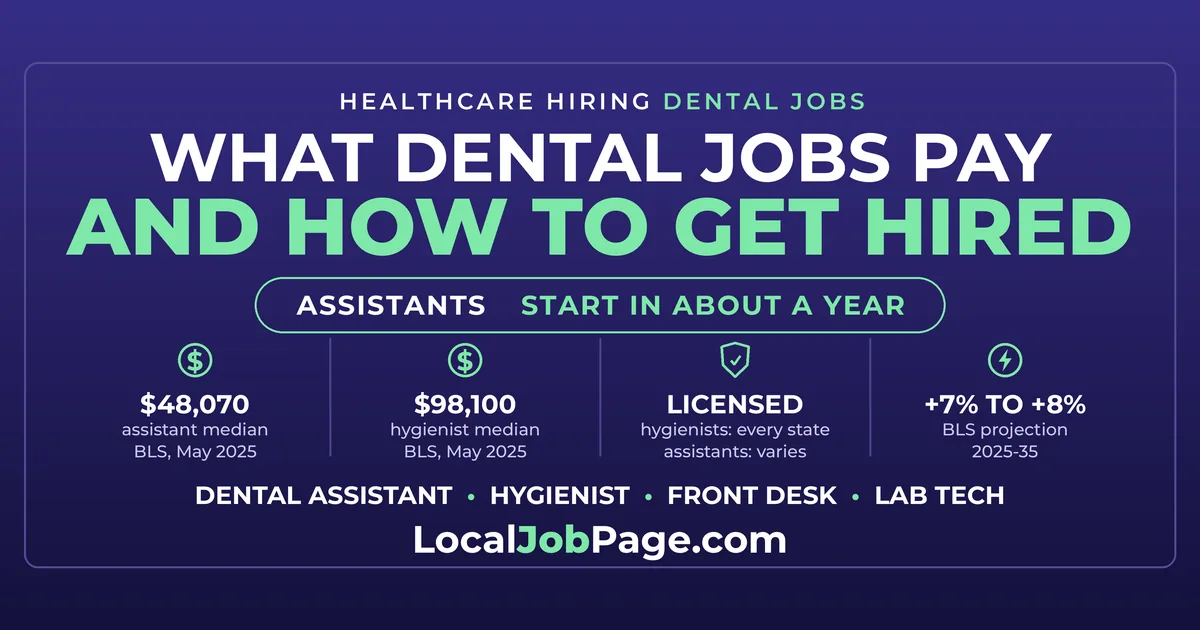
| Dental assistant | $48,070 ($23.11/hr) | Postsecondary certificate |
| Dental laboratory technician | $49,610 | High school diploma plus on-the-job training |
| Dental hygienist | $98,100 ($47.16/hr) | Associate's degree |
| Dentist, general | $170,950 | Doctoral or professional degree |
The spread inside each job is wide. The lowest-paid tenth of dental assistants earned less than $37,130 and the highest-paid tenth more than $62,250. For hygienists the range ran from under $74,880 to more than $126,050. Among dentists, specialists sit far above generalists: BLS put the median for orthodontists at $289,140 and for oral and maxillofacial surgeons at $352,220.
Where you work moves the number too. Dental assistants in government jobs, which include military and veterans' health facilities, had a median of $55,270, compared with $48,000 in dentists' offices. Pay also varies a great deal by state and metro, so check local listings before you weigh a training program against a paycheck.
🎓 Training and Credentials
This is where the dental field differs most from one state to the next. Each state sets its own rules for what assistants and hygienists may do, so the path below is the general shape, not a promise for any one state.
Dental assistant: about a year, sometimes less. BLS says many dental assisting programs take about one year and end in a certificate or diploma, and two-year associate's programs exist but are less common. Some states require graduation from an accredited program and an exam. Others have no formal education requirement and let offices train new assistants on the job. Tasks such as taking X-rays or polishing teeth often require a separate state license, registration or certification, so ask what a program qualifies you for in your state.
Dental hygienist: a degree and a license. Hygienists typically need an associate's degree in dental hygiene, and BLS says those programs usually take three years. Every state requires hygienists to be licensed. In most states that means graduating from an accredited program and passing written and clinical exams, then keeping up continuing education.
Dentist: the long road. Dentists need a DDS or DMD from an accredited dental school, which most applicants enter after a bachelor's degree and an entrance exam, plus a state license. Specialists add a residency of two to four years, longer for oral surgery.
Dental lab technician: learn at the bench. No license is required. Most technicians start as helpers and learn on the job, though some community colleges offer dental laboratory technology programs that employers may prefer.
Your state's Board of Dental Examiners publishes the exact rules. Read them before you enroll anywhere.
🔥 Who's Hiring
Private dental practices are the core employer. BLS counts 91% of dental assistants and 94% of hygienists working in offices of dentists. That includes solo practices, group practices, and the large dental support organizations that run hundreds of offices under one name, such as Aspen Dental and Heartland Dental.
Beyond private offices, look at community health centers and other outpatient clinics, which serve patients on Medicaid or a sliding fee scale, and government employers, including military and veterans' health facilities. Dental laboratory jobs sit mostly with medical equipment and supply manufacturers, where BLS counts 61% of the broader lab technician group.
Growth is steady rather than explosive. BLS projects dental assistant jobs to grow 7% and hygienist jobs 8% from 2025 to 2035, both much faster than the average for all occupations. Those are ten-year model projections, not a forecast for next year. Dental laboratory work is the exception: BLS projects the broader group of dental, ophthalmic and medical appliance technicians to shrink 2% over the same decade.
⚠️ Who This Field Is Not For
Dental work is close, precise and repetitive. You spend most of the day leaning over a patient's mouth, so neck, back and wrist strain is a real part of the job. Infection control is constant: gloves, masks, sterilizing every instrument. If needles, blood or anxious patients bother you, the front desk or the lab is a better fit than the chair.
Hygiene is also a field where full-time hours are not guaranteed. Because many dentists book a hygienist only a few days a week, plan on piecing together more than one office until you find a full-time spot. And because licensing is state-specific, a credential earned in one state may not carry over if you move. Check reciprocity rules before you relocate.
🔎 Search Dental Jobs Now
- Dental assistant jobs
- Dental hygienist jobs
- Dental receptionist jobs
- Dental office manager jobs
- Dental billing and insurance jobs
- Dental lab technician jobs
- Dentist jobs
- Aspen Dental jobs
- Heartland Dental jobs
New to the field? Start with assistant and receptionist searches, the two roles with the lowest barrier to entry.
🗺️ Where to Look in Your City
Dental offices follow population, so these are some of the largest and fastest-growing markets on the LocalJobPage network.
- Dental assistant jobs in Houston
- Dental assistant jobs in Dallas
- Dental assistant jobs in Phoenix
- Dental assistant jobs in Atlanta
- Dental assistant jobs in Chicago
- Dental hygienist jobs in Los Angeles
- Dental assistant jobs in Charlotte
- Dental hygienist jobs in Denver
- Dental assistant jobs in Tampa
- Dental hygienist jobs in Seattle
Not on the list? Find your city.
Frequently Asked Questions
How much do dental assistants make?
The national median was $48,070 a year, or $23.11 an hour, in May 2025, according to the Bureau of Labor Statistics. The highest-paid tenth earned more than $62,250.
How long does it take to become a dental assistant?
Many certificate programs take about a year. In states with no formal education requirement, some offices hire and train assistants on the job, though X-rays and expanded duties usually need a state credential.
Do dental hygienists need a license?
Yes. Every state requires hygienists to be licensed, typically after an accredited associate's degree program and written and clinical exams. Requirements vary by state.
What is the difference between a dental assistant and a dental hygienist?
Assistants support the dentist chairside and handle instruments, records and patient prep. Hygienists clean teeth and screen patients in their own appointments, need more training and a license, and earn roughly twice as much at the median.
Can I work in a dental office without any training?
Yes. Receptionist, scheduling and billing roles need no clinical credential, and in some states offices train assistants on the job. Ask the office what your state allows.
Start Your Dental Career Search Today
Create a free LocalJobPage account to save searches and get new dental openings as they post, or browse all jobs near you.
Employers: Hiring assistants, hygienists or front-desk staff? Post your openings on LocalJobPage and reach job seekers across the network.
Related Reading
- Healthcare Jobs Without a Bachelor's Degree: What They Pay and How Long Training Takes
- Pharmacy Jobs: What They Pay and How to Get Hired
- Nursing Jobs: What They Pay and How to Become a Registered Nurse
- Physical and Occupational Therapy Jobs: What They Pay and How to Get In
The fastest way into dentistry is a one-year assistant program or a front-desk job, and the biggest pay jump is a hygienist license. Check your state board's rules first, then start searching.