Holiday Pay Rules: Do You Get Extra for Working Thanksgiving?
Thanksgiving falls on Thursday, November 26, and Black Friday follows the next morning. For many retail, warehouse, hospital and restaurant workers, one of those days is already on the schedule. The question most people ask is simple: does working the holiday pay extra?
Under federal law, holiday pay is not required, but overtime rules, a few state laws and your employer's own policy can still put more money in your check for that week.
Need work now? Skip straight to the job links and begin searching now →
🏛️ What Federal Holiday Pay Law Requires
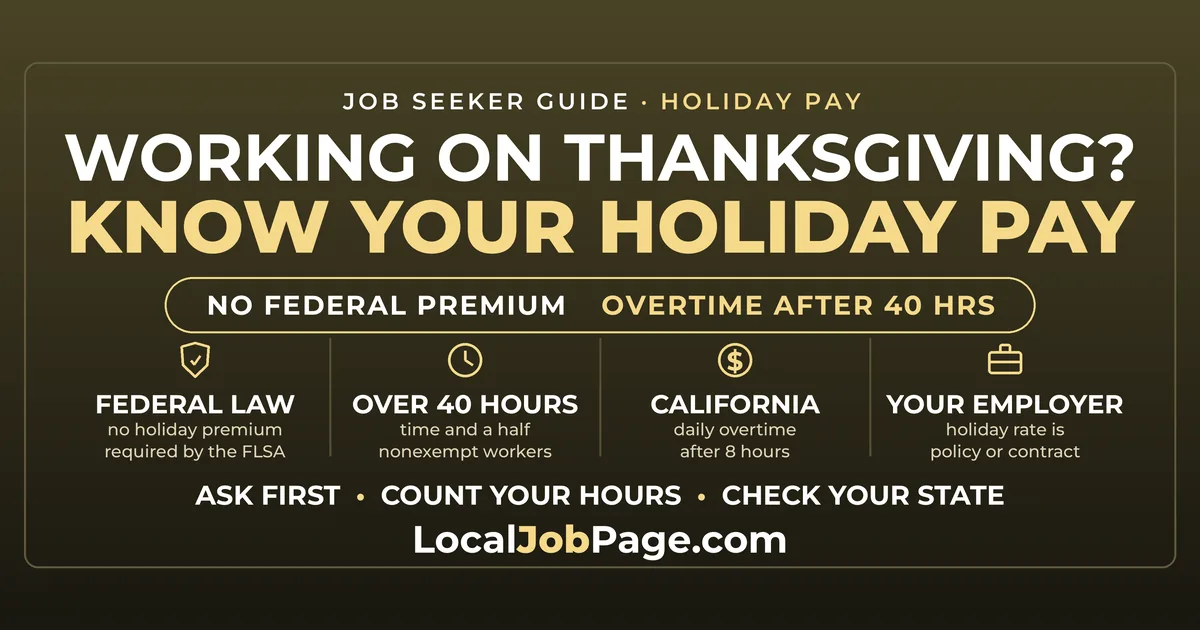
The U.S. Department of Labor is blunt about it. The Fair Labor Standards Act, the main federal wage law, does not require employers to pay for time not worked, including holidays. Paid holidays, and any bonus for working one, are a matter of agreement between you and your employer.
The same goes for premium pay. The Department of Labor's overtime guidance says the FLSA does not require overtime pay for work on Saturdays, Sundays or holidays as such. A shift on Thanksgiving Day is, legally, a shift like any other.
What federal law does require is overtime. Unless your job is exempt, you must be paid at least time and a half your regular rate for every hour over 40 in a workweek. The workweek is a fixed, recurring block of 168 hours, seven consecutive 24-hour periods, set by the employer.
That matters in a holiday week. If you normally work 40 hours and pick up a Thanksgiving shift on top, the extra hours may be overtime because they push you past 40, not because the day is a holiday. If you swap a regular day for the holiday and still finish at 40, federal law adds nothing.
📍 Where State Law Adds More
States can set rules on top of the federal floor, and the address where the work is performed decides which rules apply, not where you live or where the company is based. Three states show how differently this can play out.
California. The state's Division of Labor Standards Enforcement says hours on holidays are treated like hours on any other day, and nothing in state law requires a holiday premium. What California does have is daily overtime: time and a half for hours over eight in a workday, up to 12, and double time beyond 12. A 10-hour Black Friday shift earns two hours of overtime in California even if your week stays under 40.
Massachusetts. The state ended Sunday premium pay for retail on January 1, 2023, but it still restricts retail work on Thanksgiving and Christmas. Retail employees can work those days only when the state issues a statewide approval and the store also holds a local police permit. In an August 11, 2026 memo, the Department of Labor Standards said it will not issue that statewide approval for Thanksgiving Day or Christmas Day 2026. On several other holidays, most retail work in Massachusetts must be voluntary.
Rhode Island. State law requires at least time and a half the normal rate for work on Sundays and the holidays the law lists, and refusing to work one of those days cannot be grounds for firing or other penalty. The state carves out a list of exemptions by industry, so check the Rhode Island Department of Labor and Training's guidance for your job.
Outside these examples, look up your own state's labor department before assuming anything. Rules on paid holidays and premium pay vary, and this guide is not legal advice.
💵 Where Holiday Pay Usually Comes From
For most workers, holiday pay comes from the employer, not the law. Many companies pay a holiday rate by policy, and union contracts often spell one out. Federal contractors can owe holiday fringe benefits under the wage determinations attached to their contracts, which the Department of Labor administers.
Because it is a policy, the details vary: a rate of time and a half or double time, a flat bonus, or a paid day off later. Some require you to work the shifts before and after the holiday, and seasonal hires are sometimes left out.
✅ Questions to Ask Before You Take a Holiday Shift
- Is there a holiday rate, and is it a multiplier or a flat amount?
- Does it apply to seasonal and part-time staff?
- Do I have to work the shift before and after to qualify?
- When does your workweek start and end, and will this shift push me past 40 hours?
- Is the shift voluntary, and what happens if I say no?
Get the answer in writing, even a text. If your paycheck does not match, that record settles it fast.
🔎 Search Holiday Shift Jobs Now
- Seasonal jobs
- Retail associate jobs
- Warehouse associate jobs
- Amazon jobs
- Target jobs
- Delivery driver jobs
- Customer service jobs
- Part-time jobs
Ask about holiday pay in the interview. It is a fair question, and the answer tells you a lot about the employer.
🗺️ Where to Look in Your City
The first six cities sit in California and Massachusetts, where the state rules above apply; the rest are large metros where holiday retail and warehouse shifts are posted every year.
- Seasonal jobs in Los Angeles
- Seasonal jobs in San Diego
- Seasonal jobs in San Jose
- Seasonal jobs in Sacramento
- Seasonal jobs in San Francisco
- Seasonal jobs in Boston
- Seasonal jobs in Dallas
- Seasonal jobs in Atlanta
- Seasonal jobs in Chicago
- Seasonal jobs in Memphis
- Seasonal jobs in Columbus
- Seasonal jobs in Phoenix
Not on the list? Find your city.
Frequently Asked Questions
Does my employer have to pay me extra for working Thanksgiving?
Not under federal law. The FLSA does not require a holiday premium. Some states add rules, and many employers pay a holiday rate by policy or contract, so check both.
Do I get paid for Thanksgiving if I have the day off?
Only if your employer offers paid holidays. Federal law does not require pay for time not worked, and California's labor agency says the same for its state law.
Is working on a holiday automatically overtime?
No. Federal overtime starts after 40 hours in a workweek, whatever day the hours fall on. In California, hours over eight in a single workday are also overtime.
Can my employer make me work on a holiday?
In most states, yes, if it is part of the job. Rhode Island bars firing or penalizing employees covered by its law for refusing Sunday or holiday work, and Massachusetts makes work voluntary for most retail employees on several holidays.
Are retail stores open on Thanksgiving in Massachusetts?
Massachusetts requires a statewide approval plus a local police permit before retail employees can work on Thanksgiving. The state's Department of Labor Standards said it will not issue that approval for Thanksgiving or Christmas 2026.
Find a Job That Pays What It Should
Create a free LocalJobPage account to save searches and get new openings first, or browse all jobs.
Employers: Still short-staffed for the holidays? Post your openings on LocalJobPage and say what your holiday rate is. Candidates look for it.
Related Reading
- Holiday Seasonal Jobs 2026: When to Apply and Where to Look
- How to Negotiate a Job Offer, Even for an Hourly Job
- Retail Jobs: What They Pay and Which Ones Lead Somewhere
- New Workplace Laws in January 2027: What Changes for Workers
Before you say yes to a holiday shift, ask what it pays and count your hours for the week. The law sets a floor; the rest is what you and your employer agree to.