Job Background Checks: What Employers Can See and Your Rights
You got the offer, and now the employer wants to run a background check. That step makes people nervous because nobody explains what the employer sees, how far back it goes, or what to do if the report is wrong.
A background check is not a black box: federal law gives you the right to know it is happening, to see the report, and to fix mistakes before they cost you the job.
Need work now? Skip straight to the job links and begin searching now →
✅ What Has to Happen Before the Check
When an employer uses a background screening company, the federal Fair Credit Reporting Act (FCRA) sets the rules. Two things come first.
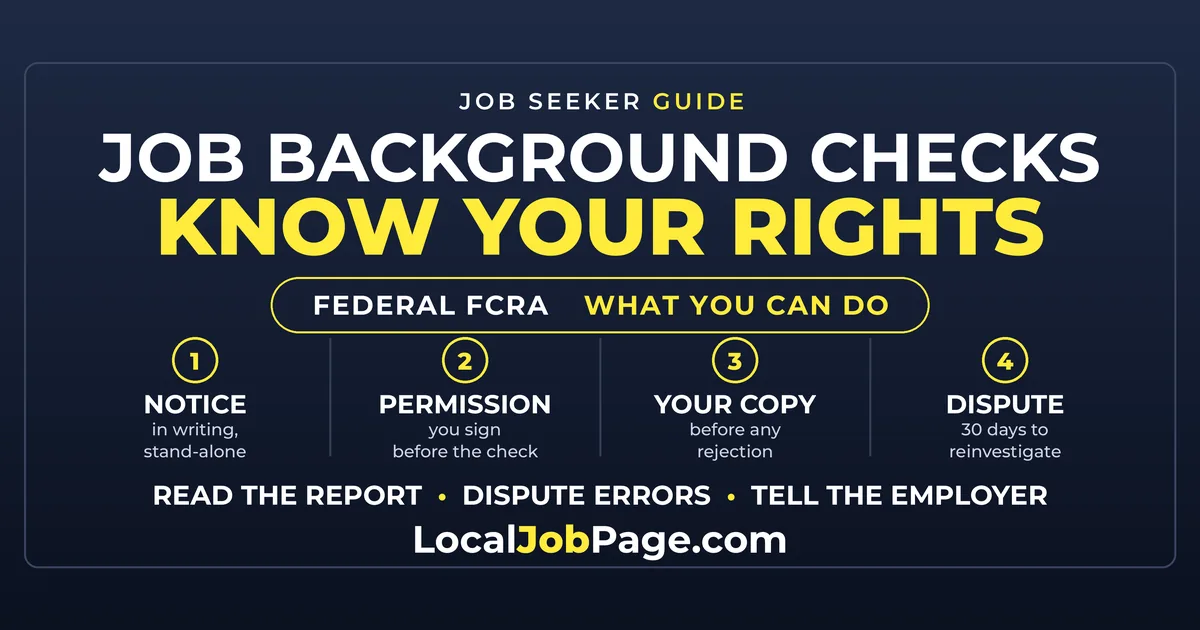
The employer has to tell you in writing that it may use the report, and that notice has to stand on its own. The Federal Trade Commission's employer guidance says plainly that it cannot be tucked inside the job application. The employer also has to get your written permission before the check is run.
If you signed a stack of onboarding forms, one of them was probably the authorization. Ask which company is doing the screening so you know who to contact later.
🔎 What Employers Can Look At
According to the FTC's guide for job applicants, a background check can cover your employment history, education, criminal and other public records, financial or credit history, and public social media activity. Not every employer checks everything, and what gets checked usually depends on the job.
Medical information is different. The Equal Employment Opportunity Commission says employers are not allowed to ask for medical information until after they offer you a job.
The EEOC also says an employer has to apply the same background standards to everyone, regardless of race, national origin, color, sex, religion, disability, genetic information or age.
📅 How Far Back a Report Can Go
Section 1681c of the FCRA limits what a screening company can report:
- Arrest records, civil suits and civil judgments: not after seven years from the date of entry, or until the statute of limitations runs out, whichever is longer.
- Most other negative items: not after seven years.
- Bankruptcies: not after 10 years.
- Criminal convictions: excluded from the seven-year limit, so federal law lets a report include older convictions.
There is one big exception. Those time limits do not apply when the job pays, or can reasonably be expected to pay, an annual salary of $75,000 or more. For those roles, older items can appear.
Some states and cities set tighter limits or restrict when employers can ask about criminal or credit history. The FTC flags this, so check your state labor department for the rules where the job is located.
⚠️ If the Report Could Cost You the Job
An employer cannot quietly pull an offer because of a report. Under the FCRA, before it takes what the law calls adverse action, such as not hiring you, it must give you a copy of the report and a written summary of your rights under the law.
That gap is your window. Read the report line by line for records that belong to someone with a similar name, a dismissed case listed as a conviction, wrong dates, or a job you never held.
If the employer goes ahead with the decision, it has to send a second notice. That notice must name the screening company and give its address and phone number, say that the screening company did not make the decision, and tell you that you can get a free copy of your report from that company within 60 days and dispute anything inaccurate or incomplete.
🧭 How to Fix a Mistake
Dispute the error directly with the screening company, in writing, and keep copies. Under section 1681i, the company generally has 30 days from receiving your dispute to reinvestigate. That can stretch by up to 15 more days if you send new information during the review. Once it finishes, it has five business days to send you the results in writing.
The FTC and the EEOC both advise telling the employer about the mistake yourself. You can also ask the screening company to send the corrected report to the employer.
If the record is accurate, such as an old conviction, the EEOC's advice is to be prepared to explain it and why it should not affect your ability to do the job. Training, steady work since and a reference who knows your work go further than an apology.
💼 Before You Apply: A Quick Self-Check
You can avoid most surprises by looking first. Pull your free credit reports, check your state court's online case search for your own name, and confirm your past job titles and dates match what is on your resume. A small mismatch can read as dishonesty even when it is an honest mistake.
🔎 Search Jobs Now
- Entry-level jobs
- Warehouse associate jobs
- Customer service jobs
- Delivery driver jobs
- Security officer jobs
- Caregiver jobs
- Bank teller jobs
- Amazon jobs
- Target jobs
🗺️ Where to Look in Your City
These are some of the largest job markets on the LocalJobPage network and are spread across every region of the country.
- Entry-level jobs in New York
- Entry-level jobs in Los Angeles
- Entry-level jobs in Chicago
- Entry-level jobs in Houston
- Entry-level jobs in Phoenix
- Entry-level jobs in Philadelphia
- Entry-level jobs in Atlanta
- Entry-level jobs in Dallas
- Entry-level jobs in Miami
- Entry-level jobs in Seattle
Not on the list? Find your city.
Frequently Asked Questions
Can an employer run a background check without my permission?
Not through a background screening company. Under the FCRA, the employer must tell you in a stand-alone written notice and get your written permission first.
How many years back does a background check go?
Under federal law, seven years for arrests and most negative items and 10 for bankruptcies. Convictions are not covered by the seven-year limit, and jobs paying $75,000 or more are exempt.
What if the report confuses me with someone else?
Dispute it in writing with the screening company, which generally has 30 days to reinvestigate, and tell the employer about the mistake at the same time.
Can employers ask about my medical history?
The EEOC says employers are not allowed to ask for medical information until after they make a job offer.
Is this legal advice?
No. It is a plain-language summary of federal rules. State and city laws can add protections, so check your state labor department or ask a lawyer.
Walk Into Your Next Offer Prepared
Knowing your record and your rights takes most of the fear out of the check. Create a free LocalJobPage account or browse all jobs.
Employers: reach job seekers across 50 cities. Post your openings on LocalJobPage.
Related Reading
- How to Spot a Job Scam Before You Apply
- Common Job Interview Questions and How to Answer Them
- How to Negotiate a Job Offer, Even for an Hourly Job
- Security Guard Jobs: What They Pay and How to Get Licensed
Read every line of your report before you accept the result. A mistake caught before the decision is far easier to fix than one found after.